

Successful issuers play differently
Over the next year, 93% of credentialing program issuers plan to make changes — a clear signal that nearly everyone sees room to evolve. And while many expect to expand programs by adding new courses (62%) or issuing more credentials (67%), the most telling insights come from their top strategic priorities.
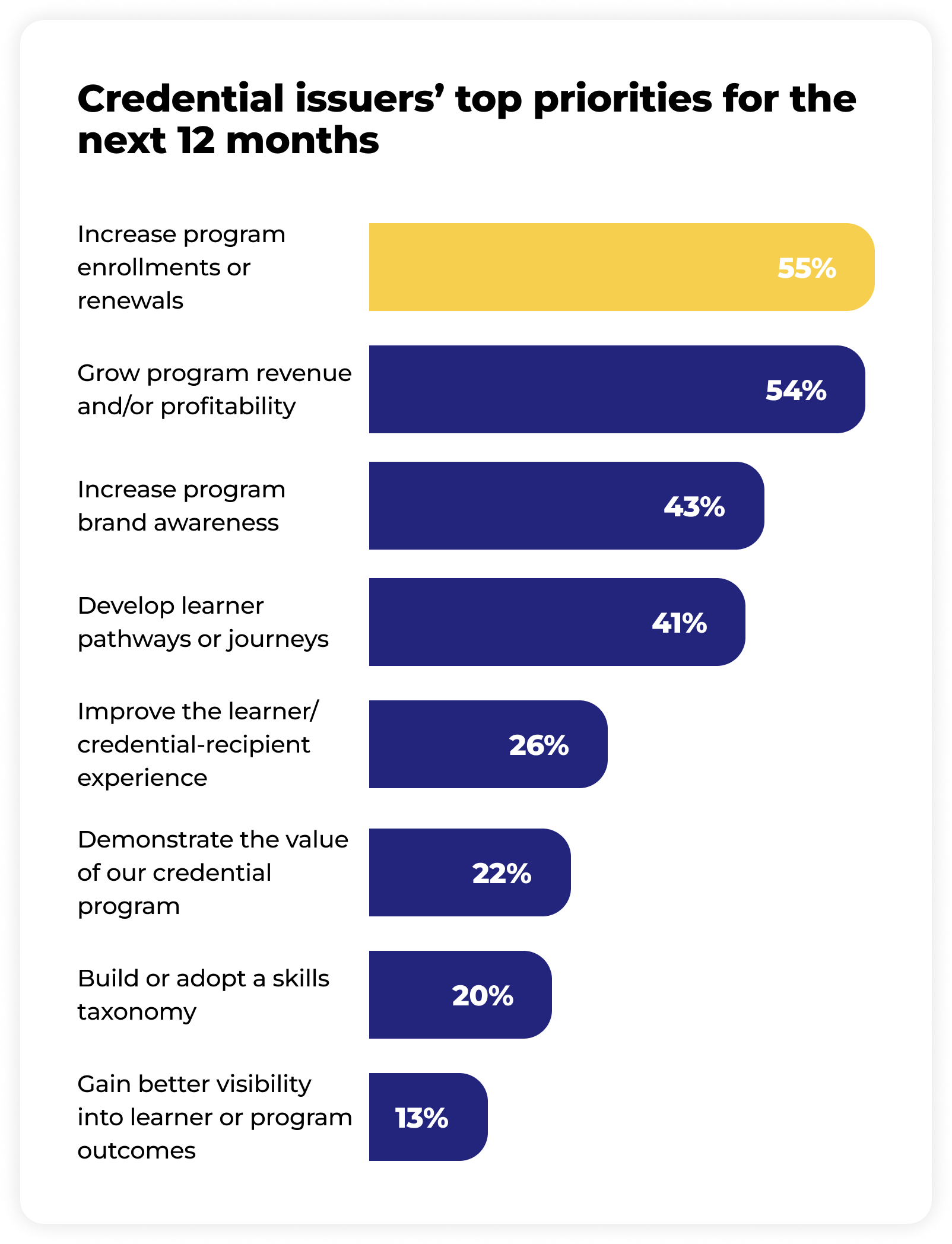
Two priorities dominate: growing enrollments or renewals (55%) and increasing program revenue and profitability (54%). Other high-ranking priorities include building program brand awareness, developing learner pathways, and improving the learner experience. Together, these priorities reveal that issuers aren’t just expanding their programs — they’re focused on proving value, strengthening visibility, and driving sustainable growth.
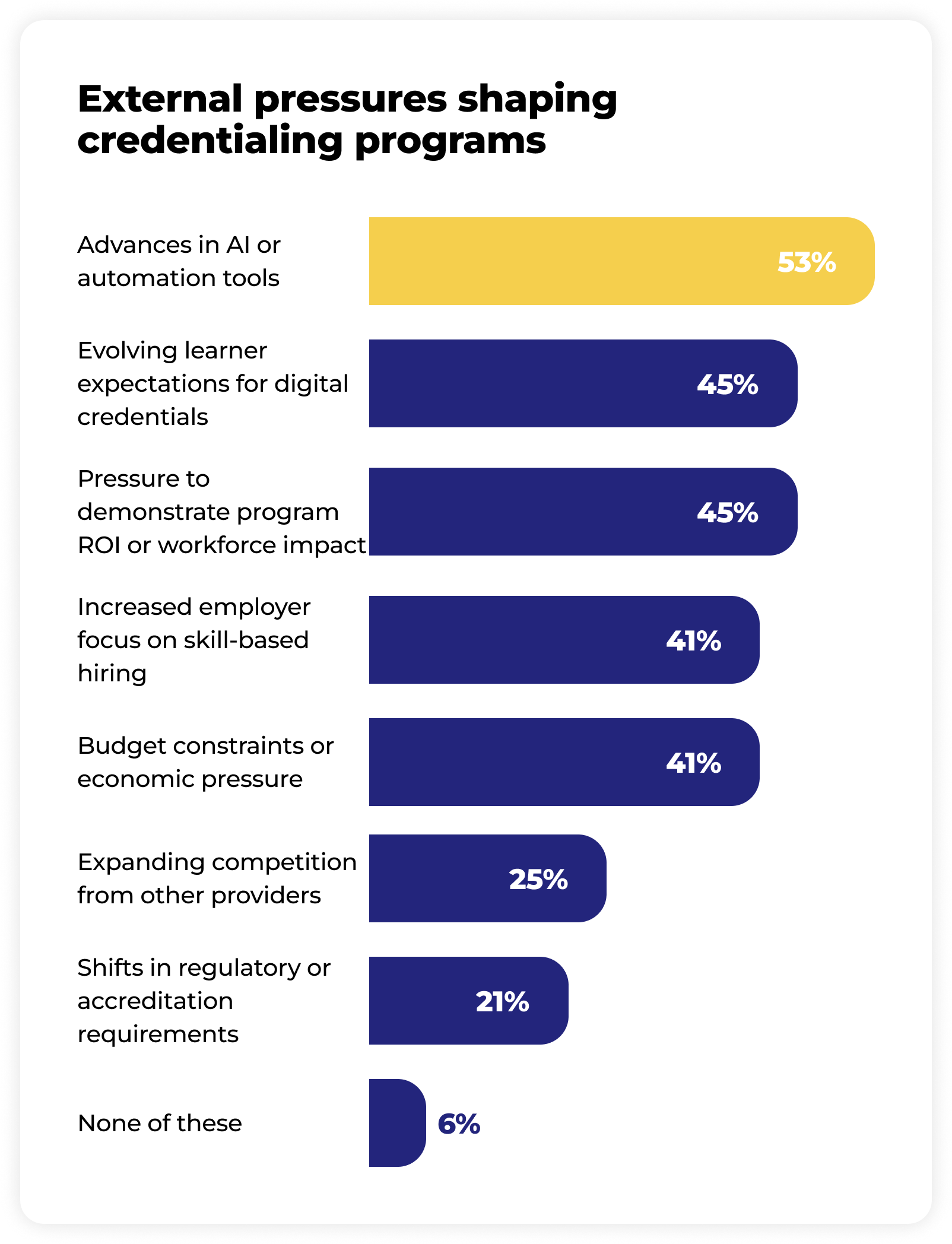
External pressures are also shaping these plans. While advances in AI lead the list (53%), issuers are equally motivated by evolving learner expectations for portable, verifiable credentials and growing pressure to prove program ROI or workforce impact.
With so much change ahead, it’s critical to understand what separates the most successful programs from the rest. Throughout this report, we've focused on how issuers can better serve employer needs and bridge the credentialing gap. But our research also reveals the operational differences that consistently drive program success.
AI isn’t just reshaping work — it’s beginning to reshape credentialing itself. While adoption is still emerging, issuers are actively exploring applications across fraud prevention, personalization, and program automation.
- 19% use AI to detect fraud or verify learner identity (40% want to).
- 16% use AI to recommend additional courses or credentials (52% want to).
- 24% use AI to generate skill metadata or tags (47% want to).
- 27% use AI to generate credential descriptions or learner-facing content (42% want to).
The takeaway: Issuers are eager to harness AI where it adds immediate value. Early adoption is modest, but demand signals that these capabilities are quickly becoming part of the future credentialing toolkit.


Maturity takes time — and focus
New this year, we asked issuers to rate their program maturity. The pattern was clear: The most mature programs are also the most successful. This reinforces a key insight — building an effective credentialing program isn’t a quick win. It requires sustained investment and strategic focus.
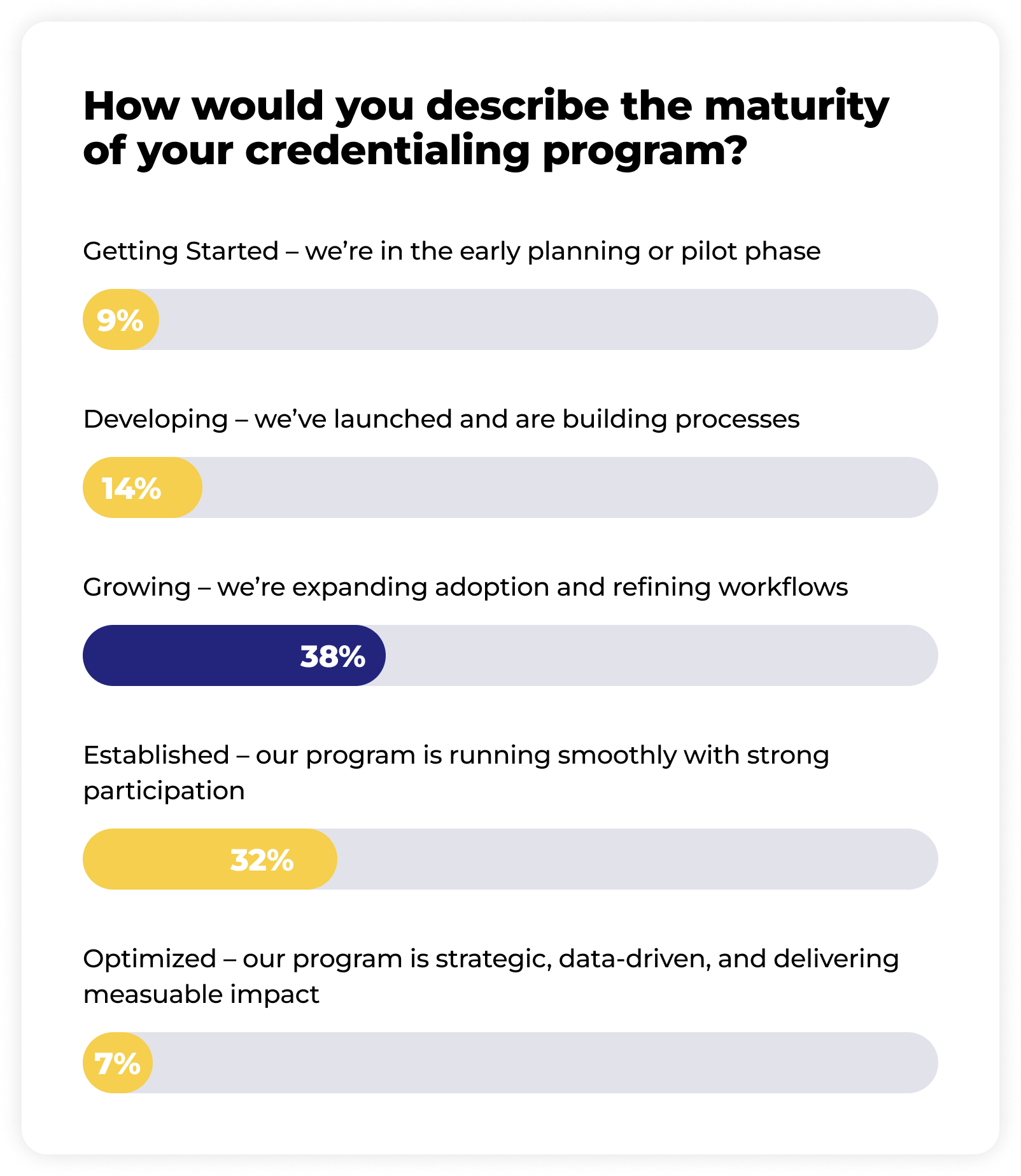
That doesn't mean newer programs can't succeed. But it does mean they should focus on high-impact practices proven by mature, successful programs. The strategies included in this report are exactly those practices.
Success factor: Define and document your credential framework
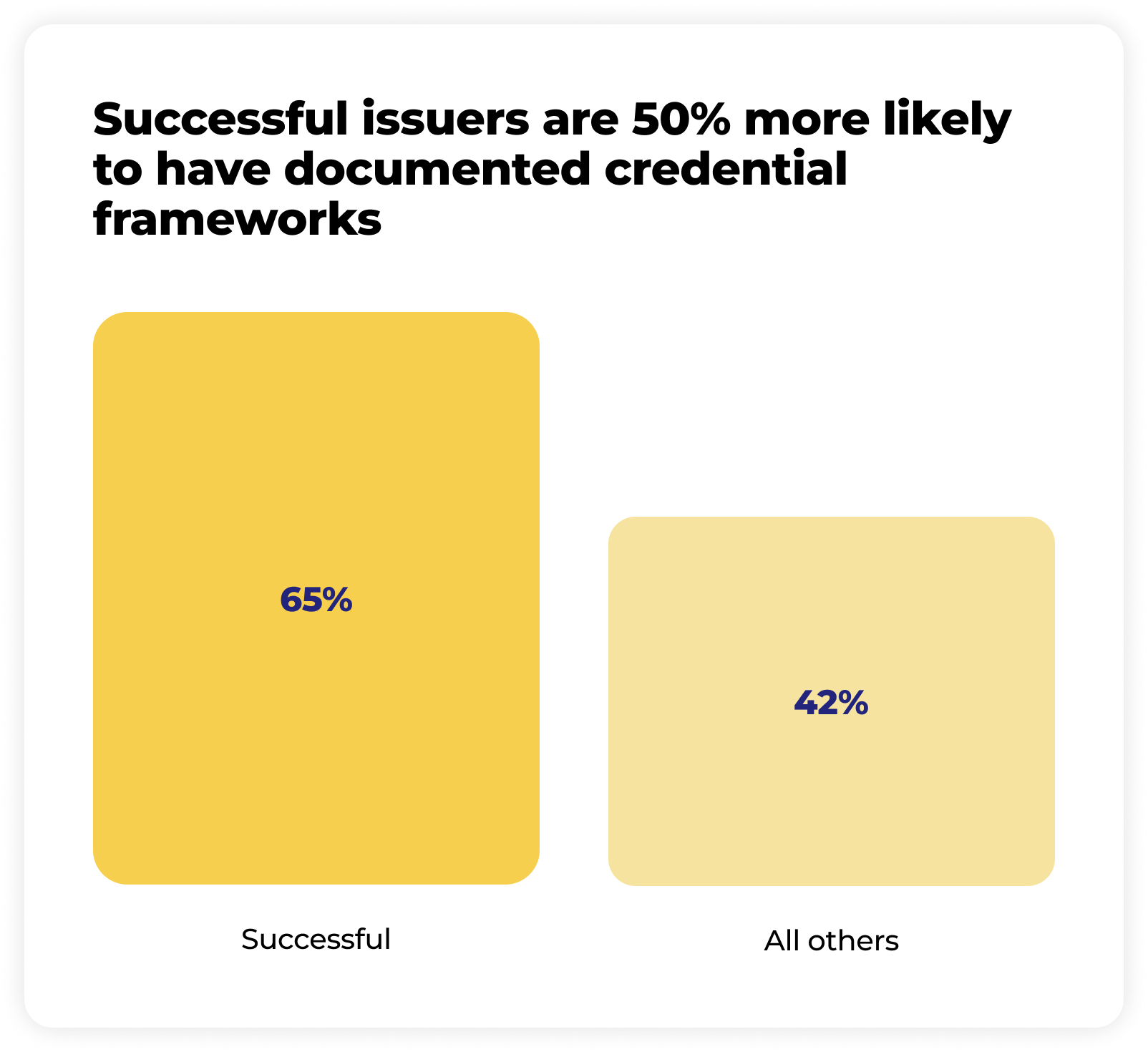
As in 2024, our data shows a clear, enduring pattern: 65% of successful issuers have a documented credential framework, compared to just 42% of their peers. Often paired with a governance model, this framework serves as the program’s blueprint — defining how credentials are structured, visually designed, and mapped to learner pathways. Governance adds the back-end rules, processes, and approvals that ensure consistent application as the program scales. Without both, portfolios quickly fragment, confusing learners and undermining employer trust.
The most effective frameworks address four key areas:
- Credential design standards — formats, tiers, and naming conventions
- Learner pathways — how credentials connect to progress and mastery
- Quality assurance processes — criteria and checks before issuance
- Success metrics — benchmarks to track program effectiveness
Case in point: Syracuse University established a Digital Badging Council of leaders from across the institution to guide new badge launches. The council created a 24-page governance document covering badge formats, taxonomy, and procedures, now used to onboard new departments. As Arthur Thomas, Executive Director of the Office of Microcredentials, explains,
“Taking the time to ensure consensus, support executive leadership, and consider how badging aligns with the academic mission has paved the way for Syracuse’s success.”
By investing in a documented framework with clear governance, issuers create the consistency, scalability, and credibility that learners and employers value most.
Learn how to design a credential framework and governance model that scales — with practical steps, examples from Syracuse University and Junior Achievement USA, and a proven 8-step process to keep credentials consistent, credible, and aligned to your goals.
Success factor: Focus on meaningful KPIs
Most issuers track KPIs, but the difference between average and top-performing programs lies in what they track. While nearly all issuers measure basics like the number of learners or credentials issued, successful issuers focus on metrics that reflect program impact, learner engagement, and employer value.
The starting point is alignment: Decide what matters most to your senior leadership and stakeholders. How do they want you to quantify learner impact and program success? The answer should shape your KPI set.
Successful issuers are more likely to track:
- Credential view or open rate — a leading indicator of learner and employer engagement
- Credential share rate — program visibility and network reach
- Program revenue or return on investment — business impact and sustainability
- Learning pathway completion rates — learner progression toward mastery
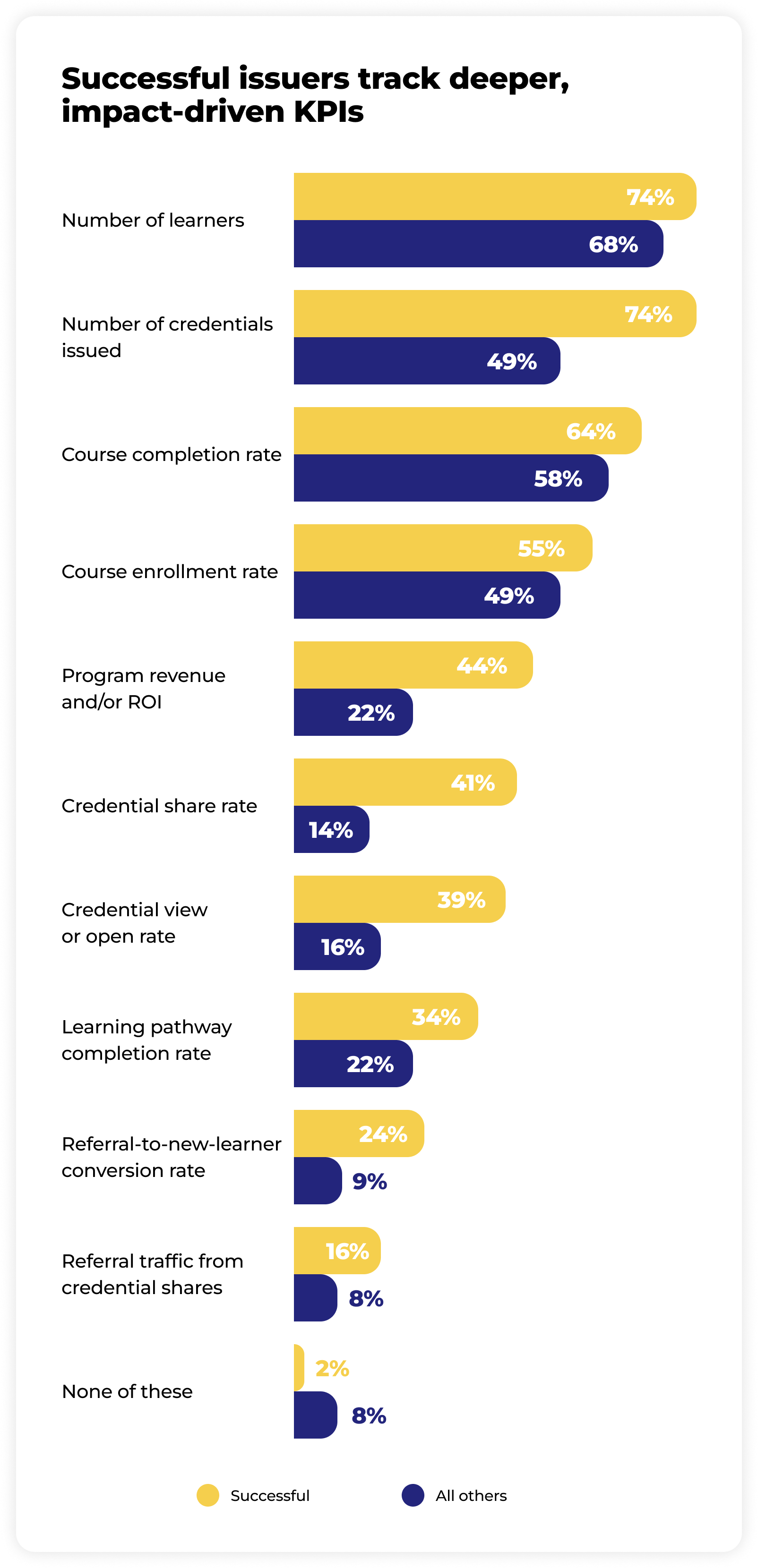
These metrics go beyond surface-level numbers, providing the foundation for tracking learner impact across the full journey — and setting the stage for a systematic approach to measuring outcomes.
Success factor: Track learner impact from start to finish
In the last section, we covered KPIs that signal program health in real time. The next step is proving the impact behind those numbers — tracking the learner journey from first click to career outcome, and doing it consistently.
Track the full journey, not just completions
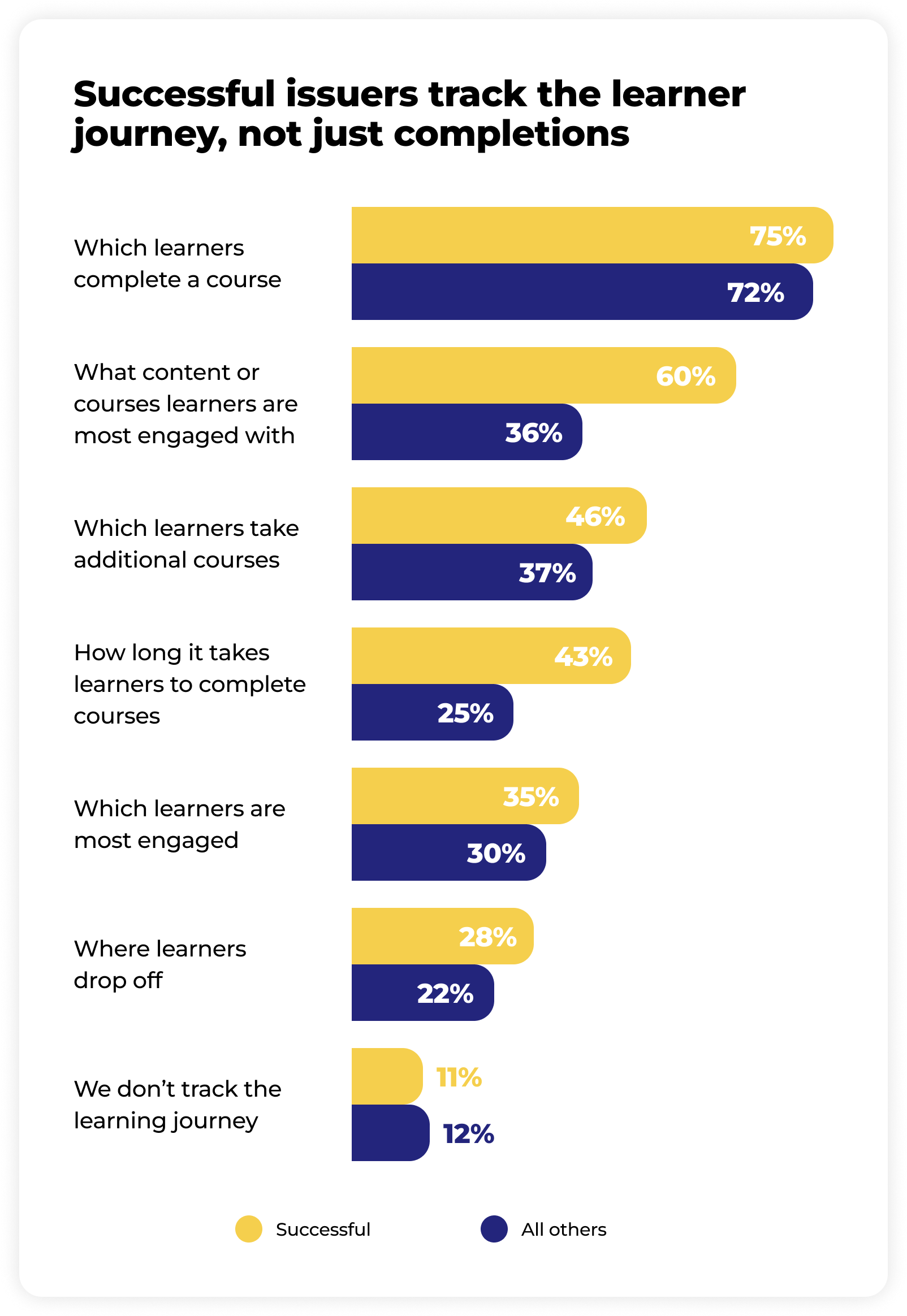
Nearly 9 in 10 issuers track some part of the journey, but successful programs go deeper. They’re more likely to monitor:
- Which content learners engage with most (60% vs. 36%)
- Which learners take additional courses (46% vs. 37%)
- How long it takes to complete (43% vs. 25%)
Capture post-completion proof
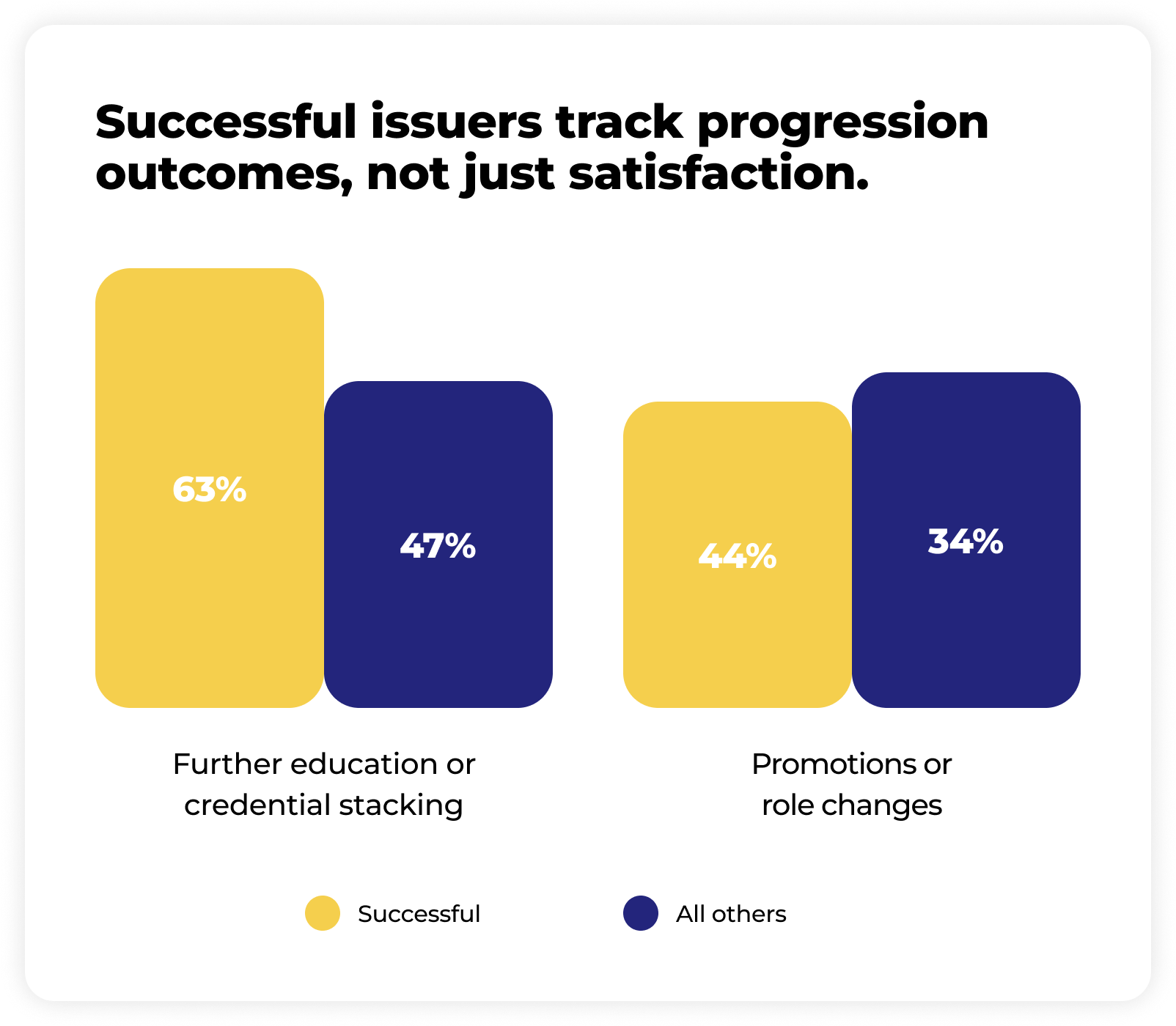
Most issuers track learner satisfaction and employment status. What distinguishes successful programs is progression: they’re more likely to track whether learners pursue additional credentials (63% vs. 47%) and achieve promotions or role changes (44% vs. 34%). These metrics prove momentum — what employers, funders, and leaders notice.
Use multiple data sources
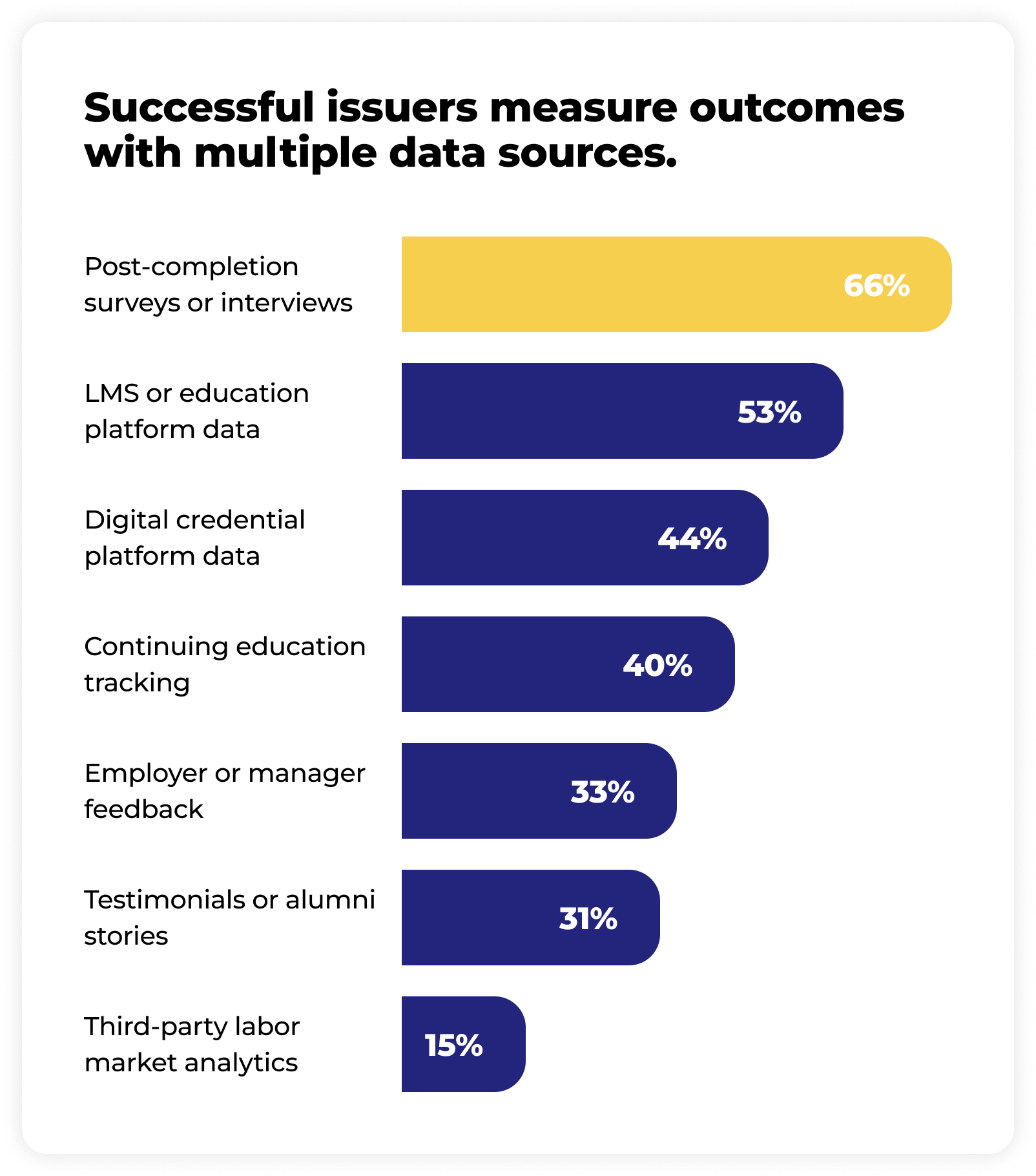
Surveys remain the most common way to track learner outcomes across all groups. But successful issuers stand apart in how they diversify their data sources. They are twice as likely as their peers to draw on LMS or education platform data (63% vs. 31%), and far more likely to layer in digital credential platform analytics (49% vs. 34%).
By combining self-reported feedback with behavioral and performance data, these programs create a fuller picture of learner outcomes and stronger evidence to prove impact.
Sherri Place, Director of Instructional Design and Content Strategy at Wharton Executive Education, emphasizes the importance of weaving reflection throughout the learning experience — not just at the end.
“We often ask learners about their goals before they start, ask them to reflect on their goals about halfway through the experience, and then end with one final reflection on whether or not they met their goals and encourage them to think about what’s next.”
This approach not only improves learning transfer but also primes learners to provide more thoughtful, actionable feedback when issuers follow up months later.
Make it systematic
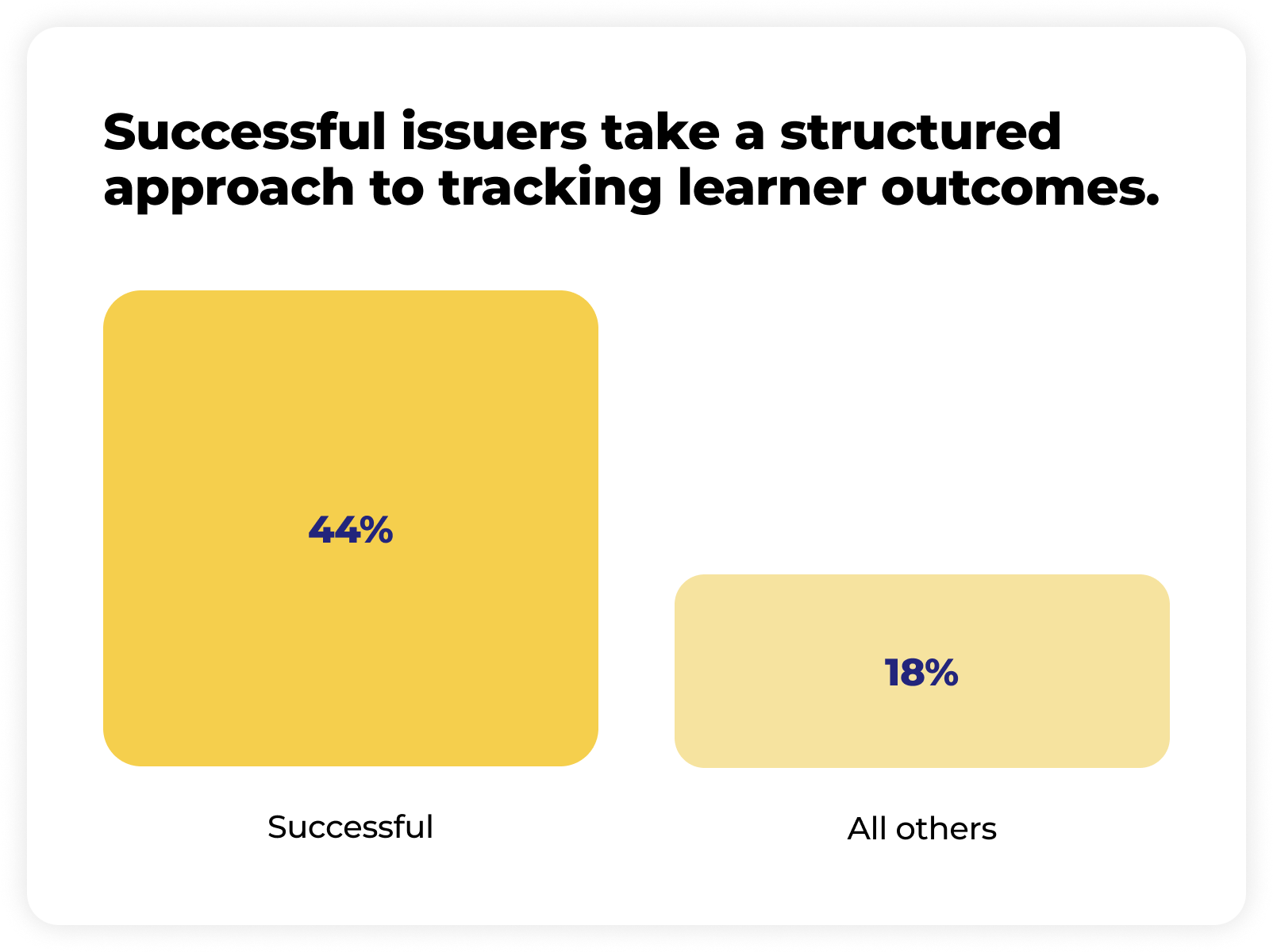
Only one-third of issuers have a formal process — but successful issuers lead by a wide margin (44% vs. 18%). Standardize your cadence (e.g., 6–12-month follow-up + quarterly review), name an owner, and automate delivery to keep your dataset complete.
Use our free post-completion survey template and rollout guide to start capturing career impact at scale — without adding headcount.
Success factor: Communicate value to leadership
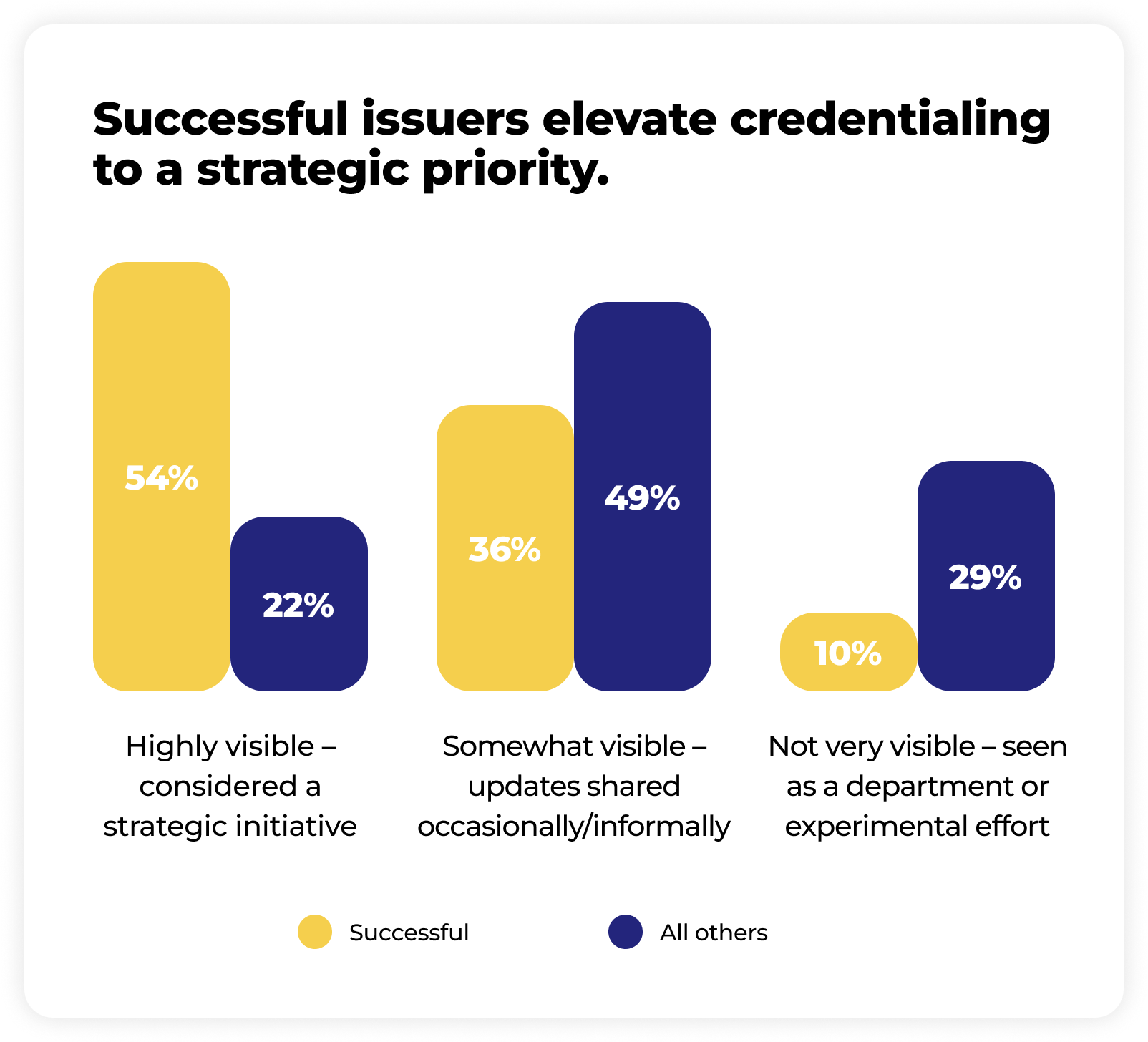
Our data shows that successful issuers are more than twice as likely to have their credentialing program considered a strategic initiative by senior leadership (54% vs. 22%). This visibility isn’t accidental — it’s built through consistent, strategic communication.
Effective communication blends quantitative results (ROI, enrollment growth, learner outcomes) with qualitative impact stories like career advancement wins, employer testimonials, and industry recognition. Whether through formal reports or quick updates, regular touchpoints keep leadership invested in — and advocating for — the program.
The operational advantage
Together, these operational practices form a playbook for sustained success. Top issuers don’t just run programs — they run programs with a clear credential framework and governance model, meaningful KPIs, end-to-end outcome tracking, and leadership buy-in. The result? Higher learner engagement, measurable impact, and long-term growth.
The encouraging news: None of these practices require massive budgets or advanced technical expertise. What they do require is disciplined, learner-focused execution — an investment that consistently pays dividends in program success and stakeholder satisfaction.
The path ahead: Turning insight into action
You’ve seen what the most successful credentialing programs do differently — now it’s time to put those insights to work. In the next section, we’ll break down the key moves to prioritize, how to sequence them for maximum impact, and practical ways to start today.


