

According to the 2025 State of Credentialing report, just over half of credential issuers (54%) have a documented credential framework.
The other half? They’ve got an informal structure (or none at all).
While you may not think you need a strict credential model right now, a lack of structure can snowball into serious problems as you scale. When digital credentials are inconsistent, ad hoc, or lack clear meaning, it’s not just frustrating for learners. It’s a missed opportunity for institutions trying to demonstrate value, for employers trying to evaluate talent, and for credentialing teams trying to scale effectively.
This isn’t to say your framework has to be perfect from day one. But by aligning on core parameters early, you can save months of costly rework — and protect your organization’s brand and bottom line.
To help you get started, we’re sharing how to build a credential framework that balances consistency with creativity and a governance model to match. We’ll also share how Junior Achievement USA used this exact approach to boost their learner engagement by 80%.
Before we dive headlong into process, let’s define two terms: “credential framework” and “credential governance.”
A credentialing framework standardizes how credentials are structured, named, and visually designed based on earning criteria and competencies.
Your framework dictates everything from specific learning pathways to badge types and tiers to naming conventions. It even defines the dimensions, such as shape, colors, icons, and fonts of each credential, based on where it sits in the broader learning program.
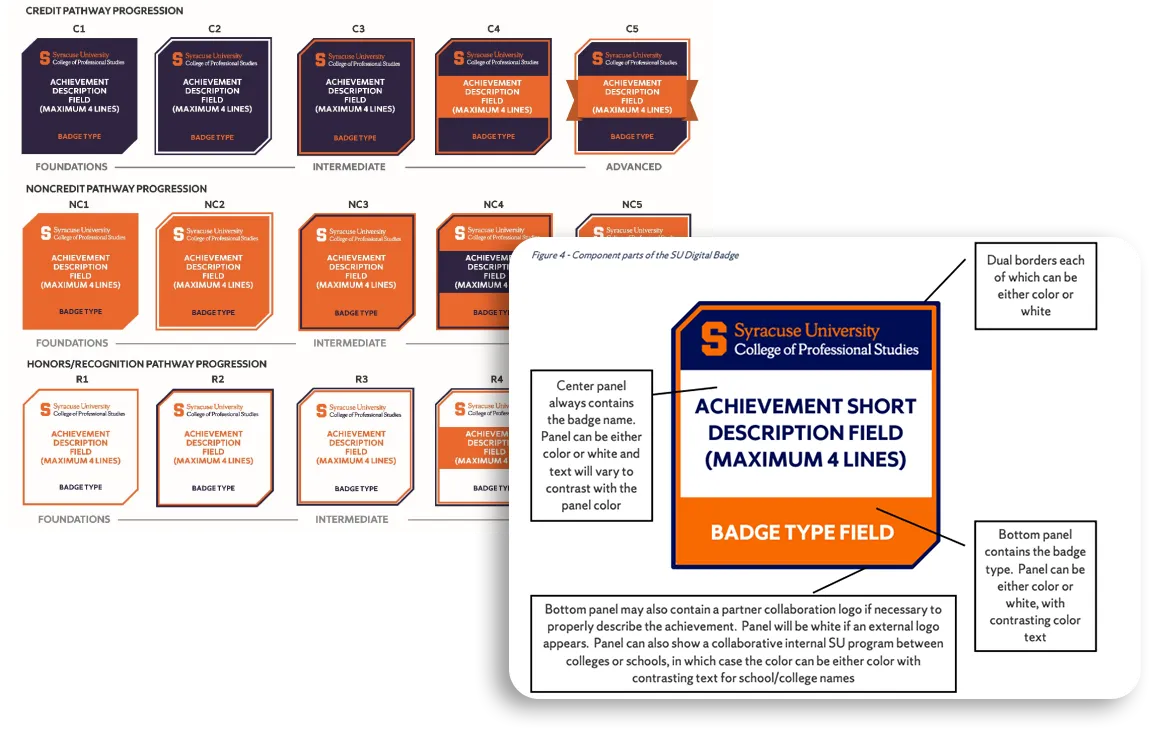
As Maise Hunns, Former Director of Professional Services at Accredible, puts it, “A great credential framework integrates best practices in the credentialing industry with creativity and customization based on a company’s brand and go-to-market strategy.”
Done well, a unified framework helps:
If your credential framework defines the front end of your credentials — defining how they look and feel — credential governance defines the back end. Think of it as a set of regulations that support your framework. That may include everything from metadata standards to badge approval processes to credential maintenance policies.
Governance rules are particularly important as your credentialing program expands.
That’s because, typically, it’s just one department within a company or a single college in a university that’s the first to adopt digital credentials. But after that group sees success, other departments or colleges want to adopt credentials, too. Without a clear structure for publishing new credentials, you risk ending up with a disjointed portfolio that undermines the integrity of your credentials and your reputation as an issuer.
Strong credential governance, on the other hand, makes it easy for new departments or colleges to slot into your framework, outlining exactly what they need to prepare before issuing credentials of their own.
“It’s essential to have multiple parameters so that it’s not just one single rule and regulation that new badges or certificates have to meet,” Maise explains. “A minimum to maximum governance model makes it an open, transparent process to incorporate different departments into your framework.”
Syracuse University sets an excellent example. They’ve created a Digital Badging Council comprised of thought leaders from various areas of the university to enable individual units to launch their badges. This group established a 24-page governance document around badge formats, taxonomy, and procedures that are now used as a framework when onboarding new departments.
Executive Director of the Office of Microcredentials Arthur Thomas shares, “The alignment and the governance of how this works within the university needs to be positively aligned. Taking the time to ensure consensus, support executive leadership, and consider how badging aligns with the academic mission has paved the way for Syracuse's success.”
A credential framework and governance model aren’t just documentation. They’re the scaffolding that supports everything else in your learning program.
Without them, even the best-intentioned credentialing efforts can quickly become fragmented. One learner’s badge may look completely different from a peer’s. Teams may start to duplicate efforts or struggle with inconsistent processes. And external stakeholders — like partners, accreditors, or employers — may find it difficult to interpret what a credential represents.
Per Maise, “You can issue beautiful badges, but if they’re not aligned to a structure your stakeholders understand and buy into, they won’t achieve their full potential.”
A strong framework creates shared standards that level-set expectations and make your program easier to scale with quality and clarity. And it’s not just theoretical.
Organizations that take the time to design these foundations — before or even after launching credentials — see measurable benefits in learner engagement, internal alignment, and program credibility.
Want help developing a scalable credential framework that fits the unique needs of your earners?
Reach out to our Professional Services team to see how we can help you set up your credential framework.
At Accredible, we identified the need for a strong framework and governance process from the start, which is why we built an entire consultancy service around it.
Rooted in IBM’s design thinking principles and our years of knowledge from working with the biggest credential issuers in the world, our Professional Services team’s methodology sets organizations up for success, regardless of the industry they play in and how big their programs grow.
“We know how to do this without guessing. We keep a very close eye on what the most innovative issuers are doing and constantly update our playbook and toolbox so that we get the right design, hierarchy, and governance in place for any kind of credential issuing organization,” Maise emphasizes.
Below, we walk through the eight steps we use to design scalable credential programs — brought to life through Junior Achievement USA's (JA USA) experience, so you can see how each one applies in practice.
Before any workshops begin, the Professional Services team conducts interviews with key stakeholders across the organization.
“This is part of our primary research,” explains Maise. “We speak with everyone involved in credential decision-making, so we understand their ambitions, identify any misalignment, and surface goals that might otherwise go unspoken.”
For the JA USA project, these conversations helped Maise’s team better understand the organization’s federated structure: JA USA serves as the parent organization, with “local areas” operating independently across all 50 states.
Holly Garner, VP US Head of Workforce at JA USA, highlights, “It was clear we had to create a consistent methodology for badge design, governance, and metadata collection process. But the solution also needed to be flexible enough for our 100+ offices to customize and have autonomy over.”
A deeper understanding of an organization’s unique requirements isn’t the only thing you can gain from these conversations. “If you listen to the language people use when talking about their offerings, the concepts and messaging you come up with will feel more grounded and relevant,” says Maise.
For example, the Accredible team learned that JA USA and its local areas offered multiple microcredentials, which, when taken together, form a broader set of knowledge, skills, and abilities. This concept translated well to a hexagonal shape, which could represent different cells in a larger beehive.

Not everyone is going to be on board with developing a credential framework and governance process right away. But without internal support, you risk poor adoption — or worse, a system that doesn’t align with your broader business goals.
Maise’s team uses two strategies to get stakeholder buy-in:
As part of the buy-in process, Holly’s team also emphasized the importance of delivering a seamless learner experience via its digital credentialing partner.
“We needed a platform that could seamlessly align with the JA brand and provide a tailored JA-branded learner experience from start to finish — to the point of making sure every URL was a JA URL so that students continued to participate in the JA ecosystem.”
If you already have credentials, it’s time to take a harder look at what you’ve got. Reflect on the conversations you had with internal stakeholders and the feedback you may have received from earners.
What’s missing in your program? What KPIs are lagging? Make a list of things your new framework will need to address.
If you don’t have credentials yet, conduct some research:
Log your answers in a shared document so people can reference them during the workshop.
The live workshop (which comes next) is meant to solidify your credential categories, hierarchies, and pathways. But it’s hard to work on those if you don’t have a rough sketch of your new visual identity.
At this step, our Professional Services team comes to the workshop with a few shapes, icons, or logos that best represent what we heard and found in Steps One through Three. “This V1 is never the final result, but it’s something you can take to the workshop so people aren’t staring at a blank page,” Maise explains.
Now it’s time to get all of your stakeholders in one room to decide on your preliminary:
From your discussions and research, you should have a sense of what categories you’ll need for your credentials.
You will likely need some to represent recognition or awareness, and others to represent synthesis or mastery. You may also have some that fall under a more structured program with skill assessments or milestones. To solidify these categories, ask each participant to write their credentials on sticky notes and place them in a named category column on a whiteboard.
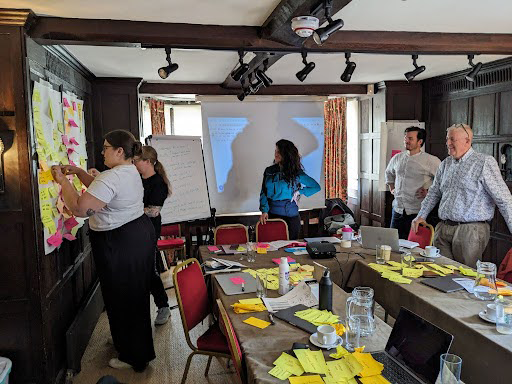
For JA USA, this was a great way to gather everyone’s opinion. “We debated about what we should be badging and how to badge it, whether a credential goes into the microcredential or knowledge category,” Holly says.
“What really helped us refine our framework was Accredible’s team sketching out how other groups do it. We were able to take the learnings they had and marry them to what we were trying to accomplish at JA.”
Once the categories are fairly clear, it’s time to think about a second dimension: hierarchy. In this exercise, participants come back to the board and start moving their sticky notes higher or lower within the category.
“This shows you how much complexity you have in each category and might give you inspiration for how to represent it visually,” says Maise. For JA USA, the number of lines underneath each credential represented the secondary dimension.
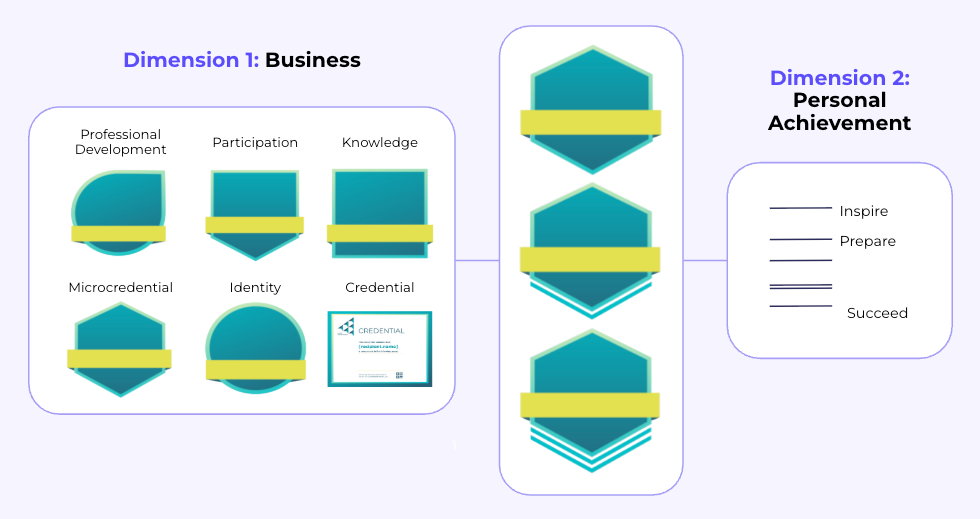
And those lines naturally started to form part of their governance process. If a local area wants to issue a new badge with three lines, for example, the program must be of similar duration and dose to the three-line badges that already exist in JA’s portfolio.
In the final part of the workshop, participants start to map out learner scenarios. For example, if you’re designing for an association, an ideal pathway might be:
You may have more of a constellation model where users can navigate their way through. Or, you could have a mix between the two. Collection credential models require you to take three to four courses, but you can take them in any order.
For JA USA, this systematic way of assigning shapes and chevrons allowed them to create a fair recognition of achievement for the entire JA community, including students, alumni, volunteers, and board members.
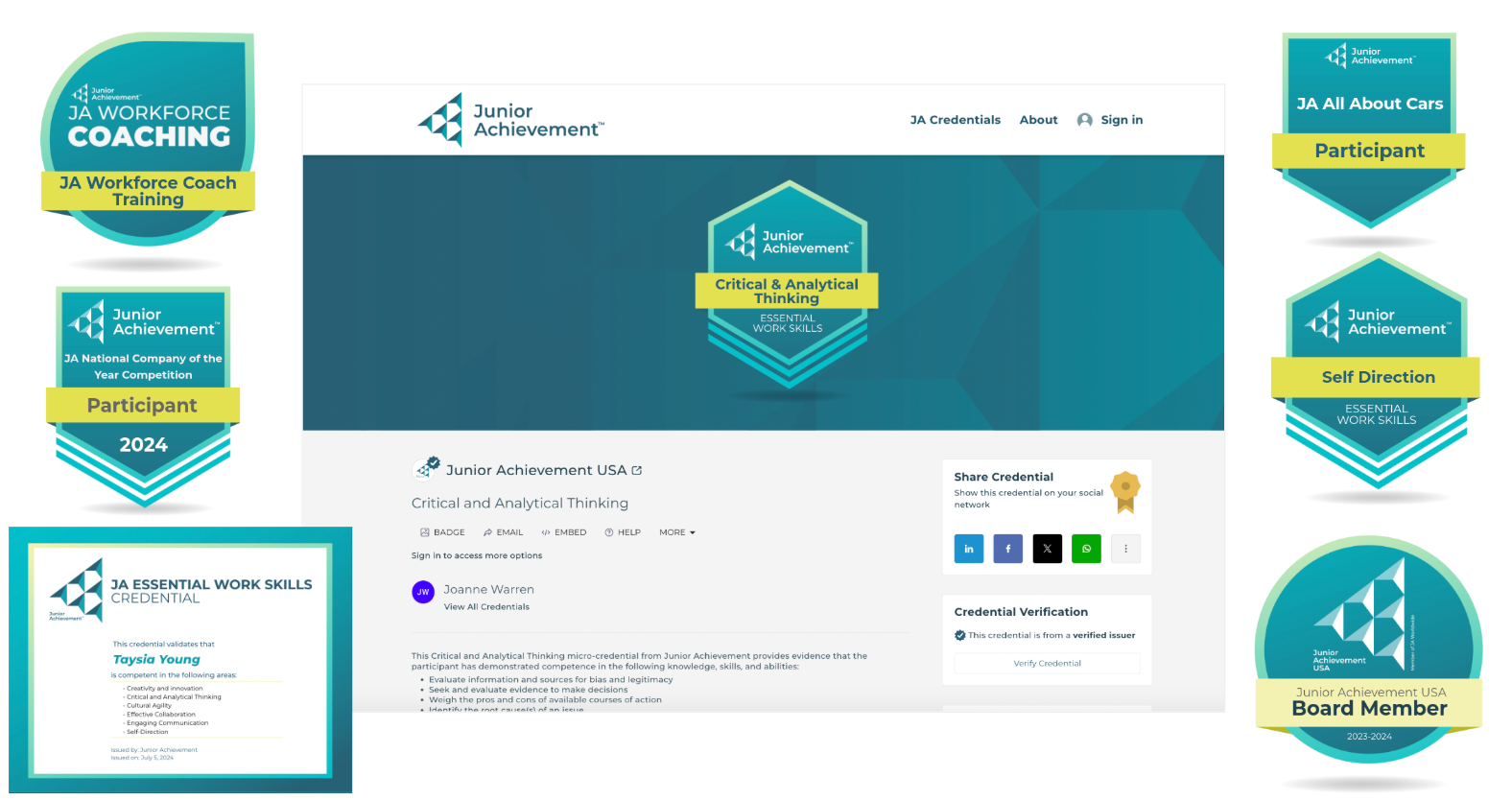
Plus, mapping out these pathways early made it easy for them to configure their credentials in Accredible.
At Accredible, we work with designers to bring the workshop feedback to life.
If you’re doing this on your own, consider pulling in your marketing team at this stage. After all, badges are an awareness and enrollment play. When your credentials look the part, they drive organic traffic to your site, boost credential engagement, and increase referrals. That connection between credential quality and sharing is well documented: branded, well-designed credentials see meaningfully higher share rates than generic ones. Our guide to increasing credential sharing covers this alongside the other levers that move that number. Getting marketing involved now decreases the likelihood that you’ll have to rebrand your credentials down the road.
That said, getting your credentials off the ground is more important than filling in every last structural detail. As Maise likes to tell her clients, “It’s okay to have empty spaces in the framework.”
At this point, our Professional Services team reviews the copious notes they took and begins translating them into decision trees:
From here, you can map out your requirements for new credentials, incorporating what you now know about the categories of credentials you offer, which ones are more complex, and which ones are part of a larger program. This will help your team determine whether you should issue a new credential in the future and if you do, what that credential should look like and where it should go.
Holly points out, “This was a really important piece of the project. We serve over 100 areas; without a clear shared understanding of the role of badges and governance, there’s a chance we would have gotten 100 different variables associated with each badge. It would’ve created significant data hygiene issues and not allowed the power of a shared vision to be developed.
With Accredible’s help, we built out a governance process that standardized our must-haves but also let local areas choose from a set of configuration options that could make their credentials special.”
Here’s a genericized example of a credential issuance plan, including visual classifications for clarity and consistency.
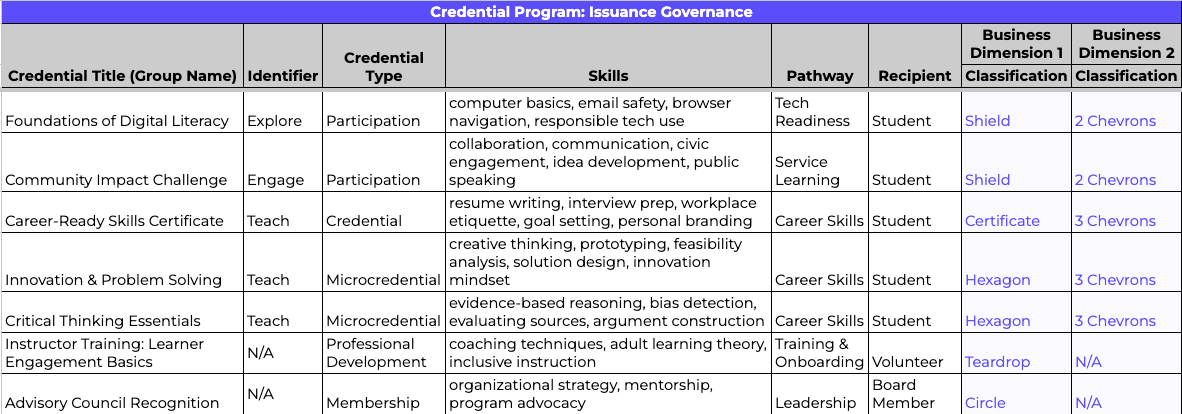
While it may seem like overkill when you already have frameworks and governance in place, having an approval committee that can make fair, unbiased decisions about new credentials or amendments to the process is key to maintaining consistent, on-brand credentials over time.
Ideally, the people on this governance board will have gone through your workshop, know your framework and governance process inside and out, and act in the best interest of the entire organization.
To streamline the approval process, JA USA created a badge application form for departments that want to issue new credentials. That way, requesters know what’s required and can prepare a fully baked proposal for the board’s review.
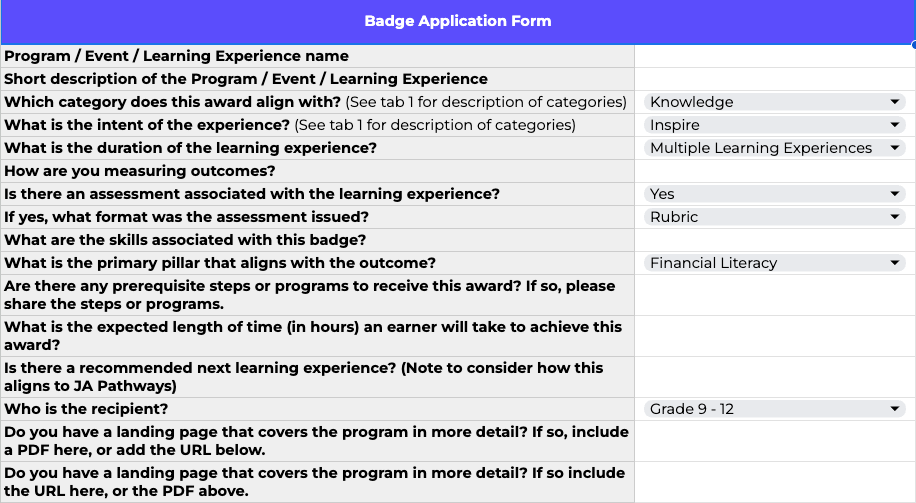
This project didn’t just prevent a messy situation; the framework energized the entire organization with excitement around the potential of badging and credentialing. “With our pilot areas, the process is appreciated. We have a common understanding of the credential catalog, what data is needed to publish a credential, and the questions that really need to be thoughtfully considered before going down the path of creating a new credential,” Holly says.
That enthusiasm is carrying over into recipient engagement. Since implementing this new framework, JA USA has:
Want to hear more about JA USA’s framework journey?
Catch the replay of “From Badges to Big Data: Junior Achievement's Credentialing Journey,” a presentation Maise and Holly gave via The Learning Guild.
Employers, colleges, and other external organizations are picking up on the hierarchies and categories that our customers have created. And that tells us something about the industry at large: there’s a demand for credential frameworks.
“The market is starting to recognize the language of levels, pathways, and metadata. That tells me there’s a need for ecosystems that map credentials clearly to real-world value,” Maise says.
In the future, we might start to see more standardized credential frameworks come into play, perhaps with already established paradigms like the 4 D’s (Discover, Define, Develop, and Deliver) or Bloom’s traditional taxonomy.
“But there’s never going to be a one-size-fits-all,” Maise predicts. “Every framework I’ve seen has been different. What’s critical is making sure it aligns with your go-to-market strategy. Learners are savvy and will gravitate toward programs with frameworks that have proven success with employment and acceptance rates.”
Want help developing a scalable credential framework that fits the unique needs of your earners? Reach out to our Professional Services team to see how we can help you set up your credential framework.
Schedule a demo and discover how Accredible can help you attract and reward learners, visualize learning journeys, and grow your program.
Book a demo
Accredible is the world’s leading digital credential platform, enabling education and training leaders to increase learner engagement and drive program growth.


Accredible is the world’s leading digital credential platform, enabling education and training leaders to increase learner engagement and drive program growth.

