

For today’s credentialing programs, issuing a digital certificate or badge is no longer the finish line — it’s just the beginning. Learners earn credentials to advance their careers, build confidence in their skills, and unlock new opportunities. But how do you know if your program delivers on that promise?
That’s the challenge. Measuring learner outcomes — especially for non-credit, alternative, or employer-driven programs — is hard. There’s rarely a built-in way to track what happens after completion, forcing many credentialing teams to rely on anecdotal evidence rather than rigorous data.
Programs require a feedback loop tailored to their reality: lean teams, tight budgets, and external stakeholders who still expect proof of impact. That disconnect doesn't just limit your data — it weakens your ability to secure funding, attract new learners, and improve what comes next.
This guide will help you identify which learner outcomes to focus on, how to measure them realistically, and how to act on what you learn. We’ll even provide a free post-completion survey template — a plug-and-play tool you can start using immediately to gather insights and demonstrate the value of your program.
Today’s learners are looking for proof. They want to know: What will I gain from this credential? Will it help me get hired, promoted, or grow professionally?
According to Strada Education Foundation, career advancement is one of the top motivators for enrolling in non-degree programs. However, many institutions and providers lack a reliable method for tracking whether learners achieve those outcomes.
Other research, such as Work Shift’s review and the CredLens project by the nonprofit Education Quality Outcomes Standards Board (EQOS), reveals how rare it is for non-degree programs to collect consistent and actionable outcome data.
Still, programs that do measure outcomes have a significant advantage. They can:
You don’t need a massive research team to measure outcomes, but you do need to be clear on what matters most to your stakeholders. Start by identifying the types of learner impact that align with your goals:
Once you know what to measure, you can decide how best to capture it — through surveys, analytics, interviews, or employer feedback.
There is no single way to capture learner outcomes, and the best programs often employ a combination of qualitative and quantitative methods. Depending on your resources and goals, you might draw from:
With a digital credential platform like Accredible, you can also gain visibility into learner engagement and program performance through real-time data — like credential shares, views, referrals, learning pathway completions or drop-offs, and more. This behavioral insight is critical for refining strategies and demonstrating program ROI.
However, while each method has value, many teams require a scalable and repeatable way to consistently gather outcome data, especially after learners have had time to apply what they have learned.
That’s where a post-completion learner survey comes in.
Reflection in Practice: Wharton Online
Sherri Place, Director of Instructional Design and Content Strategy at Wharton Executive Education, recommends integrating reflection into the learning experience — not just at the end. She says,
“We often ask learners about their goals before they start, ask them to reflect on their goals about halfway through the experience, and then end with one final reflection on whether or not they met their goals and encourage them to think about what's next.”
This not only improves learning transfer but also primes learners to provide more thoughtful and useful responses when you follow up months later.
To make it easy to start measuring impact, we’ve created a free survey template designed specifically for credentialing programs.
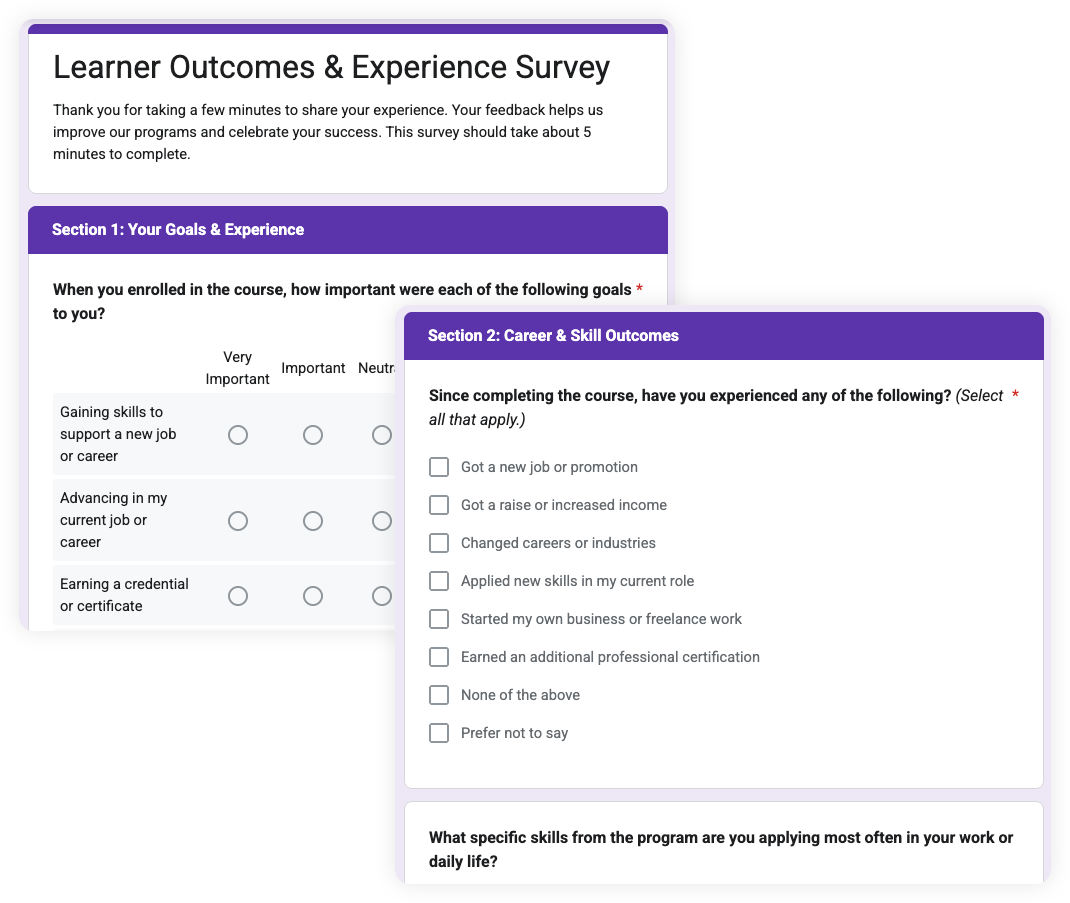
This modular survey is intended to be sent 6–12 months after program completion, when learners have had time to apply what they have learned. It asks them about their original goals, their achievements, and how satisfied they are with the experience.
It’s available in two formats:
A few example questions:
Even a few responses can yield compelling quotes, proof points, and trends you can use to refine your offerings or strengthen your pitch to stakeholders.
Once customized, you can send the survey manually or connect to Accredible’s Email Campaigns to send it automatically after a set period (e.g., 6 months post-credential).
Even with best practices, response rates may vary — but 10–25% is typical with a well-timed, short survey.
If you're already issuing digital credentials through Accredible, the good news is that sending this survey can be fully automated.
With Email Campaigns, you can create a custom learner outcomes message and schedule it to send automatically (e.g., 6 months after a credential is issued). That way, you collect post-completion feedback at scale, without the ongoing lift.
With this automation, you can:
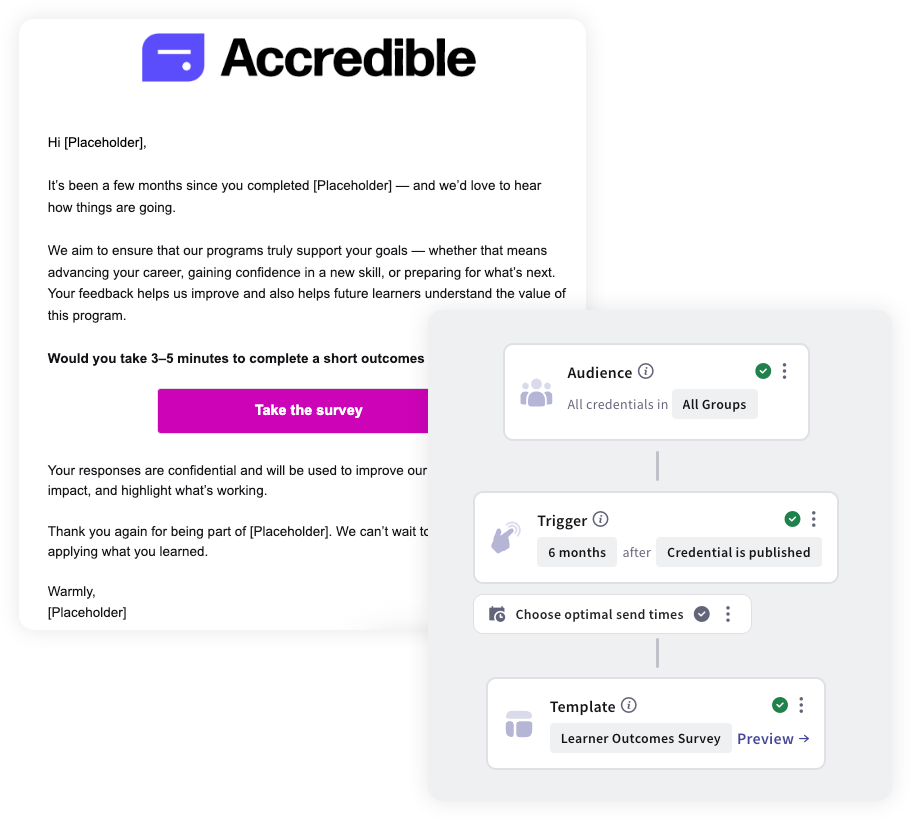
Need help getting started? Our Help Center article provides step-by-step instructions and sample email copy you can use.
Collecting feedback is only the first step. Once you have responses, here’s how to turn them into action:
Once you have outcomes data, the next challenge is connecting it to the metrics your leadership actually cares about — pipeline, retention, time-to-productivity, enrollment growth. That's where most programs stall.
Our guide, From Credentials to Consequence, breaks down how leading programs make that leap and where to start if you're not there yet. Read the guide →
The Learner Outcomes & Experience Survey gives you a streamlined way to capture what happens after the credential and use those insights to grow your program and deepen learner trust.
Use the Google Doc to revise the survey collaboratively, or adapt it for another survey tool. Use the Google Form to quickly launch and collect responses.
Get started in 3 simple steps:
Want to see it in action? Watch our 30-minute on-demand webinar, Measuring Credential Value & Learner Outcomes, where we walk through how to launch the survey, automate delivery, and use outcomes data to improve your programs and prove credential value.
Or request a 1:1 consultation and demo with an Accredible digital credentialing specialist, and we’ll help you set it up for your program.
Schedule a demo and discover how Accredible can help you attract and reward learners, visualize learning journeys, and grow your program.
Book a demo
Accredible is the world’s leading digital credential platform, enabling education and training leaders to increase learner engagement and drive program growth.


Accredible is the world’s leading digital credential platform, enabling education and training leaders to increase learner engagement and drive program growth.

