

What happens to a credential after someone earns it?
For many programs, not much. It lands in an inbox, gets a quick look, and sits there. The learner and the program move on. That's a missed opportunity on both sides.
The earner just did real work to earn something that could help their career, and many don't fully realize it. According to the 2025 State of Credentialing, 91% of HR leaders actively look for digital credentials when evaluating candidates. 86% are more likely to interview someone who has one. 46% reach out directly when a relevant credential shows up in their LinkedIn newsfeed. The earner who shares is doing something concrete for their career.
The program is sitting on something bigger, too. In 2025, Accredible customers saw learners engage with 6.8 million credentials — downloading them, adding them to resumes, and sharing them across their professional networks (a 25% year-over-year increase). Those shares generated over 900,000 referral clicks (up 34% from the year before). That's more than one in four credential shares turning into a referral click from a real person — a potential customer, student, or member discovering a program they'd never heard of before.
The programs generating those numbers aren't doing anything mysterious. Northwestern Kellogg grew credential sharing from 19% to 92% and saw a 112% jump in referral traffic. ServiceTitan sustains a 94% credential share rate and gets 11 or more weekly referral clicks to their sales demo page — a pipeline channel their marketing team didn't see coming. Asana hit a 91% share rate in year one, contributing to a 6x lift in Asana Academy-sourced lead conversion.
None of that happened by accident. It's the result of a handful of decisions — about how credentials are designed, communicated, delivered, and followed up on. This guide walks through each one, with the real programs and data behind it so that you can build the same results into yours.
Not issuing digital credentials?
The strategies in this guide apply to verifiable digital credentials — the kind with a shareable landing page with embedded metadata about skills earned, assessment criteria, and issuer details (example). Paper certificates, PDFs, and LMS badges weren't built for this — they lack the shareable landing page, program links, and tracking that make the strategies in this guide possible. If you're still evaluating the move to digital credentials, here's why it's worth making, and what programs are seeing on the other side.
Before any tactic works, the credential itself has to earn the share. A learner won't post something they're not proud of, and pride comes from both what the credential represents and how it looks and feels when they receive it. The decisions in this section happen before any credential goes out. They determine whether the earner's first instinct is to share or to close the tab.
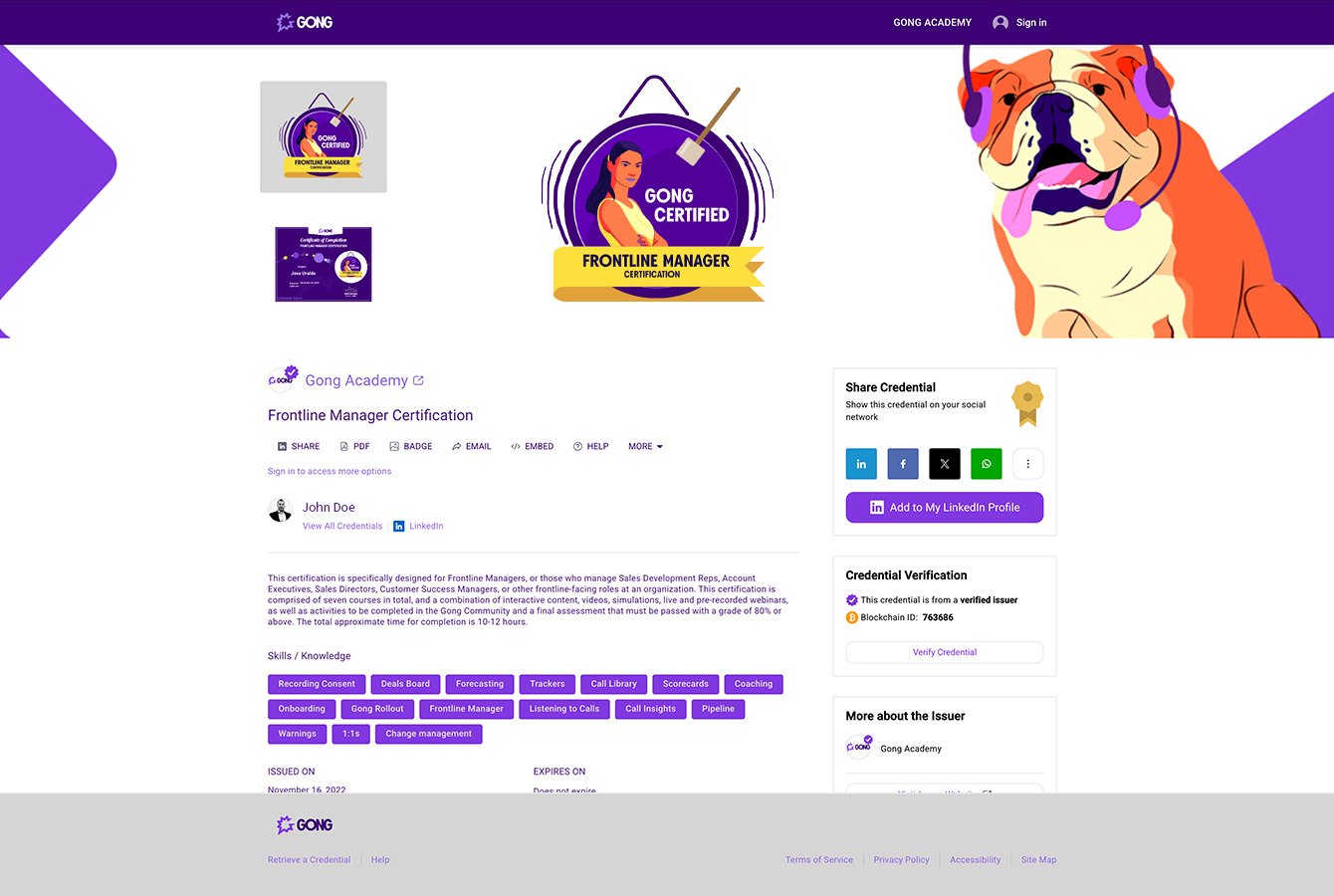
We’ve found that branded digital credentials see an average of 65% higher sharing than non-branded ones. Earners share things that feel like a real achievement from a real organization. A credential that looks like it came from a third-party platform undermines that feeling.
The specifics matter: a custom domain (CNAME), fully branded visual design (including page header, footer, colors, etc.), and a branded email sender all contribute to the earner's experience of receiving something official from your organization.
JJ Janikis, Head of Customer Education at Asana, describes what that looks like in practice: "The custom branding, credential landing page, navigation, and domain made our credentials feel native to our learning ecosystem." Tanya Austin, Professional Learning & Micro-Credentials Program Specialist III at Iowa State University, puts it directly: "It had to feel like Iowa State — not a third-party tool." That's not cosmetic. It's structural — and it directly affects share rate.
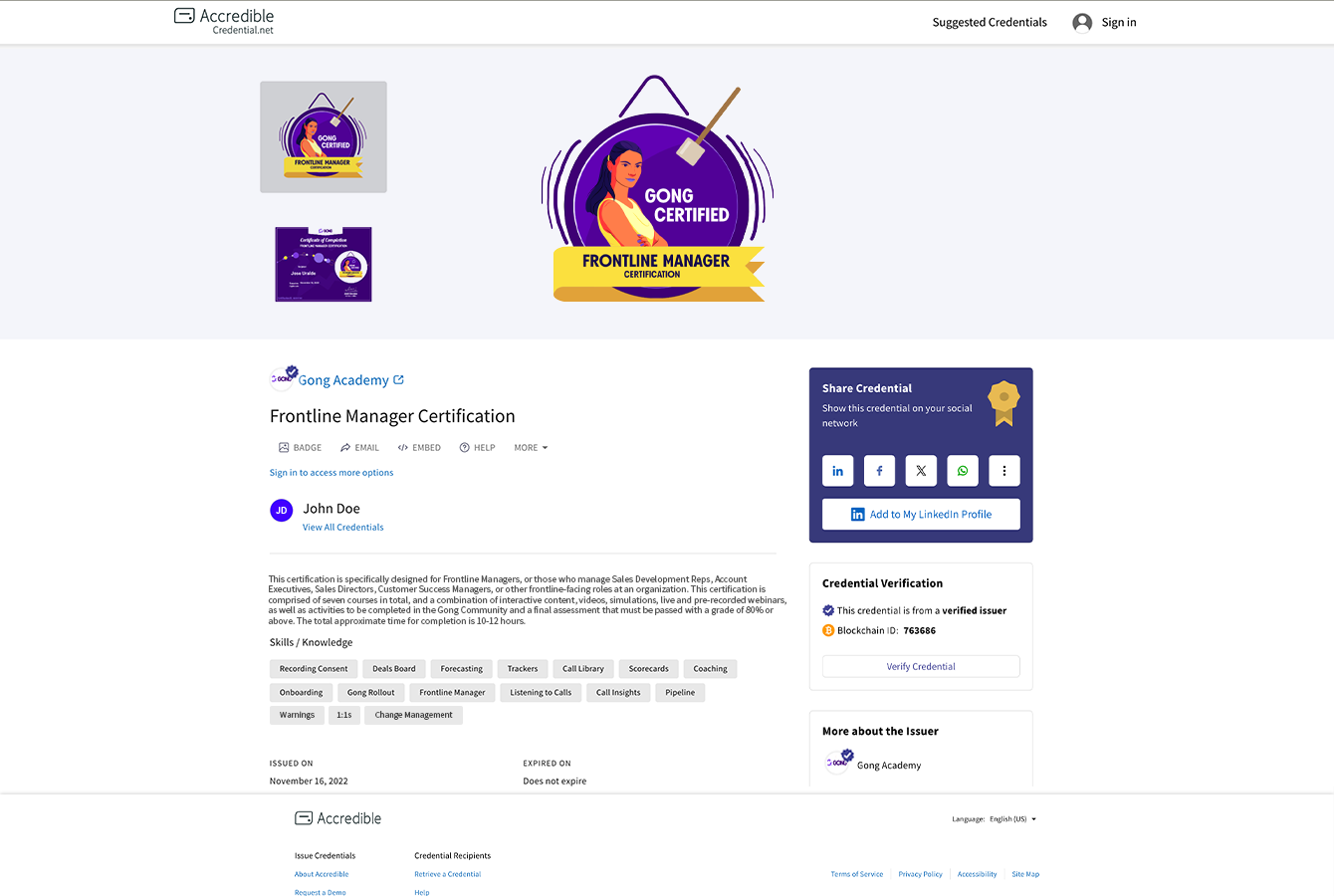
A credential that clearly communicates what was earned — not just that something was completed — is more shareable and more valuable to anyone who encounters it. Skill tags, earning criteria, and evidence of competency make a credential legible to employers and professional peers, not just the earner.
According to the 2025 State of Credentialing, 97% of employers want a clear summary of what was learned. But only about 7 in 10 issuers provide one, and fewer than half specify the level of achievement and and include evidence of learning in their credentials.
Amanda Brantner, Senior Director of Content and Educational Portfolio Strategy at the Gies College of Business at the University of Illinois, explains the standard her team builds to: “A key part of our approach is ensuring each credential has enough metadata to stand on its own. When someone opens a credential, they can see exactly what the learner completed, what skills they demonstrated, and how it connects to broader outcomes — making it meaningful to both learners and employers.”

When a non-recipient clicks a shared credential and immediately understands its value, that's a referral that can convert.
Credential inflation is a real risk, and it shows up in share rates. Earners don't post completions they're not proud of, and a program that issues credentials for every minor interaction produces lower share rates and lower program credibility at the same time.
Danielle Combs, Senior Program Manager for Customer and Partner Relations at ServiceTitan, is direct about this: when internal stakeholders start requesting credentials for additional program touchpoints, the answer has to be "Is this actually worthy of that level of recognition?" LogicMonitor applies the same standard — every badge should be worth stepping away from your day job to earn. A governance model that defines what earns a credential before the requests start coming in is worth building early.
Most programs wait until the credential delivery email to explain what a digital credential is and why it's worth sharing. That's too late. By the time a learner receives their credential, the explanation feels like an afterthought, and earners who don't already understand the value are unlikely to act on a call to action they've never considered before.
The programs with the highest share rates start that education before the course begins. Amanda Brantner at the University of Illinois has seen this firsthand: "We get questions from learners like, 'How do I share this?' or 'What should I do with it?' Helping them understand not just what a credential is, but how to use it, is really important."
The goal is simple: by the time a learner earns a credential, sharing should feel like a natural next step — not an unfamiliar instruction they're encountering for the first time. The credential delivery email becomes a trigger, not an explanation.
The practical mechanism is a dedicated learner-facing page — on your website or inside your LMS — that explains what earners will receive, why it matters to their career, and how to use and share it. Build it before the first credential goes out. The learners who arrive at issuance already knowing what to do with their credential are the ones who share them.
Resource: For the full implementation guide — page structure, modular copy blocks, sample CTAs, and real examples from programs like UiPath, Rutgers, and City & Guilds — see the Credential Landing Page Guide.
Friction overrides every other tactic in this guide. You can design a beautiful credential, educate your learners thoroughly, and write a strong delivery email, but if the path from "I earned this" to "I shared this" has unnecessary steps, most earners won't complete it.
Requiring login to claim or view a credential can reduce sharing by up to 75%. The Maker Group learned this firsthand: when they moved from a platform that required account creation to one that didn't, sharing jumped from 20–25% to 88%. Paul Voisard, a Partner at The Maker Group, is clear about the lesson — the sharing experience has to be frictionless. Anything that interrupts the moment between earning and posting is a lost share.
For many programs, this is a digital badging platform selection criterion rather than a configuration setting and is worth assessing before assuming it can be resolved with a settings change.
The credential landing page should surface the LinkedIn newsfeed share, the profile add, and other sharing options in a single view. No hunting, no extra steps. Each additional action required between "I earned this" and "I shared this on LinkedIn" represents a measurable drop-off. Accredible's data is consistent: share rates increase significantly when unnecessary steps are removed from the sharing process.
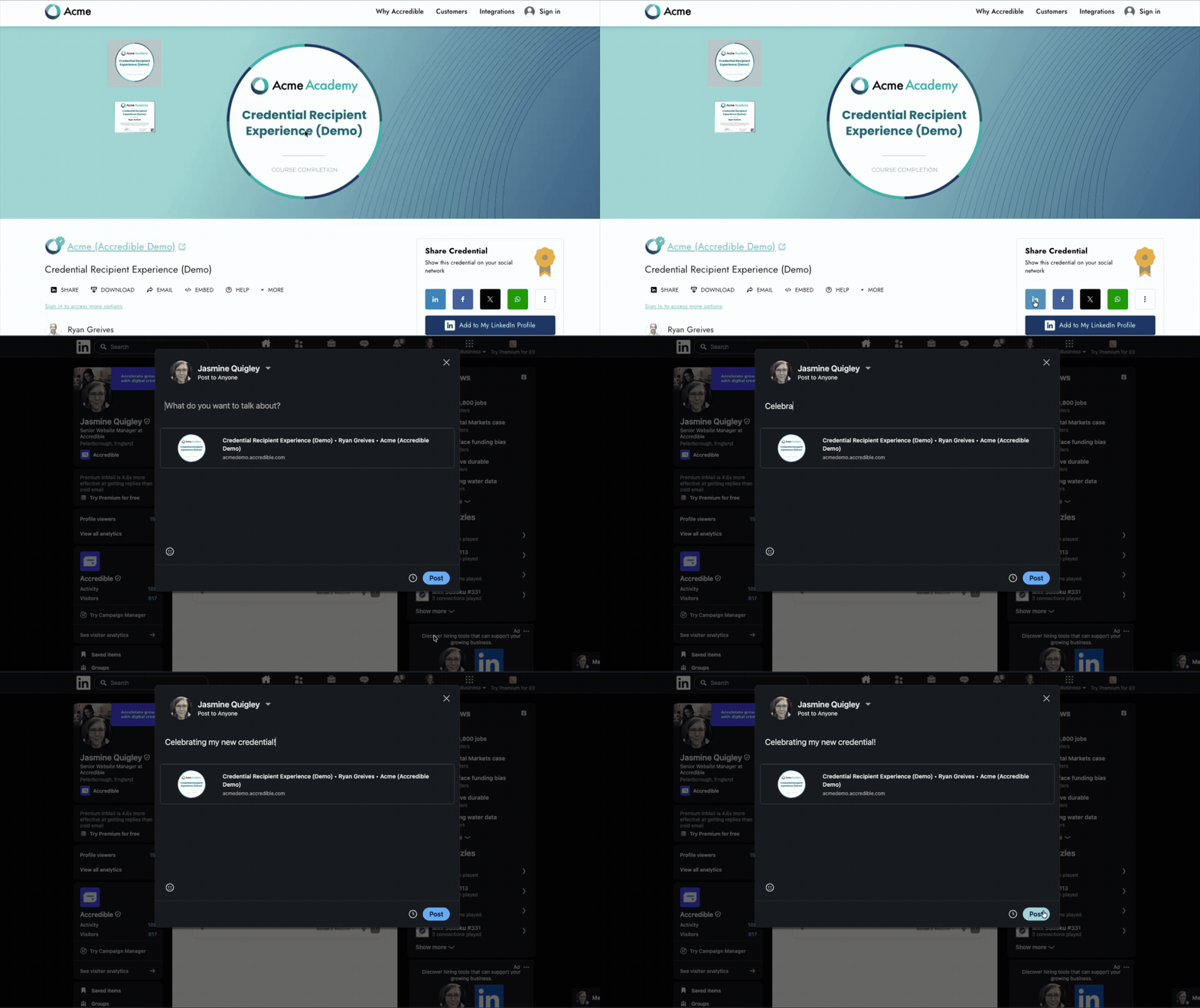
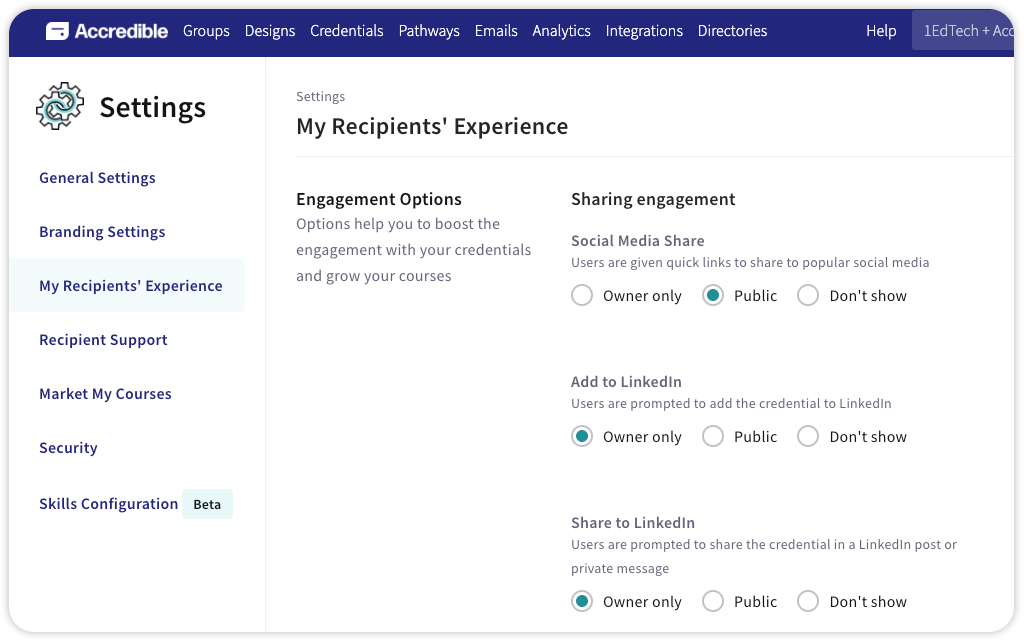
This is the most common sharing misconfiguration we see, and the easiest to fix. Both "Add to LinkedIn" and "Share to LinkedIn" are set to owner-only by default in the Accredible platform, meaning the options are hidden from anyone who isn't signed in. For most programs, that's everyone. Credentials are going out, earners are opening them, and the LinkedIn sharing options they're looking for simply aren't visible.
Flipping both to public takes under a minute. In Accredible, go to Settings → My Recipients' Experience → Sharing engagement. If you haven't checked these recently, do it now — before anything else in this guide.
Every shared credential links back to the same place: the credential page. That's where every non-recipient click lands — the professional who saw their colleague's post and didn't know your program existed until that moment, the potential new learner who wants to know more, the hiring manager who clicked through from a profile. Many programs treat this page as a static record of achievement. The highest-performing ones treat it as an active marketing surface that works on their behalf every time a credential is shared.
The header and footer of the credential page are the first things a non-recipient sees when they land. Leaving these blank or carrying your credentialing platform's branding instead of your own means every visitor's first impression belongs to someone else. A fully branded header and footer, matching your site's design and linking to wherever you want visitors to go, turns every credential view into a direct path back to your program. Accredible is one of the only platforms that lets you customize these completely, so the credential page feels like an extension of your website rather than a detour from it.
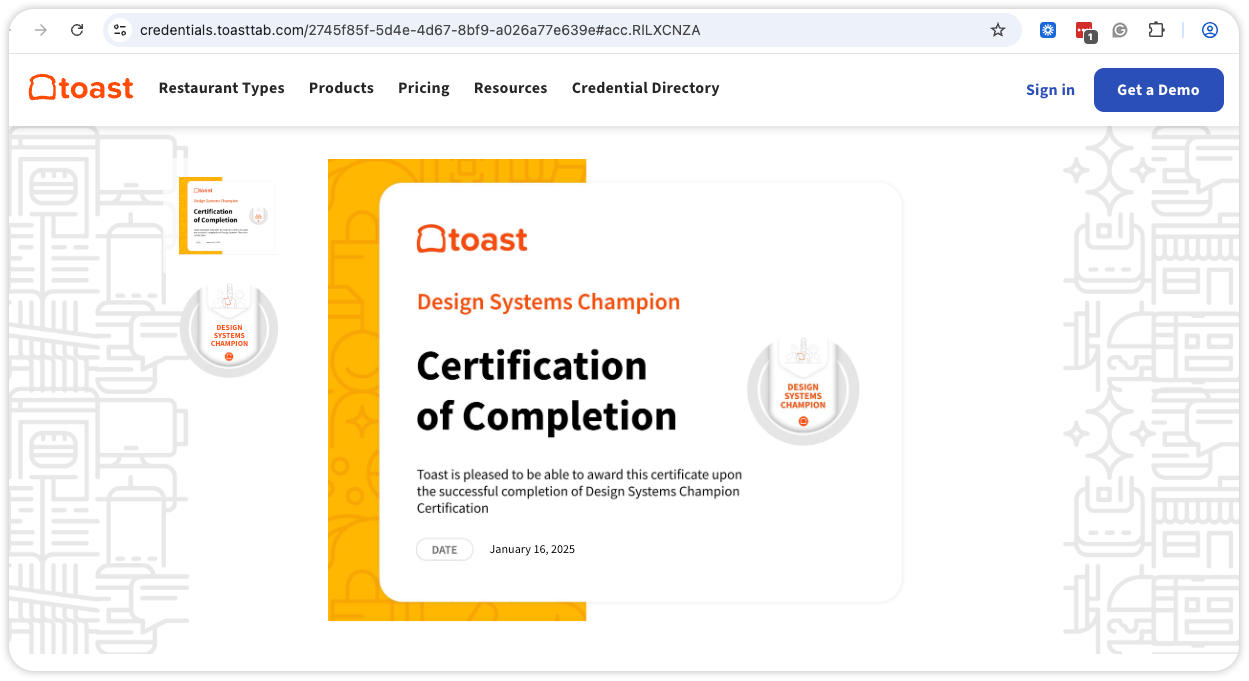
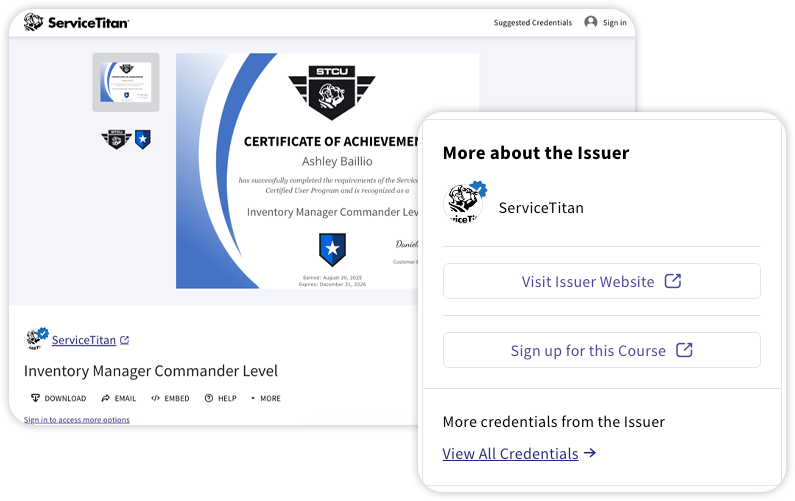
The credential page can carry a message from the issuer, a call to action (CTA) to your enrollment page, a link to your program directory, or all three. If the page doesn't tell those visitors what to do next, the opportunity ends at the click.
Danielle Combs at ServiceTitan described the moment her marketing team realized credential pages were generating weekly referral traffic: "We never saw it when we first went into it as an asset to us. I was absolutely amazed at the number of click-throughs we get on credential referral links to our prospect demo site. We're actually getting deals, we're getting sales from it.”
That connection between a credential share and a business outcome happens at the credential page, specifically because the page has a link that goes somewhere meaningful.
This is a setup decision that determines what you can measure indefinitely. You can add UTM tracking (simple tags that identify where website traffic originates) to any link on your credential page to start attributing referral traffic directly to credential shares.
A professional education program at a major research university made this decision when they launched their digital credential program, pulling Accredible engagement data into Salesforce from day one — attributing net-new leads back to credential shares. The result: a 127% credential referral rate — meaning every shared credential generated more than one referral back to their program pages — and reenrollment growing from 35% to over 50%.
Without UTM tagging, you can see share count, but not what sharing is actually generating for your program.
Timing is one of the most underleveraged sharing drivers in credentialing — and one of the easiest to fix once you know it matters.
While there are circumstances that require delay and/or human review before a credential goes out — a final exam that needs grading, a submitted project under evaluation, a qualification requiring sign-off from a committee or certifying body, or holding credentials for a cohort ceremony — the emotional peak at credential completion is real and brief. Credentials issued at the moment of completion consistently outperform those sent in a batch run days later. The share happens — or doesn't — in the hours after achievement. Once that window closes, even a well-designed credential arriving days later is working against a diminished emotional state.
Automated digital credential issuance tied directly to LMS completion is the right default. The credential arrives the moment it's earned — no manual processing, no batch delay, no dependency on an administrator's schedule.
The credential delivery email is the highest-leverage individual touchpoint many programs underuse. It's the first moment an earner encounters their credential. And in most programs, it's treated as a notification rather than an activation.
Most earners don't know what their credentials can do for their careers. The delivery email is where that context gets planted. Include data points from sources like the 2025 State of Credentialing: 91% of hiring managers look for credentials when evaluating candidates; 86% are more likely to interview someone who has one; and 46% reach out when a credential appears in their LinkedIn newsfeed. A congratulations is appropriate — a congratulations paired with a clear reason to act on it is what drives sharing.
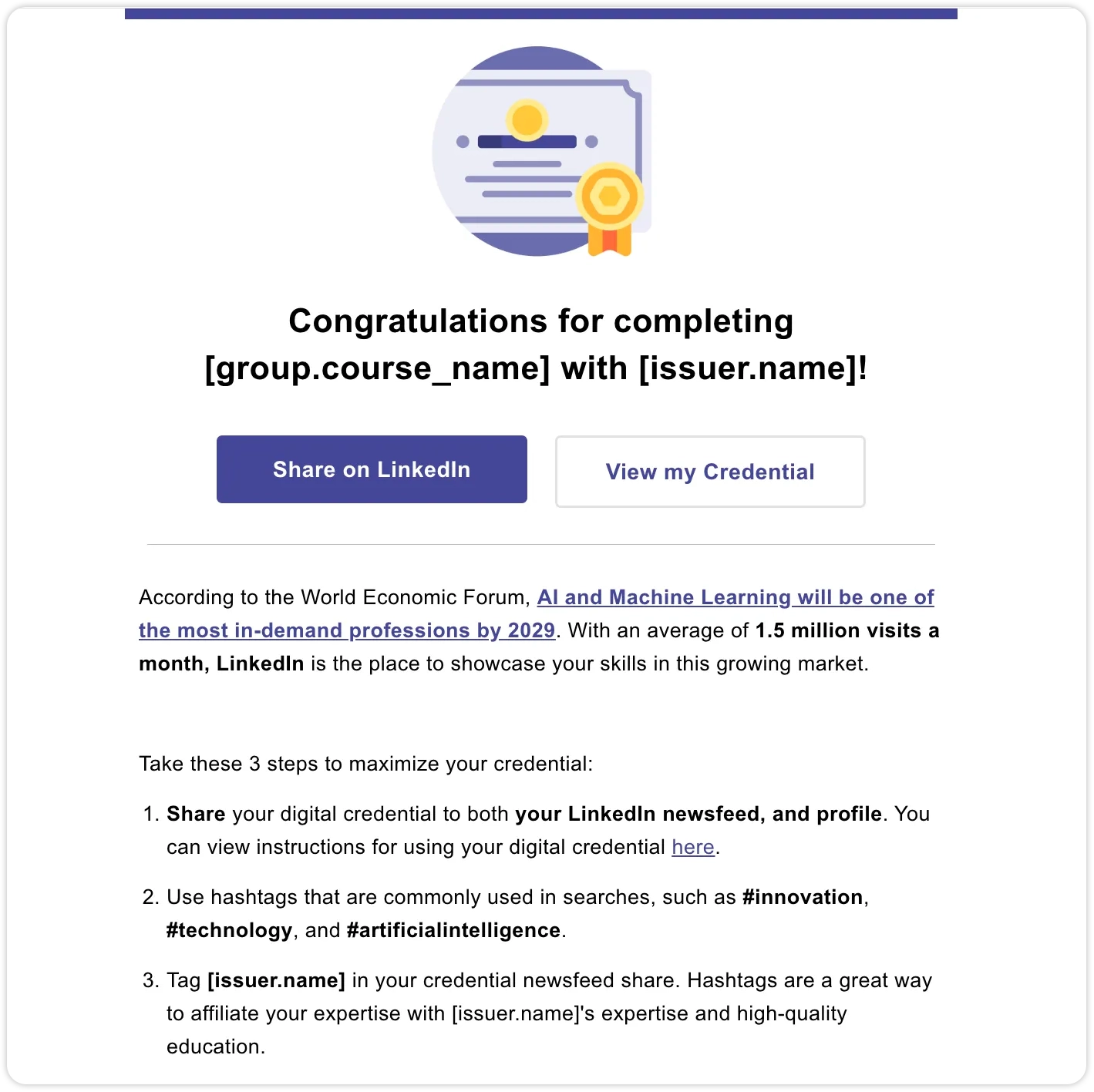
"View Credential" is not the same as "Share on LinkedIn." Programs that explicitly tell earners where to share — and ask them to do it — see meaningfully higher sharing rates than those that leave the action implied.
The College of Professional Studies at George Washington University moved from a generic credential email to one with a specific LinkedIn share call to action. That change, combined with a follow-up email campaign, contributed to a 581% increase in LinkedIn sharing rate. The ask works when you make it clearly.
Learners often struggle to explain their credentials in real-world terms. Equip them with “credential-in-action” language.
Gies College of Business includes sample LinkedIn posts in credential delivery emails: "Proud to have earned my Strategic Leadership & Management credential from @GiesBusiness! This program has equipped me with valuable frameworks for driving team performance and organizational strategy. Excited to apply these insights in my leadership journey. #WeAreGies"
This removes the blank-page problem for earners who want to share but don't know what to write — consistently one of the most underestimated friction points in the sharing process. A two-sentence sample post is a five-minute addition to an email template with a measurable effect on share rate.
Sender name, domain, subject line, visual design — the credential delivery email should be unmistakably from your organization, not from a platform. A branded, trusted-looking email gets opened and acted on. A third-party-looking one gets filtered or ignored before the earner ever sees their credential.
While 71% of issuers send an email to award a credential, only a third send a reminder to open and share it. Think about how many emails learners receive in a day — a single credential email is unlikely to be the one that breaks through. Most non-sharers simply needed a second ask.
Across Accredible customers using Email Campaigns, programs see an average increase of 3.6 percentage points in open rate and 2.84 percentage points in LinkedIn share rate compared to programs relying on a single issuance email.
Someone who didn't open the credential email hasn't seen their credential. A single resend to non-openers captures a meaningful segment of earners who missed the initial send — through a busy inbox, a distracted day, or a spam filter. Low effort, consistent payoff, almost universally underused.
This targets earners who opened but haven't shared. The message is simple: you've earned something worth sharing, and here's exactly how to do it.
Together, these two campaigns compound quickly. The College of Professional Studies at George Washington University added both to their program and saw a 43.1% increase in credential open rate, a 133% increase in LinkedIn profile add rate, and a 581% increase in LinkedIn sharing rate — the combined result of an improved delivery email and a deliberate follow-up sequence.
Some programs extend this beyond email. SMS credential delivery and reminders see meaningfully higher open rates than email and can run alongside or in place of an email reminder — useful for reaching earners where they're most likely to act.
While not tied to the initial credential share, renewal campaigns are worth building into your follow-up sequence. An earner who renews their credential and reshares it extends your program's visibility at no new issuance cost. Pre-expiry reminders — timed at 60, 30, and seven days before expiration — surface credentials back into earner attention at the moment renewal is most relevant, rather than after the credential has already lapsed.
The moment the first credentials are shared, how your program responds shapes whether others follow. When an earner sees that sharing generates a response — a comment from a professor, a reshare from the program account, a congratulations from the organization — every other earner watching learns that sharing is worth doing. That signal matters most early, when individual shares carry the most weight.
At Databricks, the brand LinkedIn account and program leaders like Rachel Canetta, Senior Manager of Certification, actively engage with earner shares — commenting, congratulating, and amplifying posts directly in the LinkedIn feed. At one leading university program, faculty leave personal, course-specific comments on earner posts.
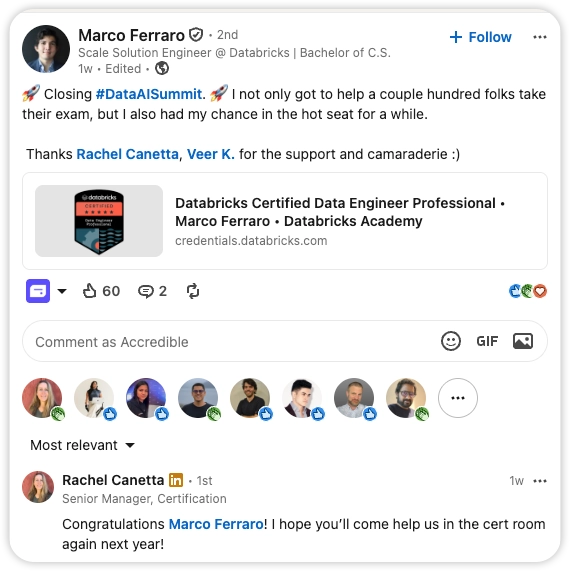
The effect is that sharing a credential doesn't just broadcast an achievement — it opens a conversation with the institution. A share with institutional engagement generates more reach than one that goes unacknowledged, and it signals to every other earner in the network that the program is paying attention. It's also what separates successful credentialing programs from the rest: 69% of high-performing issuers actively recognize learners who share their credentials, compared to 45% of others.
Accredible analytics surface your 'credential influencers' — the earners generating the most views and referral clicks from their shares, whose networks are actively discovering your program through their posts. Build relationships with them.
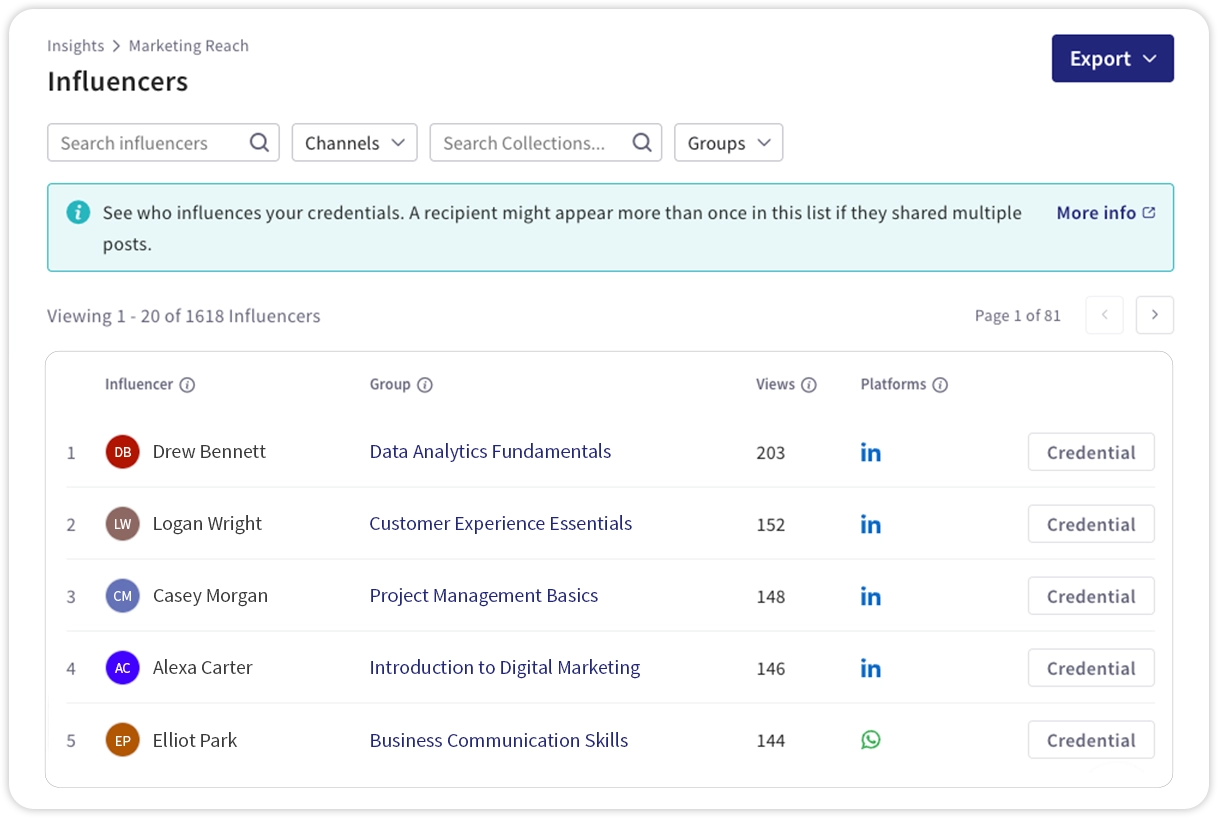
For these earners, go further than a like or a comment. Spotlight them on your program page or social channels, offer a discount on their next course, grant early access to a new credential, or reward them for sharing a testimonial. A learner who shares a testimonial gives your program something a LinkedIn post can't: a story that works across your website, your sales conversations, and your marketing long after the original share has scrolled out of view.
ServiceTitan built a complete sharing incentive loop: earners who share their credential and submit a screenshot or link receive access to a swag store with items only certified earners can claim. Their credential share rate has stayed between 90% and 94% since partnering with Accredible in 2023.
"Sharing is so organic at this point that we don't even have to prove to our executive team that our programs are working," says Danielle Combs. "They see experts in the trades sharing their credentials on LinkedIn, Facebook, everywhere. The great thing is execs like and comment on those posts, so our engagement doubles."
At their annual Pantheon conference, top-level certified earners who register in advance receive custom varsity jackets with their name and certification badge — with additional patches earned for subsequent certifications. Sharing becomes part of a professional identity, not just a one-time post.
Ready to prove the business value of your program? Sharing drives visibility, referrals, and enrollment — but at some point, leadership will ask what it's actually changing. The Credentials to Consequence guide shows how leading programs connect credential data to the business outcomes that earn sustained executive attention.
Everything in this guide compounds, but it doesn't all have to happen at once. The three moves with the highest proof-to-effort ratio:
1. Check your LinkedIn share settings today. If "Share to LinkedIn" is set to owner-only, flip it to public. 30 seconds. Program-wide impact. This is the single most common misconfiguration we find with customers and the most disproportionate quick win in this guide.
2. Add specificity to your delivery email. Add one sentence that tells earners to share on LinkedIn and gives them a career reason to do it. George Washington University's 581% LinkedIn sharing rate lift came from exactly this change. Not a redesigned email or a new campaign — a specific ask with a specific reason.
3. Activate one follow-up email. Choose non-openers or non-sharers. Set it to send 14 days post-issuance. One email, one segment. Most programs have never done this, and it moves share rates consistently. If you're on Accredible, it takes under 10 minutes to configure in Email Campaigns.
Everything else in this guide — credential page optimization, learner education, incentive programs, and social engagement — builds from these three. Start here.
Ready to build a sharing strategy for your program? Our team works with credentialing programs at every stage — from first-time setup to building a program that proves its value to leadership. Talk to our team →
Schedule a demo and discover how Accredible can help you attract and reward learners, visualize learning journeys, and grow your program.
Book a demo
Accredible is the world’s leading digital credential platform, enabling education and training leaders to increase learner engagement and drive program growth.


Accredible is the world’s leading digital credential platform, enabling education and training leaders to increase learner engagement and drive program growth.

