


Gies College of Business at the University of Illinois has earned global recognition for its innovative and learner-centric approach to academic programming. Its flagship iMBA — a fully online, 72-credit-hour MBA — and portfolio of stackable educational offerings have become widely popular over the past five years. So popular, that its iMBA was named the #1 business school innovation of the decade by Poets&Quants.
Learners can apply online graduate course credits they’ve earned to an iMBA or professional certificate, encouraging them to continue pursuing their business education at Gies Business — whenever the time is right for them.
Per Amanda Brantner, Senior Director of Content and Educational Portfolio Strategy at Gies Business, “Our focus has always been on making education accessible. A learner may need a microcredential today, a certificate next year, and a degree at some point down the road. We believe modular education is imperative, and we’ve been able to build a model to support every student’s journey.”
A focus on flexibility has paid off. Since 2020, Gies College of Business has awarded nearly 42,000 digital credentials through Accredible, with learners earning at least three microcredentials on average. And 78% of the students who earned them rave about their credentials on LinkedIn, spreading awareness of the unique programs Gies Business offers and getting a new generation of learners interested in pursuing online business education.
credential engagement rate
credential LinkedIn share rate
of learners earn multiple credentials (3 per learner, on average)


Roughly a decade ago, Gies College of Business seized an opportunity to launch an online MBA program. As a land-grant institution, democratizing access to high-quality graduate education aligns with the College’s values. Plus, it fits the new way students wanted to learn — on their own terms.
Amanda noted, “We recognized that learners don’t always start their journey knowing exactly where they want to go. We wanted to build a model where someone could take a course and later apply that toward a degree when the timing is right.”
The team found an LMS to support their move to online courses quickly. Yet, over time, they realized there were two critical missing use cases:
A digital credentialing platform seemed like a good way to address both needs. But the team couldn’t afford to add any more administrative burden to their plates: they already spent over 300 hours planning and launching each new course. So, they set out to find a tool to minimize admin overhead, connect to their existing tech stack, and help them market and grow their programs.
It just so happened that the Gies College of Business was working with an LMS (Thinkific) that integrated with Accredible — which meant the team had seen firsthand how intuitive Accredible was to use and how well it integrated with their current systems.
More importantly, they saw how Accredible could scale. “With a population of more than 6,000 online learners, issuing credentials could get really cumbersome,” Amanda explains. “What stood out about Accredible was its automation features. Automatically awarding credentials is a game-changer for us.”
Accredible fulfilled another essential requirement in the School’s digital credential vendor evaluation: preserving the University of Illinois brand. Accredible’s custom attributes and white-labeling capabilities would give the team control over the learner experience without adding unnecessary overhead.
Amanda and her team knew that to support the integrity of the College’s online curriculum, the digital credentials they issued needed to carry weight. “A key part of our approach is ensuring each credential has enough metadata to stand on its own,” she says. “When someone opens a credential, they can see exactly what the learner completed, what skills they demonstrated, and how it connects to broader outcomes — making it meaningful to both learners and employers.”
So the team got to work, attaching relevant metadata to each credential in Accredible — things like course details, earning criteria, acquired skills, and evidence of learning.
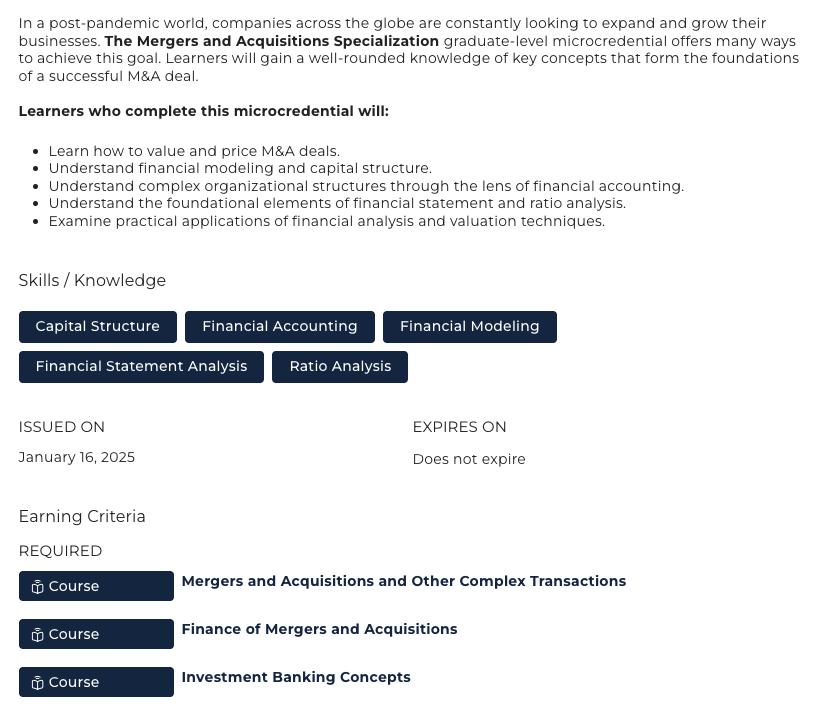
For the learner, credential metadata solidifies and contextualizes their learning — even if they earned a credential from a non-credit course. For prospective employers, credential metadata signals a candidate’s expertise.
Amanda’s team also developed a governance framework to bolster and standardize the meaning of each credential. There are four award categories: academic achievement, continuing and professional education, participation, and engagement. And each category comes with a specific type of digital credential or badge.
“This framework ensures that one part of the College isn’t awarding a certificate for walking in the door, while another is awarding a certificate for a larger assessment,” Amanda shares. Having a structure in place reinforces the value of each credential for learners and employers and helps the College evaluate and round out their coursework as it expands over time.
Learners at the University of Illinois have a special affinity for the institution Graduate students have a special affinity for the University of Illinois — and the Gies College of Business, specifically. Beyond capturing the right metadata, their credentials had to match that same brand and spirit.
“Our certificates and badges needed to feel like an extension of our institution, not like they came from another third-party tool,” Amanda says. “With Accredible’s white-labeling capabilities, we could create credentials that are ours.”
Custom email branding, fonts, colors, logos, a dedicated credential subdomain, and personalized headers and footers ensure Gies Business credentials reflect the school’s brand — and make learners proud to receive and share them. More than that, Accredible credentials help the College manage its external influence — boosting the brand whenever a credential is viewed or shared.
Once credentials were created, Amanda and her team began automating the credential-earning process. “We wanted to avoid more time being added and more manual tasks by automating as much as possible,” says Amanda. “Accredible has been a great partner in making that seamless, with native workflow features and integrations.”
Today, a majority of Gies’ digital credentials are auto-awarded via integration. As soon as a learner completes their learning experience in the LMS, Accredible sends them a credential. As Amanda puts it: “No need to wait for a backend process to run to recognize a learner’s achievements. Sending them out immediately is both a persistence motivator and next credential motivator.”
And it shows in the numbers. A whopping 62% of learners earn multiple credentials. On average, they earn three — many of which are earned on their way toward a specific certificate or degree.
If a digital credential is awarded on a credit-bearing collection of courses, Amanda’s team verifies that students have (1) earned the proper grade and (2) completed an entire course sequence. Then, they upload that data to Accredible, which automatically awards each credential. Less time spent issuing credentials gives staff more time to continue curating the kind of content that appeals to the modern business student.
Amanda and her team saw early on that credentials could be an effective marketing tool. Besides branding the Gies Business credentials, the team put a lot of effort into communicating the value of credentials to their learners.
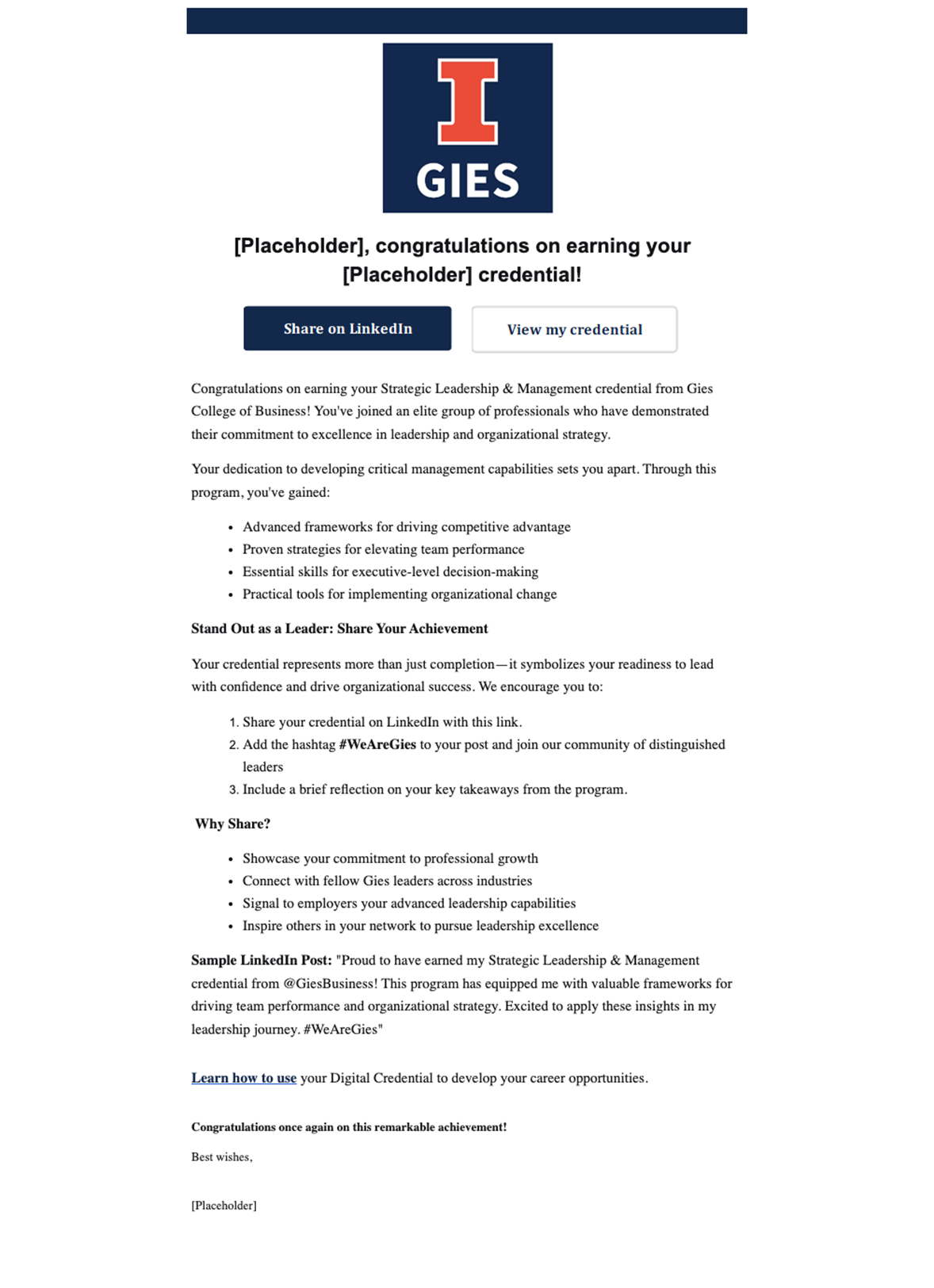
“Within Accredible, we customized our messaging so that learners understood what their credential meant, what they could do with it, and the benefits of sharing their accomplishments on their resumes and social media as soon as they received it,” Amanda emphasizes.
As shown below, the team even includes a sample LinkedIn post at the bottom of credential emails to encourage sharing them online. The staff also uses academic newsletters, advisors, and peers to remind learners of the value of their credentials and nudge them to showcase those credentials in their resumes and professional networks.
After students share credentials on social media, professors and staff chime in with congratulations, making the learner’s achievement that much more meaningful.
Taking these steps has increased engagement and sharing by more than 48% since 2022. Today, 80% of learners who receive a credential add it to their LinkedIn profile or share it to their feed.
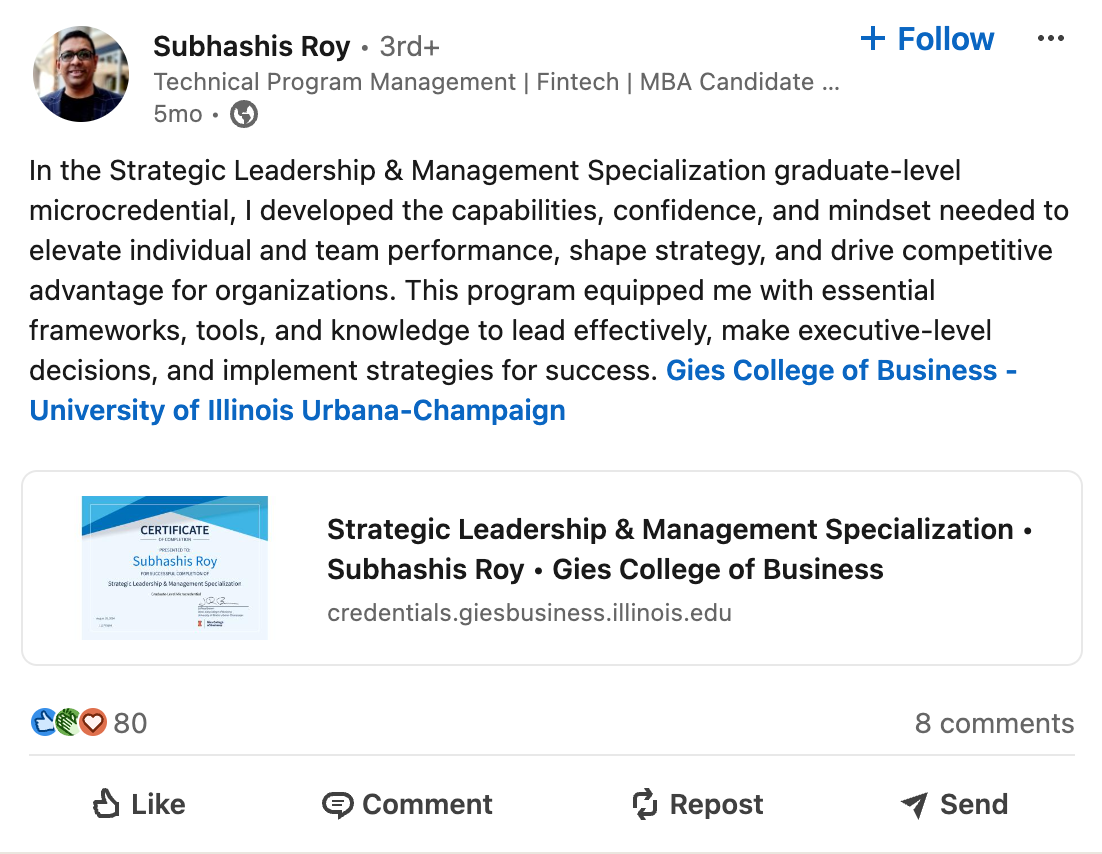
“Students are very proud of the recognition they’re receiving, and they want to get into their peer networks. That, of course, is attracting others to look into our programs and see how Gies can benefit them and their careers,” Amanda highlights.
Gies College of Business has already had incredible success with digital credentials. Still, they’re always looking for ways to improve and expand their strategy, leaning on Accredible to help them get and stay ahead of the credentialing curve.
Amanda shared, “Accredible allows us to extend our work and do what we do better, helping us understand industry best practices and continuously doing what we’re doing in a better way.”
Plans are underway to introduce stackable digital credentials in other professional education programs — and even to undergraduate students pursuing bachelor’s degrees from other colleges on campus.
"We’re now supporting broader university adoption of Accredible and working closely with other colleges on campus to help bring their digital credentialing strategies to life. It’s been a really exciting place to be,” Amanda says.
Schedule a demo and discover how Accredible can help you attract and reward learners, visualize learning journeys, and grow your program.
Book a demo
Accredible is the world’s leading digital credential platform, enabling education and training leaders to increase learner engagement and drive program growth.


Accredible is the world’s leading digital credential platform, enabling education and training leaders to increase learner engagement and drive program growth.


