


If you’ve ever organized a work project in your life, there’s a high chance you know of Asana. With over 170,000 customers (including the likes of Uber, Amazon, Spotify, and Google), Asana has built a system that helps people get things done.
In 2024, Asana was looking to deepen its enterprise footprint and saw certifications as the way in. While they already had Asana Academy for self-service e-learning, they wanted to design a flagship credentialing program — one that would give learners portable, verifiable, career-advancing skills to drive business impact within their existing teams and beyond.
Leadership set ambitious targets around user adoption, thought leadership, and buyer demand — but it wasn’t their first rodeo. JJ Janikis, Head of Customer Education at Asana, explains, “It was up to me to define our credentialing program, but a lot of our new leadership had come from Salesforce, so there was authentic buy-in and a clear model for what good could look like.”
Strategic thinking, cross-functional collaboration, and a leading digital credential platform made it all come together, fast. In just one year, Asana issued over 74,000 Collaborative Work Management credentials through Accredible, and that success quickly gained industry attention. Forbes named Collaborative Work Management a top AI certification to add to your resume, and Accredible awarded it Credentialing Program of the Year.
Credentials issued
Credential share rate
Increase in Academy-sourced lead conversion
“New skills should help people advance their careers. Our users needed a way to signal to their organizations, and the rest of the workforce, that they were enhancing themselves.”

JJ Janikis, Head of Customer Education at Asana

Building a training and certification program that would appeal to individual professionals and enterprise orgs alike wasn’t going to be a walk in the park. To make sure they were designing a program for people who already worked in enterprise settings (or aspired to in the future), JJ and his team went straight to the source.
“Our approach was really putting ourselves in their shoes and asking, ‘What does the customer want and need?’” JJ shares. “Our community was looking for best practices and wanted a POV from Asana on how to do meaningful work within their organization. So we decided to take a role-based approach, and create this concept of a ‘workflow specialist.’”
Grounding the certification in the collaborative work people do every day was how Asana could drive real adoption, and real adoption is what would drive enterprise interest — but only if users could show their skills publicly (solidifying a need for Asana at work) and take them wherever they were headed next (generating more buyer demand over time).
Per JJ: “New skills should help people advance their careers. Our users needed a way to signal to their organizations, and the rest of the workforce, that they were enhancing themselves.” That’s where digital credentials came in.
“A project manager advocated for our new certification on her TikTok, telling other project managers to check it out. We were able to attribute a significant portion of those new registrations to her post.”
JJ Janikis, Head of Customer Education at Asana
JJ saw digital credentials as the way to incentivize users to get certified. They’d get an official record of their learning, which they could display in their resume and on their LinkedIn profile. And when they shared their achievements, they’d be promoting the program and promoting Asana in general.
“That was a non-negotiable, really. If I’m earning a credential, it has to be something that I can share,” JJ emphasizes. “We also wanted it to be part of a broader digital wallet of credentials that users can earn in other places. That’s what validates it, makes it credible. And that’s what initially attracted us to Accredible.”
With Accredible as their credentialing partner, JJ’s team began to think about how Asana could leverage the platform to gamify learning, market the program, and scale enterprise adoption.
The first thing JJ and his team had to do was set up a framework and governance model for the program to accommodate the 10,000 learners they hoped to enroll (and continue to nurture) in year one. Thinking ahead, they opted for a more modular program that would let users complete learning in smaller segments, ultimately leading to larger credentials that demonstrated outcome-based learning, not just a command of Asana features.
“Accredible allowed us to create two categories of credentials. One — which we consider the sort of ‘entry point’ — is a skill badge,” says JJ. These lighter-weight credentials have some coursework, some practice, and a quiz to verify learner knowledge.
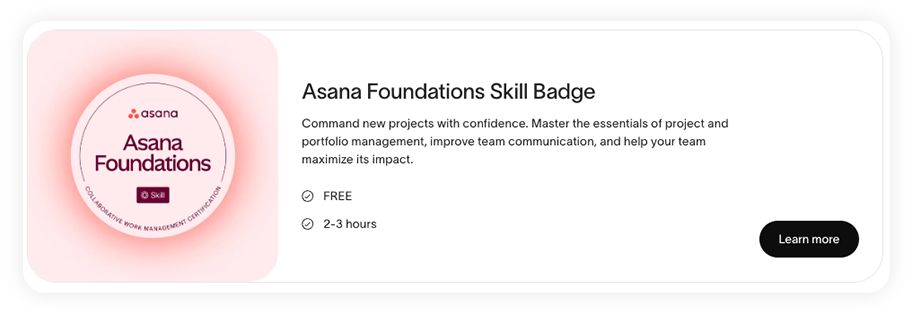
“The other category is a more formal role-based certificate, which incorporates more extended learning, a capstone project, and a more rigorous exam,” he notes. This certificate verifies that the learner has the knowledge and can put it into practice.
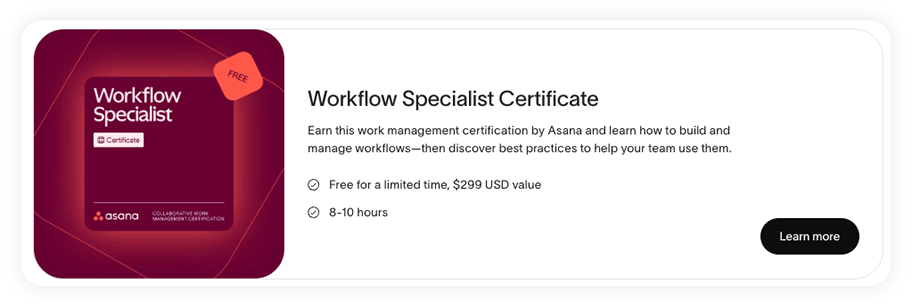
“With this structure, we could add course elements across multiple programs so learners felt like they accomplished something at each step and got credit for it, while developing skills that connected to and built on each other,” JJ points out.
They kicked things off by building the Asana Foundation Skill Badge to codify what customers were asking for (more verified best practices) and the Workflow Specialist Certificate as a nod to the key role learners had in their organization as a result of using Asana. Both drew on a mix of new assets and reimagined ones from Asana Academy.
Once the content was prepared, all JJ had to do to issue credentials was hook Accredible up to Skilljar, the LMS where Asana was hosting all of its courses.
“Because Accredible had a native plug-in, I just established the connection between completion criteria in Skilljar and the badge or certificate in Accredible. Now the platform automatically connects user information and issues the digital credential.”
While the ease of integration was a definite plus, the real win was building a community of credential holders who carry their skills — and their enthusiasm for Asana — wherever they go. Unlike Skilljar’s badges, Accredible credentials aren’t tied to a learner’s company.
“The credential is unique to the learner. They own it,” JJ explains. “It doesn’t go away if they ever leave their organization, which is really important as people evolve their careers.”
As with any training program, content was JJ’s priority. But the look and feel of the credentials mattered, too. The credentials needed to be sleek and on-brand enough for people to actually want to share them — after all, the whole goal was to build excitement as learners built up their badge count and worked toward that final certificate.
So JJ and his team picked a name for the broader program that would emphasize transferable skills for early-career PMs, ops pros, and career switchers: “Collaborative Work Management.” Then they worked with their design team to create a visual identity to reflect that elevated positioning — made possible by Accredible’s whitelabeling feature.

“We wanted credentials to feel like an extension of our overall Asana web surfaces,” JJ highlights. “Accredible’s ability to whitelabel really stood out. The custom branding, credential landing page, navigation, and domain made our credentials feel native to our learning ecosystem.”
Besides having beautiful badges and certificates, JJ knew they had to make credential sharing effortless — another aspect of Accredible that set the platform apart.
When a learner is issued a badge, they’re taken straight to a credential landing page that details what credential they earned, what skills they’ve developed as a result of the course — even top job titles related to the credential and top employers of people who hold it.
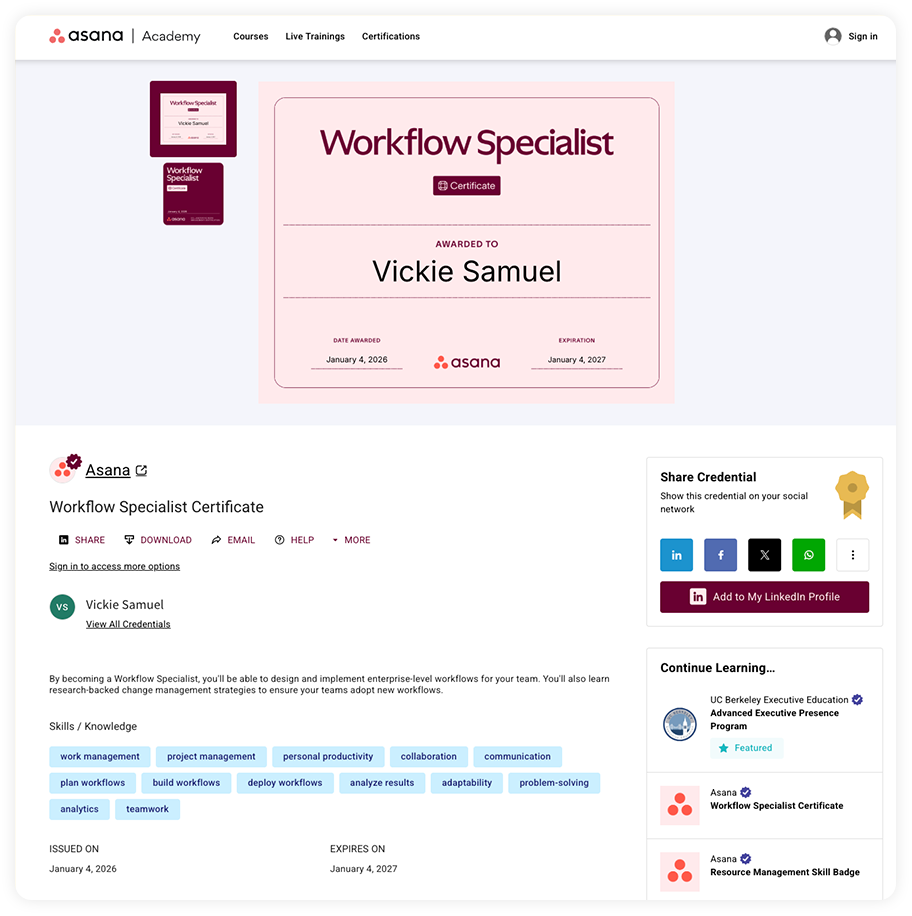
Just below the fold, learners are encouraged to share their credentials to LinkedIn, Facebook, X, or even WhatsApp. There’s also a button to quick-add their credential to their LinkedIn profile.
This frictionless sharing process led to a 62% credential-sharing rate on LinkedIn, contributing to Collaborative Work Management’s organic, learner-driven growth.
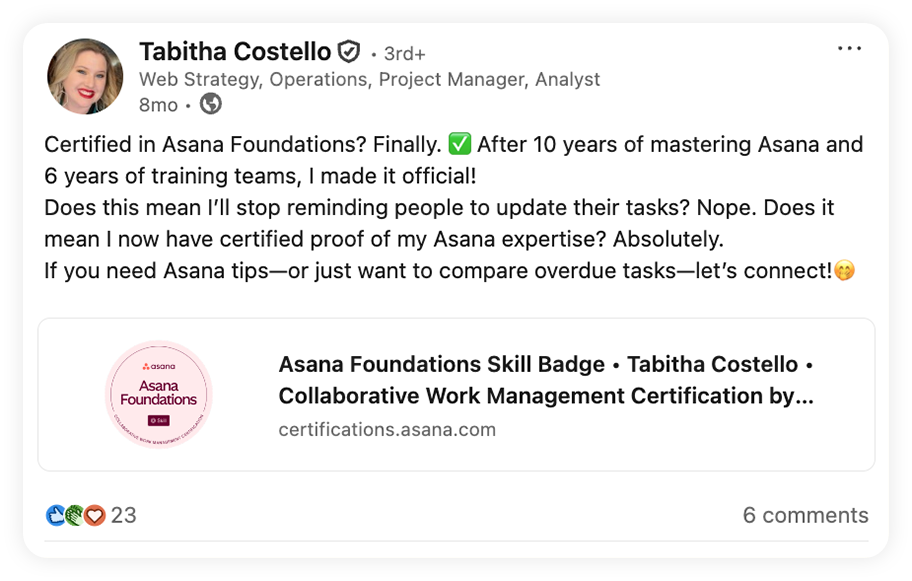
But the real virality came from TikTok.
“On a random Tuesday, I'm starting to get messages from people on our analytics team asking if something happened with Asana Academy. We’d gotten a ton of new users,” JJ recalls.
“Turns out a project manager advocated for our new certification on her TikTok, telling other project managers to check it out. We were able to attribute a significant portion of those new registrations to her post,” says JJ, proof that the strategic bet was working: give people credentials worth earning, and they’ll spread the word.
Executives were already bought into the idea of credentials. But to really scale the program, JJ knew that he’d have to prove that credentials were creating enterprise pipeline.
JJ had a partner on the marketing team who built an end-to-end campaign in Salesforce and Marketo to track and nurture participants after they registered for the program and got certified. “We set it up so we could see leads and ARR as a direct result of credentials, which was really exciting because ROI means a lot when you can put a dollar sign behind it,” says JJ.
There were a lot of dollar signs. Academy-sourced leads converted at 5–6x higher rates than other channels.
JJ and his team also worked with the product team to prove that credentials have a lasting impact on adoption. “There’s a bit of a selection bias, because people completing certifications are probably already high adopters. But we were able to show that the program is a retention tool; it maintains earners as active users,” JJ highlights.

Originally, JJ and his team set out to reach 10,000 learners. But in one year, they had over 60,000 completions.
And they did it without sacrificing quality. Customer satisfaction remained consistently high (mid-4s out of 5; 90% top-two-box), and credential engagement was equally strong: Asana achieved a 92% credential open rate and 91% share rate.
Collaborative Work Management isn’t just training Asana users; it’s multiplying them, and JJ’s team isn’t stopping here. In fact, they’re making certifications an even more integral part of Asana’s growth strategy — mapping new certifications to upcoming product releases and tying them directly to buyer and retention campaigns.
Ready to turn your program into a growth engine? Get in touch with one of our credentialing experts today.
Schedule a demo and discover how Accredible can help you attract and reward learners, visualize learning journeys, and grow your program.
Book a demo
Accredible is the world’s leading digital credential platform, enabling education and training leaders to increase learner engagement and drive program growth.


Accredible is the world’s leading digital credential platform, enabling education and training leaders to increase learner engagement and drive program growth.


