


In a tough employment market, Iowa State University (ISU) students are coming out on top — thanks to one of the most ambitious microcredentialing programs in higher ed.
Designed to help learners prove what they know and what they can do, the University’s learner-centered microcredentialing initiative is shaping students into more adaptable, confident, competitive job candidates, even as the world of work continues to evolve. And it’s clear this kind of differentiator is in high demand.
In the first year of its rollout, ISU issued 600 digital badges across more than 80 microcredentials through Accredible and was even highlighted as a way for students to “gain an edge in a skills-based workforce” in the school’s student newspaper, Iowa State Daily.
Rather than inventing something entirely new, Iowa State focused on bringing alignment and shared standards to credentialing efforts already underway across campus. With leadership support and cross-campus collaboration, the University moved to centralize and formalize those efforts, ensuring that every badge issued carried the weight of the Iowa State name, not just a digital graphic.
Digital badges issued across 80+ microcredentials
Credential share rate
LinkedIn share rate


At Iowa State, the concept of badging wasn’t new. Many departments wanted to issue them or had been issuing a version of credentials for years, but in a siloed, ad hoc kind of way. There wasn’t a defined standard for what those badges looked like or what they really meant.
In 2023, ISU’s Office of the Provost convened a task force to assess the appetite for microcredentials across campus. Microcredentials could allow students to explore, earn, and verify new skills through short, flexible educational programs.
There was so much interest that the University created a new role to lead the effort. Tanya Austin stepped into that position — now serving as Professional Learning & Micro-Credentials Program Specialist III — bringing firsthand experience from her time issuing badges as an Assistant Director in Business Career Services.
“In my previous role, I led a leadership program in the business career services center, and I saw firsthand the power and value of providing digital credentials and verified learning and skills to students, and their competitive nature of wanting to attain more, share more,” she explains.
But designing credentials that students, faculty, and employers would all see value in wasn’t going to be easy.
“It was our charge to create a more centralized approach to ensure we have a consistent user experience and that our credentials are of high quality,” Tanya points out. “Even though they come at no additional cost to students, when Iowa State’s name is on something, we have trust that we need to uphold.”
To get there, Tanya spent nine months getting to know the microcredentialing space — speaking with peers, working with organizations like UPCEA and AACRAO, and immersing herself in best practices for recognizing skills beyond the transcript, especially in non-credit settings.
“I was learning as much as I could and then funneling it down to what makes the most sense for us,” she shares. “We wanted to start small with something really great, versus trying to be everything to everybody.”
That started with finding the right technology partner. The platform had to support a credentialing framework that could evolve with in-demand skills, scale across the university, issue badges that stayed with students post-graduation, and uphold the ISU brand.
It wasn’t a short list of requirements. But in speaking with colleagues, Accredible kept coming up as a potential option. And in the University’s formal RFP process, Accredible stood out — not just in terms of functionality, but for its custom branding capabilities, analytics, and learner communication. Perhaps most important to the team, though, was the knowledge and support of Accredible’s staff.
“We didn’t know what we didn’t know,” she admits. “Having that partnership to help make sure we were thinking through everything appropriately and accurately was extremely, extremely helpful.”
Plus, Accredible could scale. “It was clear they had features that would help ISU expand their use of credentials, like an integration with Workday, SMS learner engagement, sophisticated Email Campaigns, and modular Pathways,” Tanya says. With the right partner in place, the team got to work.
Tanya knew she needed broad buy-in from faculty and staff if she wanted help evangelizing microcredentials across campus. So she assembled a microcredential work group with representation from each college on campus and asked members for feedback on the most important elements to include in the program.
The resounding theme was this: microcredentials can’t just be a badge for showing up.
“That was one of our guiding principles. We did not want to be in the game of providing recognition badges. At all,” she notes. “We needed to develop credentials for skills that employers are actually looking for, and they needed to come with verification artifacts to maintain the trust employers have in the ISU brand, even if the student doesn’t obtain them through credit-bearing curriculum.”
That meant adding clear metadata (think: skills and knowledge, earning criteria, issue and expiration dates) and real assessments to every badge. As she puts it, “People need to know what a learner did, how they were tested, and what they accomplished.”
To guarantee every new microcredential hits that high bar, the team created a credentialing framework with seven institutional quality standards.
Today, that review committee evaluates every request for a new badge against these criteria to ensure it aligns with current workforce needs, reflects what students are learning in and out of the classroom, and carries real weight.
As Tanya and her team started to formalize her credentialing framework, they realized that, without connecting more tactical skills (such as goal-setting, interviewing, proficiency in specific technology) to larger career goals (such as being an effective communicator or critical thinker, launching scientific research, having a more global perspective as a leader), it would be too easy for learners to earn one badge, then stop.
“We wanted to keep learners engaged and motivated, not make this a one-and-done program,” Tanya says.
Accredible’s Pathways feature let them create visual connections between different credentials and what they could lead to professionally. To date, ISU has built eleven Pathways that follow a knowledge → proficiency → mastery progression, with required and optional components to balance structure with learner choice.
“Some learners don’t want to learn everything about a particular topic,” she explains. “Because they’re pursuing certain roles or have personal professional interests, they can pick and choose. And because they have that agency, they’re more engaged.”

ISU’s Pathways serve as built-in roadmaps, showing learners where they could go next, while rewarding them for what they’ve already accomplished.
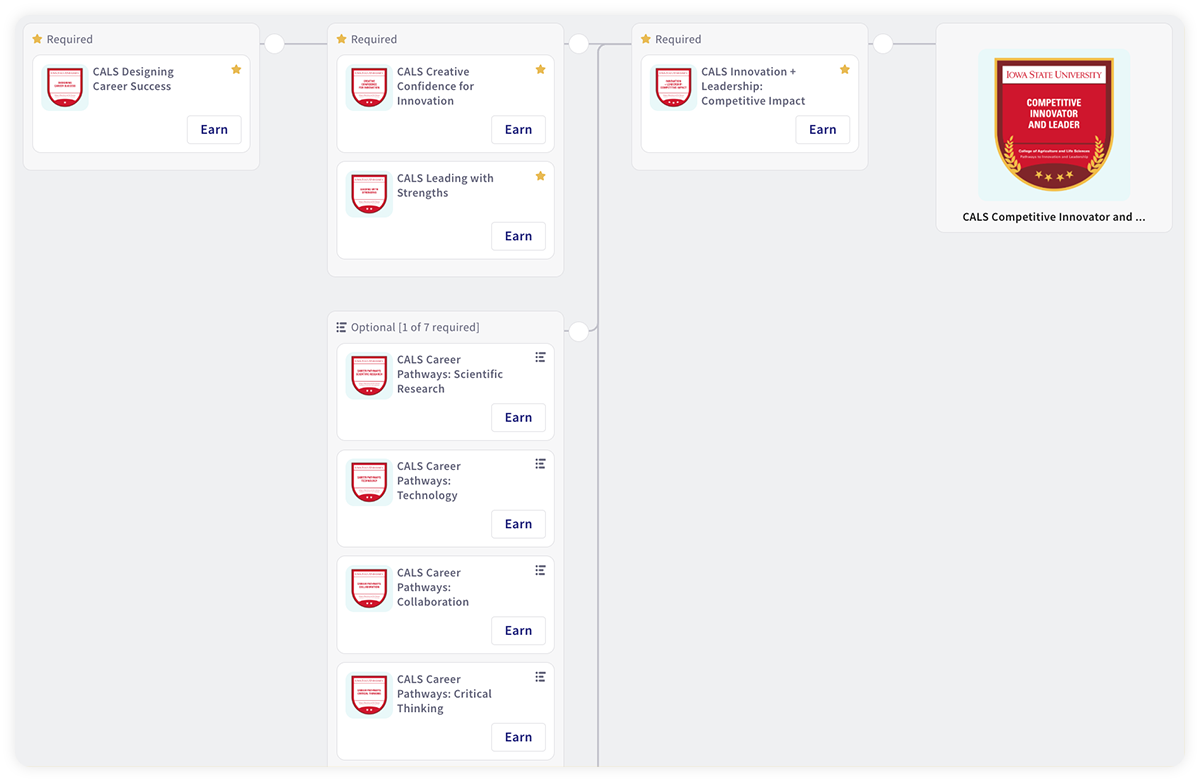
“When I see a path in front of me, it keeps me on task, right? So it’s pushing these learners to ask themselves, ‘If I earn more, what could that get me?’ and shows them how to get there,” Tanya says.
Pathways was a great start to getting students excited about badges. But the credentials had to have the right look and feel and be super easy to share if they were going to gain traction.
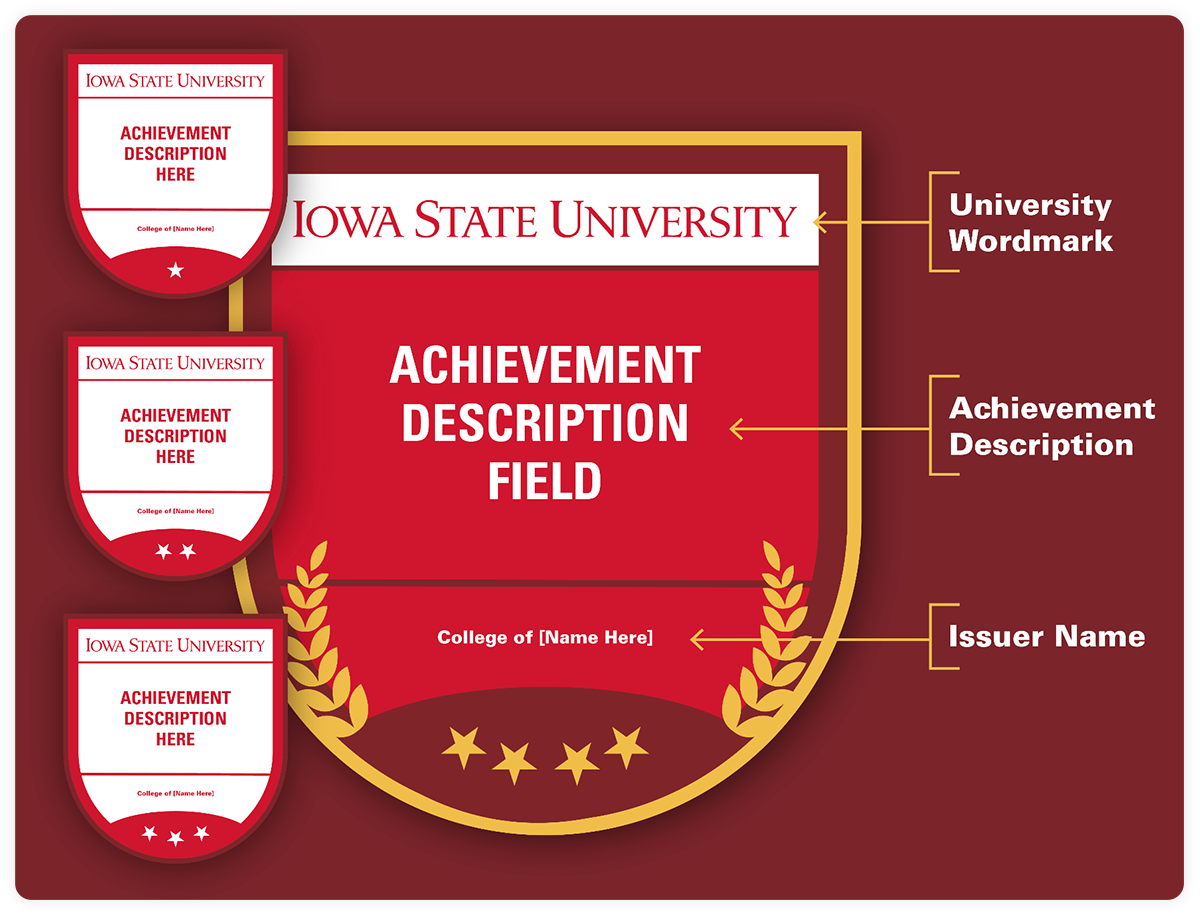
Working with her design counterparts, Tanya and team came up with a program identity that was visually consistent with the ISU brand.
“It had to feel like Iowa State — not a third-party tool. Accredible lets us keep our design standards and institutional branding, while adding all the metadata that makes our credentials meaningful,” Tanya says. “When an employer sees our badges, they know it’s a verified, high-quality microcredential.”
Using Accredible’s whitelabeling feature, they extended that brand identity across the institution’s entire credential landscape, from the University’s Microcredential Program page to its library of credential offerings, down to the individual credential landing pages.
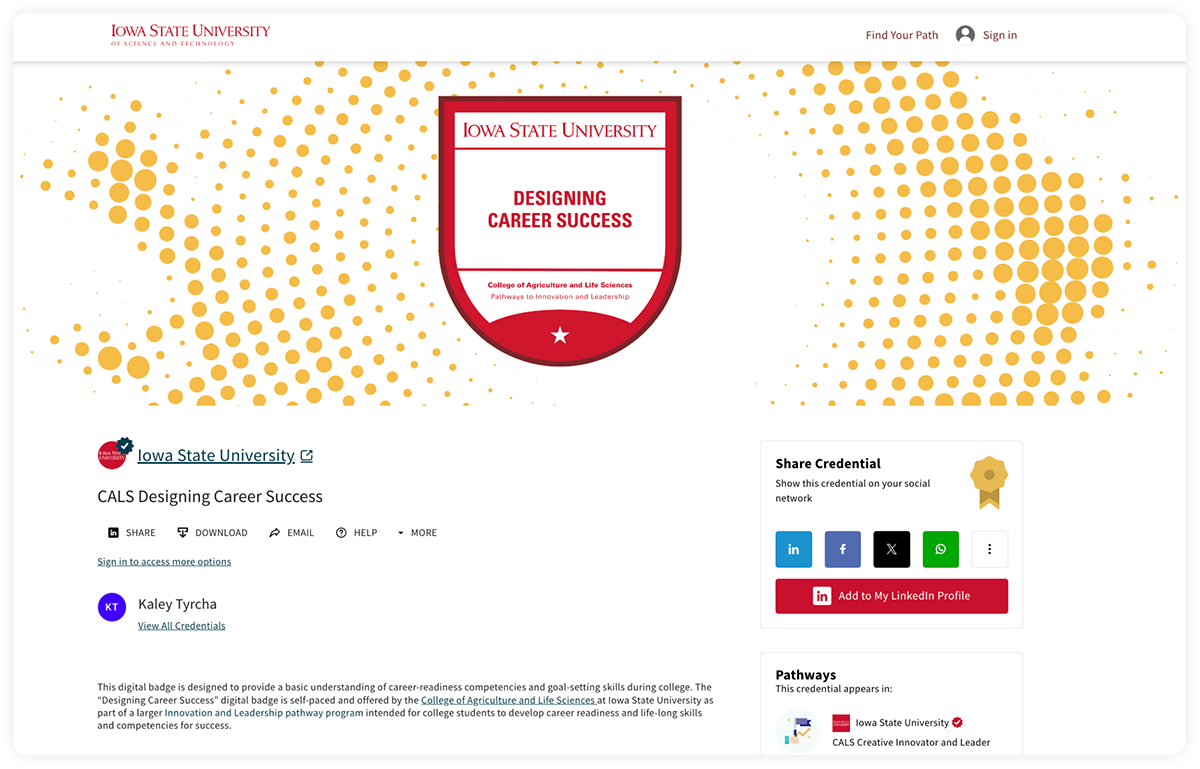
Tanya’s team then set up Accredible’s Email Campaigns to automatically deliver personalized messages to each badge earner, congratulating them on their achievement and explaining how to add their credential to their LinkedIn profile with Accredible’s one-click add feature. If the learner didn’t open their badge within a week, they received a follow-up reminder.
Those little nudges made a big difference. Though it’s still early days for ISU, they’ve already hit an 85% credential engagement rate and 75% LinkedIn share rate.
“Students are proud of their credentials. They want their peers to know about their badges, they want hiring managers to know about their badges,” Tanya highlights.
For one student, Katrina Hageman, being able to share microcredentials on LinkedIn was a driving force in getting new badges.
“LinkedIn is a tool I highly value as a college student. Gaining digital badges to display on my LinkedIn profile and résumé is what motivated me to pursue the Pathways workshops. It’s not just a badge, it’s the work you put into earning it that stands out.”
ISU’s hard work has paid off big time. In just one year, the University issued over 600 badges to undergraduate, graduate, and professional learners, building momentum and informing their future credential marketing strategy.
“Accredible’s analytics are phenomenal. I can see how many credentials we’ve issued, which platforms learners are sharing on, and which badges drive the most activity. That’s critical because now I know where students are finding out about credentials and can put more effort into those channels.”
But the real ROI is in connecting those KPIs to outcomes data. How badges affect the internships students secure, where and how often they are hired, and how they manage career pivots — that’s what will underscore their value to ISU long-term.
“Helping students stand out and gain confidence as they search for internships and post-grad work is what this program is all about,” she emphasizes. “We’re really excited to show that a degree and a collection of digital badges that tell a story about students’ interests or career aspirations is what really differentiates our learners.”
ISU is building a credentialing program that really matters to students and to employers. If you’re looking for ways to give your students a competitive edge, get in touch to see how Accredible can help you do the same.
Schedule a demo and discover how Accredible can help you attract and reward learners, visualize learning journeys, and grow your program.
Book a demo
Accredible is the world’s leading digital credential platform, enabling education and training leaders to increase learner engagement and drive program growth.


Accredible is the world’s leading digital credential platform, enabling education and training leaders to increase learner engagement and drive program growth.


