

.webp)
A practical guide for academic innovation, continuing education, and credentialing teams building programs that drive enrollment, engagement, and proof of impact.
Why we wrote this guide
Higher education institutions have issued credentials for centuries. What’s changed is what a credential is expected to do. Today’s students want to share what they’ve earned the moment they earn it. Employers want to verify it in seconds, not weeks. And the institutions issuing credentials are under more pressure than ever to prove that their programs are working, to students, to leadership, and to the funders and boards who approve next year's budget.
This guide covers what digital credentials are, the specific challenges higher education institutions face around issuing and managing them, and how a purpose-built credentialing platform changes what's possible, from instant verification to structured learning pathways to re-engaging your certified community long after they've graduated.
Use this guide to:
Who this guide is for
This guide is written for academic innovation leads, continuing education directors, registrars, and credentialing program managers at colleges and universities: anyone responsible for how their institution issues, manages, and gets value from academic credentials, badges, and transcripts.
If you’re evaluating whether to move from paper or PDF credentials to a digital platform, or you already have a digital credentialing tool and want to know what a purpose-built platform adds, this guide will help you build the case internally and ask the right questions of any vendor you evaluate.
For most of higher education’s history, a credential has been the conclusion of a process: a student completes a degree or program, receives a certificate, and the institution’s job is done. That model still describes how a lot of programs operate. It also explains why so many institutions have no idea what happens to a credential after it’s issued.
A growing number of institutions are rethinking that model. Instead of treating a credential as a receipt, they treat it as the start of an ongoing relationship, one that drives visibility for the program, engagement from the student, and a referral loop back into enrollment
Colleges and universities issue more types of credentials than most other sectors: degrees, microcredentials, continuing education certificates, professional development badges, executive education certificates, conference and event recognition, and increasingly, stackable credentials that build toward a larger qualification.
The traditional model is a physical certificate handed to a graduate at commencement, or mailed afterward. Graduates keep it for personal records and reference it on resumes, but it rarely does anything beyond that. As more institutions add continuing education, microcredential, and professional certificate programs alongside traditional degrees, the limitations of that model (one certificate, one moment, no follow-up) become harder to ignore.
Three challenges come up consistently across institutions, regardless of size or program type: verifying credentials without manual effort, giving students and graduates a better experience requesting and using their records, and proving that credentialing investment is actually working.
Employers, background check companies, and other institutions routinely contact registrars and credentialing offices directly to confirm that someone actually graduated or holds a certification. Each request means staff time spent searching records, confirming identity, and replying, often by phone or email, with no audit trail and no way to scale during peak hiring seasons.
“We issue thousands of credentials, but we can’t tell you if anyone uses them.”
— University of South Carolina
Transcripts and certificates are still commonly requested by phone, email, or in-person visits to a registrar’s office. Requests get delayed, documents get lost, and the same verification gets repeated every time a new employer or institution asks for proof. This creates frustration on both sides: graduates wait longer than they should, and credentialing staff face a steady stream of repetitive manual requests that pull them away from higher-value work.
Few institutions can answer a simple question: are students actually opening, sharing, or using the credentials we issue? Without that data, it’s difficult to justify continued investment in a credentialing platform, to show a provost or board that a microcredential program is driving enrollment, or to demonstrate to accreditors and employers that a program’s outcomes are real and visible.
“It sounds cool, but what are we actually getting from it besides a nicer PDF?”
— Foundation for Economic Education
Credential fraud is real — diploma mills, falsified transcripts, and fabricated certifications all cause genuine harm to institutional reputation and to the employers who rely on a credential being accurate. But for most institutions, the bigger day-to-day problem isn’t fraud itself. It’s the time cost of manual verification, and the absence of a fast, self-serve way for employers and other institutions to confirm a credential is real.
Digital credentials solve both. A verified digital credential lives on a dedicated, secure page that can be checked in seconds, no phone call to the registrar required. For institutions that want an additional layer of tamper-proofing, credentials can be written to the blockchain, making them provably unalterable. Open Badges 3.0 and W3C Verifiable Credentials support also means credentials issued through Accredible are portable and interoperable with the broader credentialing ecosystem, not locked into a single platform’s format.
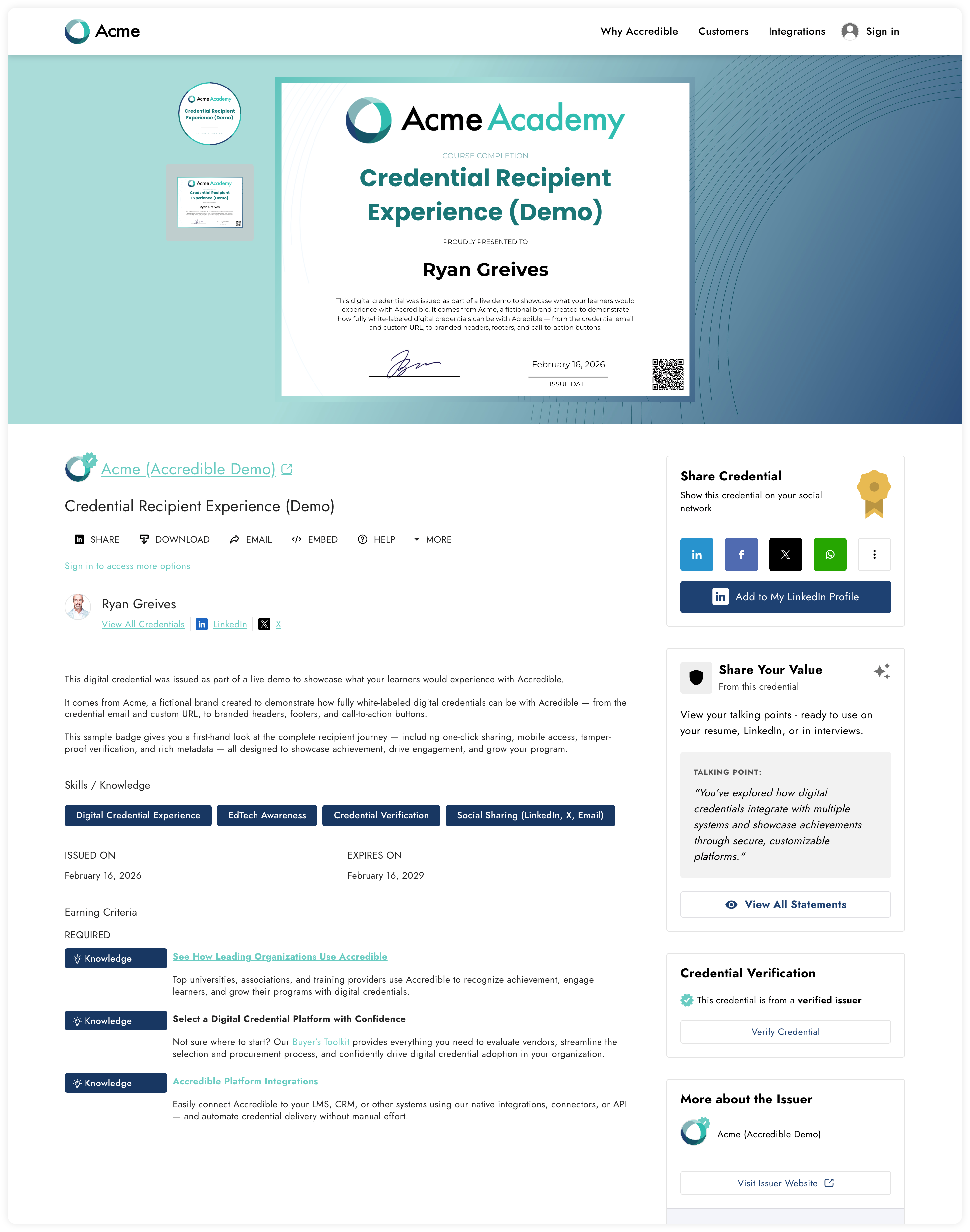
With a digital credential, verification happens on a dedicated, publicly accessible credential page. An employer, background check company, or hiring manager can confirm a credential is genuine in seconds, with no need to call or email your registrar’s office. Expired or revoked credentials display an automatic banner showing they’re no longer valid, so there’s never ambiguity about current status.
Yes. Credentials can be issued as verifiable credentials secured to the blockchain, which makes them impossible to edit, falsify, or reproduce without detection. If someone attempts to copy or alter a blockchain-secured credential, it simply won’t verify against the blockchain record. This is particularly relevant for high-stakes credentials: degrees, licensure-adjacent certifications, and anything tied to professional eligibility.
How does Accredible support credential verification for higher education?
Accredible gives every credential a dedicated, instantly verifiable page, removing the need for employers or other institutions to contact your office directly. Accredible enables institutions to:
A diploma or certificate is rarely the only document a graduate needs. Transcripts, exam results, and supporting records are requested constantly, for further study, for licensure, for employer verification, and the manual process behind most of those requests hasn’t changed in decades: a form, a wait, sometimes a fee, and a PDF or sealed envelope days or weeks later.
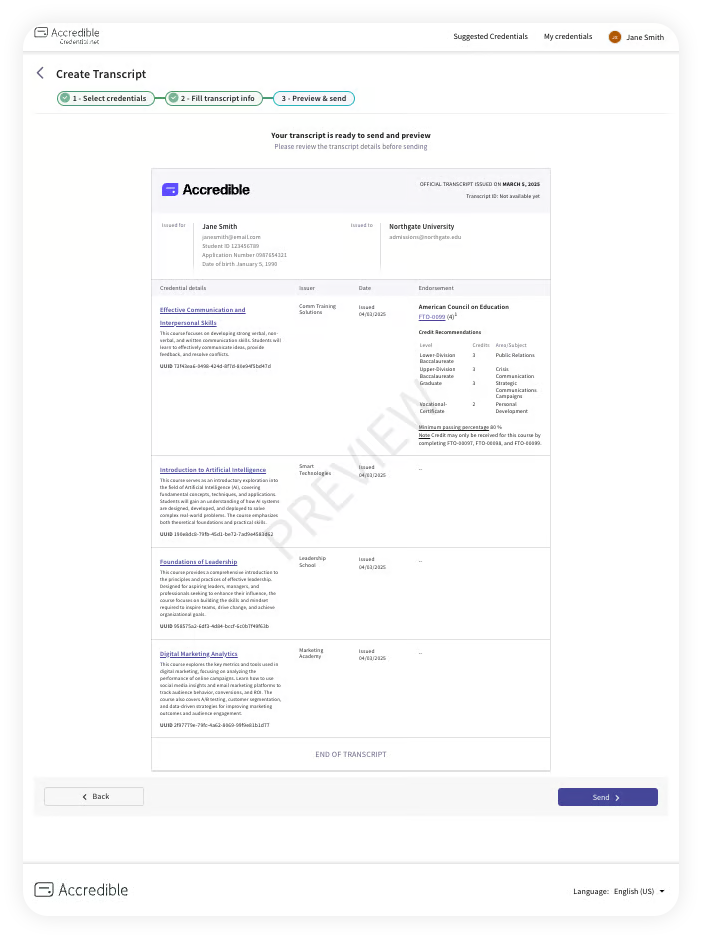
Digital credential transcripts give institutions a structured, verifiable, and instantly shareable record of everything a student has earned: degrees, microcredentials, continuing education certificates, and more, in one place. Rather than requesting a new transcript every time a third party asks, a student can share a single, always-current, independently verifiable link. For institutions on Connect and Growth plans, transcript letters can be generated automatically using stored student attributes, removing the manual drafting work that previously fell on registrar staff.
A digital diploma or certificate confirms a single achievement: a degree, a course, a certification. A digital transcript is the comprehensive record: every credential a student has earned through an institution, contextualized and verifiable as a complete academic history. Institutions increasingly need both: individual credentials for sharing and motivation, and a consolidated transcript for credit transfer, licensure, and employer due diligence.
Yes. Once a transcript record exists on a digital credentialing platform, students can access and share it on demand, with no new request, no waiting on staff availability, no risk of a lost or delayed document. This also reduces the volume of routine, repetitive requests landing on registrar and credentialing staff. This applies equally to the verification of degrees: rather than routing every employer inquiry through the registrar, the credential itself is the verification, available on demand.
How does Accredible support digital transcripts in higher education?
Accredible lets institutions issue comprehensive, verifiable digital transcripts that consolidate every credential a student has earned, shareable by the student and verifiable by anyone, without a new request to the registrar. Accredible enables organizations to:
Beyond verification and records, digital credentials change what a graduate can actually do with what they’ve earned. Recipients access their credentials online at any time, without creating a new account. They can share to LinkedIn, Facebook, or X, embed a credential in an email signature or personal website, and add it to a smartphone wallet for on-the-go access — useful for showing proof of eligibility on a job site or in an interview, without digging through a credential email buried in an inbox.
None of this requires the recipient to manage a password, remember a login, or wait on an institution to respond. The credential is theirs, accessible whenever they need it.
Authentic marketing, genuine recommendations and word-of-mouth, not paid promotion, is consistently the hardest kind of marketing to manufacture. Digital credentials make it possible without trying. When a student earns and shares a credential, they’re doing so because they’re proud of it, not because they were asked to advertise. That moment of genuine pride is what drives visibility for a program far beyond what a paid campaign typically achieves.
“People don’t look to the company to see that a product is good, they look to the customers to see that a product is good. There is no better sign of validation than a past student proudly showcasing their certificate on LinkedIn.”
— Paulina Karpis, brunchwork Co-Founder
Institutions can support this moment with a call-to-action built into the credential delivery email, directing recipients to add a credential to LinkedIn or share it to a specific platform, without making sharing a requirement. The decision to share has to stay with the student for it to read as authentic.
Most institutions have already moved away from purely physical credentials, even if only to a PDF. But a PDF is a digital file, not a digital credential. It carries none of the verification, sharing, or analytics capability that a true credentialing platform provides. The table below breaks down where each format stands on the dimensions that matter most to credentialing teams.
Digital credentials aren’t limited to replacing a PDF or printed certificate. Badges represent microcredentials and stackable achievements as students progress toward a larger award. Certificates recognize course or program completion. Membership and event credentials cover conference attendance, volunteer recognition, and community affiliation. A single digital credentialing platform can support all of these credential types without requiring a separate tool for each.
Before comparing platforms, it helps to define what the credentialing program needs to accomplish. The right features follow from the goal, not the other way around:
With that strategy defined, the platform decision comes down to five factors that determine whether a credentialing program will scale cleanly or create new operational burden:
Your institution’s brand should be the only one a graduate sees throughout the credential experience: the URL, the email, the credential page, the directory. A platform that co-brands the experience, or pushes its own logo and marketplace in front of your students, is building visibility for itself, not for you. Full white-labeling, including a custom domain, should be available without engineering resources from your team.
Requiring a recipient to create an account before they can claim or share a credential measurably suppresses sharing. Baymard Institute research puts task abandonment at account creation at 34%. Look for one-click acceptance and sharing that doesn’t put a login wall between a student and the credential they just earned.
Most institutions run a Canvas, Moodle, Brightspace, or similar LMS, alongside a SIS, and often a CRM. The credentialing platform should sit downstream of all of them, issuing automatically when a course, exam, or program milestone is completed, without requiring your IT team to build and maintain the connection. Ask any vendor for proof of a native integration with your specific systems, not just a general claim of broad compatibility.
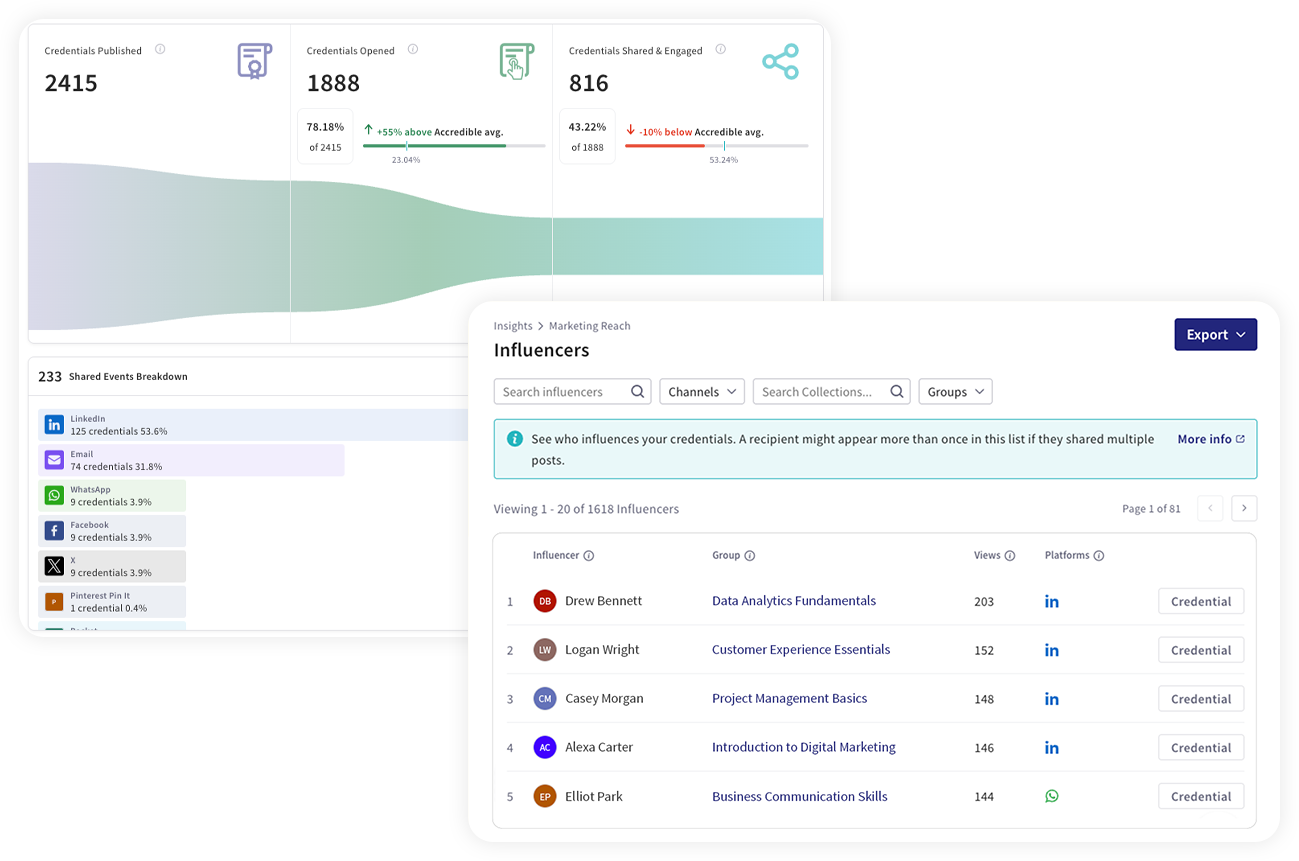
Knowing how many credentials were issued tells you almost nothing about whether the program is working. Look for analytics that show opens, shares, the platforms that credentials are shared to, referral traffic back to your program, and, ideally, enrollment or re-enrollment attributable to credential sharing. This is the data that turns a credentialing program from a cost center into something you can defend to a provost or board.
Rolling out credentialing across multiple departments, schools, or a university-wide initiative is a governance project as much as a technical one. Look for a vendor that offers structured onboarding, a dedicated point of contact, and, for larger or multi-department rollouts, professional services support to help build a credential taxonomy and governance framework before launch, not after problems surface.
How does Accredible support higher education institutions evaluating a credentialing platform?
Accredible is built specifically for institutions that need full brand control, friction-free sharing, native LMS integration, and analytics that go beyond issuance counts. Accredible enables institutions to:
Engagement doesn’t end at issuance — it starts well before, in how a program is structured to keep learners motivated through completion. For institutions using microcredentials and skill badges to structure their programs, gamification is the mechanism that keeps learners moving from one credential to the next. Gamification adds game-like elements to coursework: leaderboards, milestone badges, and incremental rewards that give learners a reason to keep going rather than waiting months for a single credential at the end.
Research backs this up. A 2020 ScienceDirect study found challenge-based gamification led to a 34% increase in student performance, with students who received challenge-based gamification outperforming lecture-only peers by 89.45%. Badge-based learning structures give learners a visible and portable record of progress at every milestone, turning each completed module into a shareable achievement rather than an internal record only the LMS can see.
When learners earn digital badges at each stage of a program, they build a visible, shareable portfolio of progress rather than a single end-of-course certificate. Tiered badge architecture lets institutions build progressive levels, typically structured as 100, 200, and 300-level badges, so learners unlock the next stage only once they’ve completed the prerequisite. Great Books Foundation used this structure to build a clear progression for K-12 teacher professional development, giving each level its own recognizable badge and earning criteria.
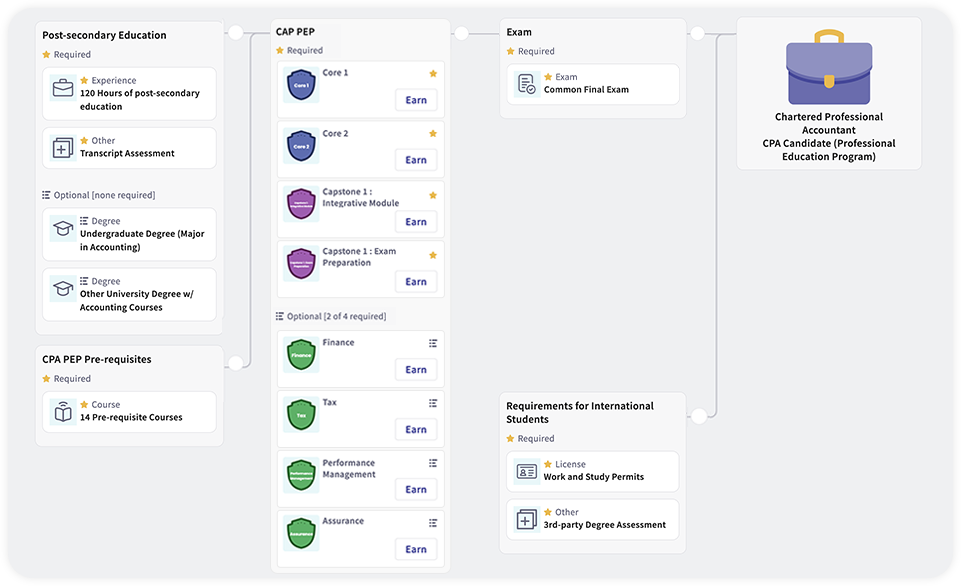
Pathways let institutions design structured learning journeys that combine mandatory and optional modules, option-pool requirements (complete any of A, B, or C), and a final completion credential. Pathways automatically calculate and display learner progress, so students always know what they’ve completed and what comes next, and institutions can track enrollment, completion, and drop-off in real time. Iowa State built 11 Pathways into their microcredential program, while Maven Analytics built 10.
Any badge or certificate issued through a digital credentialing platform can include a one-click LinkedIn add option, embedded directly in the credential delivery email or the credential’s dedicated page. Some institutions go further and include a sample LinkedIn post in the delivery email itself, prompting recipients with ready-to-use language, a tactic Gies College of Business uses to encourage sharing among its stackable credential earners.
Over 80% of the world’s population uses a smartphone, and most carry it everywhere. Digital wallet cards let recipients add credentials directly to Apple Wallet or Google Wallet, available instantly for on-site eligibility checks or interview verification, with no searching through old emails or bookmarked links.
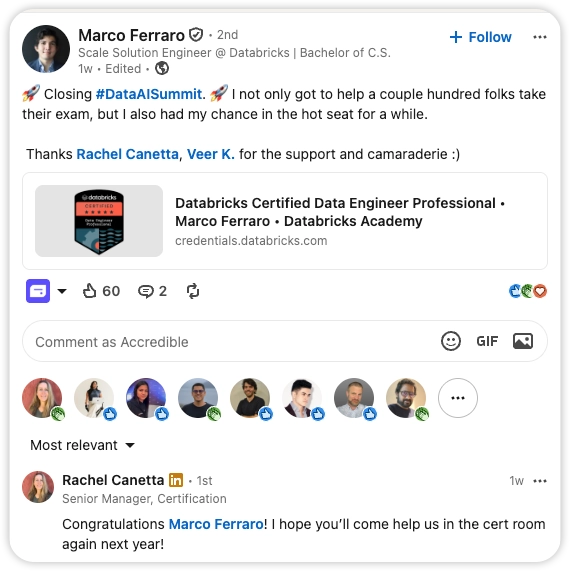
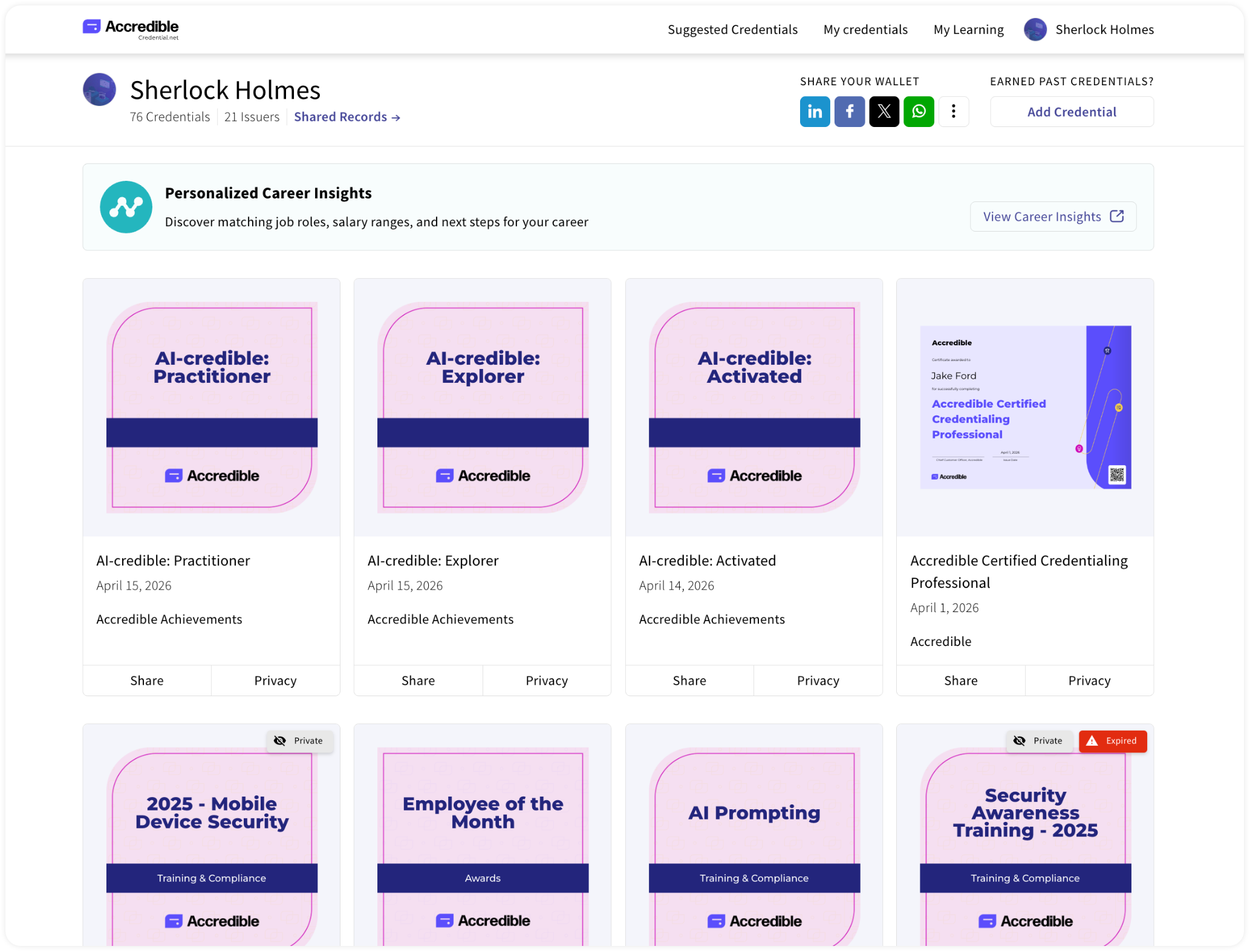
Once a learner meets a credential’s criteria, it should reach them immediately, not days later. Real-time, automated issuance means a credential arrives the moment it’s earned, while motivation is highest. From there, sharing should take one click: to LinkedIn, to a personal website, to an email signature, or to any of more than 40 supported social platforms, including TikTok, Instagram, and Bluesky alongside the more established LinkedIn and Facebook. For many learners, LinkedIn badges are the most visible signal of professional progress. A credential on a LinkedIn profile is seen by recruiters, managers, and peers in a way a certificate in a drawer never can be.
“A project manager advocated for our new certification on her TikTok, telling other project managers to check it out. We were able to attribute a significant portion of those new registrations to her post.”
— JJ Janikis, Head of Customer Education, Asana
Continuing education and professional certification programs rarely issue a credential once and walk away. Licenses lapse, certifications expire, and professionals need to retake training or accumulate continuing education units (CEUs) to stay compliant with licensing boards.
For many professional certification programs, compliance isn’t a single expiration date, it’s an ongoing accumulation of continuing education units (CEUs) earned across multiple activities, courses, or events. Each completed activity can be issued as a discrete credential carrying its own CEU value, giving professionals a verifiable, portable record of their accumulated hours rather than a self-reported log.
Managing that lifecycle manually (tracking who’s due for renewal, chasing expired certifications, fielding compliance audits) is one of the most time-consuming parts of running a credentialing program at scale.
Each activity, course, or training event in a CEU program can be issued as a separate digital credential carrying its own unit value. Because each credential is verifiable and tied to the issuing institution, professionals build a portfolio of documented, independently verifiable CEU credits rather than relying on self-reporting logs or a single platform’s internal record.
Expiration dates set at issuance ensure that older credits lapse automatically when they fall outside a compliance window, and renewal reminders prompt holders to recertify before a deadline is missed. For credentialing teams, this means compliance status is trackable in real time across the entire certified community, without manual spreadsheet reconciliation.
Automated renewal reminders can be set to trigger ahead of an expiration date, prompting the credential holder to recertify, retake required training, or submit continuing education evidence before their credential lapses. IISE uses this approach across its professional certifications, pairing renewal reminders with multi-tiered Pathways for recertification.
Credential analytics and dynamic record updates give credentialing teams a real-time, exportable view of who holds a valid credential, who’s approaching expiration, and who has lapsed: the foundation for compliance reporting without manually cross-referencing spreadsheets. For institutions running professional certification alongside academic programs, this same infrastructure supports both audiences from one system.
Credentials can be individually or batch-updated by the issuer at any time, including revocation. Once revoked, the credential’s public page reflects that status immediately, so anyone checking it sees accurate, current information rather than an outdated record.
Most institutions treat graduation as the end of the relationship with a credential holder. That's a missed opportunity. A certified community is one of the most credible marketing channels an institution has, and re-engaging it well drives both program visibility and re-enrollment into advanced courses or stackable credentials.
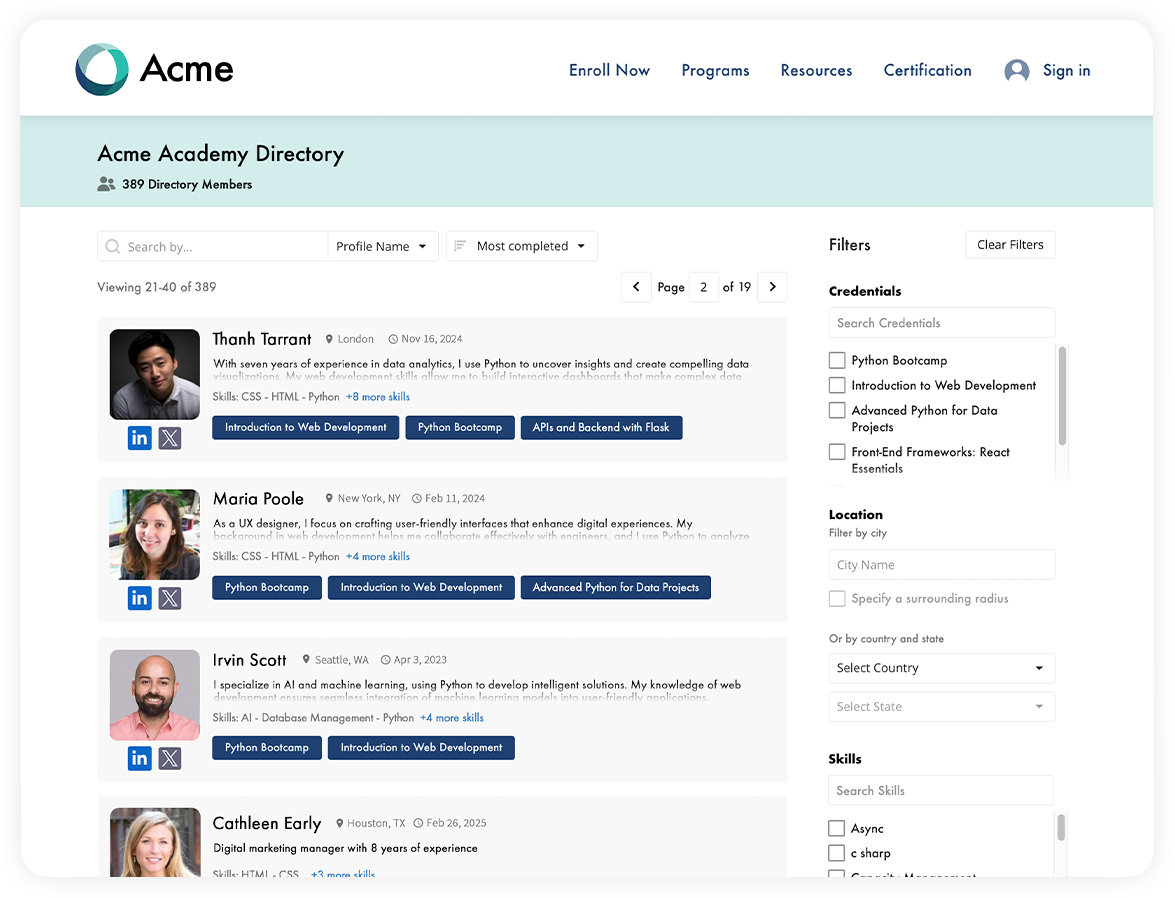
A Spotlight Directory gives an institution a branded, searchable hub where employers and prospective students can find and verify everyone who holds a given credential. Recipients can opt in, build out a profile with their employment history and credentials, and indicate they’re open to opportunities. For the institution, this turns what used to be a static list of graduates into a living, public demonstration of program outcomes, and a discovery surface that brings new employer relationships to the program.
Recommendations let institutions surface relevant next courses directly on a credential page and at the top of a learner’s course discovery feed, right at the moment a graduate is feeling proud of what they've just earned. MIT Professional Education used this approach to lift re-enrollment from 35% to over 50%. Automated email campaigns reinforce the same idea after issuance: a congratulations message, followed by a structured nudge toward the next credential in a pathway, rather than a single one-and-done email.
Because credentials carry metadata (skills, levels, completion dates, and earning criteria), institutions can segment their certified community precisely: everyone who holds a 200-level badge but hasn’t progressed to 300-level, everyone whose certification expires in the next quarter, everyone in a specific Pathway who hasn’t completed the next milestone. That segmentation is what makes targeted advanced-course promotion possible instead of a single blanket email to every graduate.
The mechanism is the same one driving authentic marketing throughout this guide: a graduate who shares a credential they’re proud of is doing far more for program visibility than any paid campaign. Job Market Insights adds another layer, showing graduates the roles, employers, and salary ranges connected to their credentials, which reinforces the credential’s value at the exact moment they’re deciding whether to share it.
“One person posts their badge, and we get three more signups. That’s the ripple effect we want.”
— CypherWorx
A credential is often the most visible, most shared piece of content an institution’s continuing education or microcredential program ever produces, which makes its design more important than it might first appear. A certificate that looks generic, or worse, carries a third-party vendor’s branding, undercuts the professionalism of the program it represents.
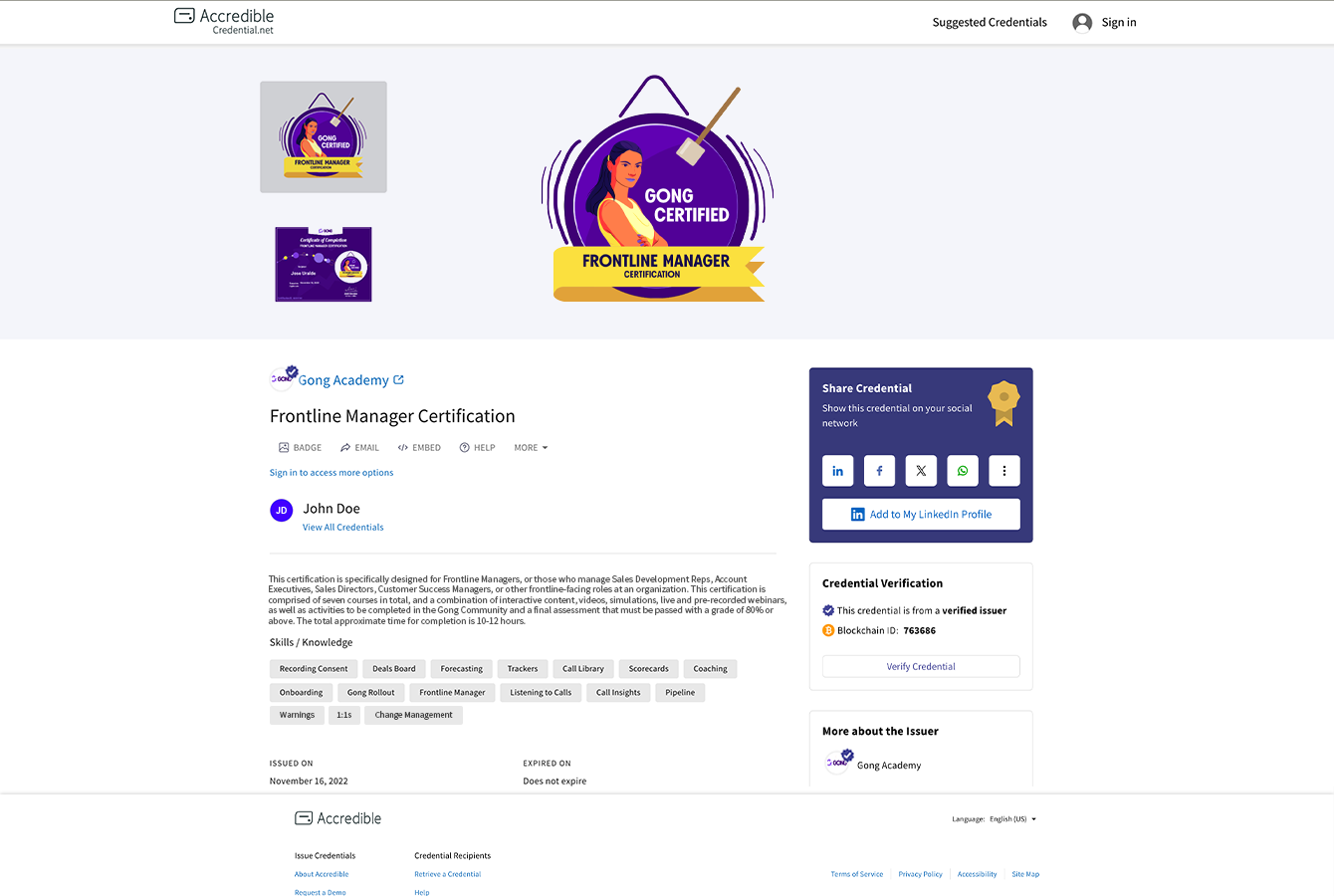
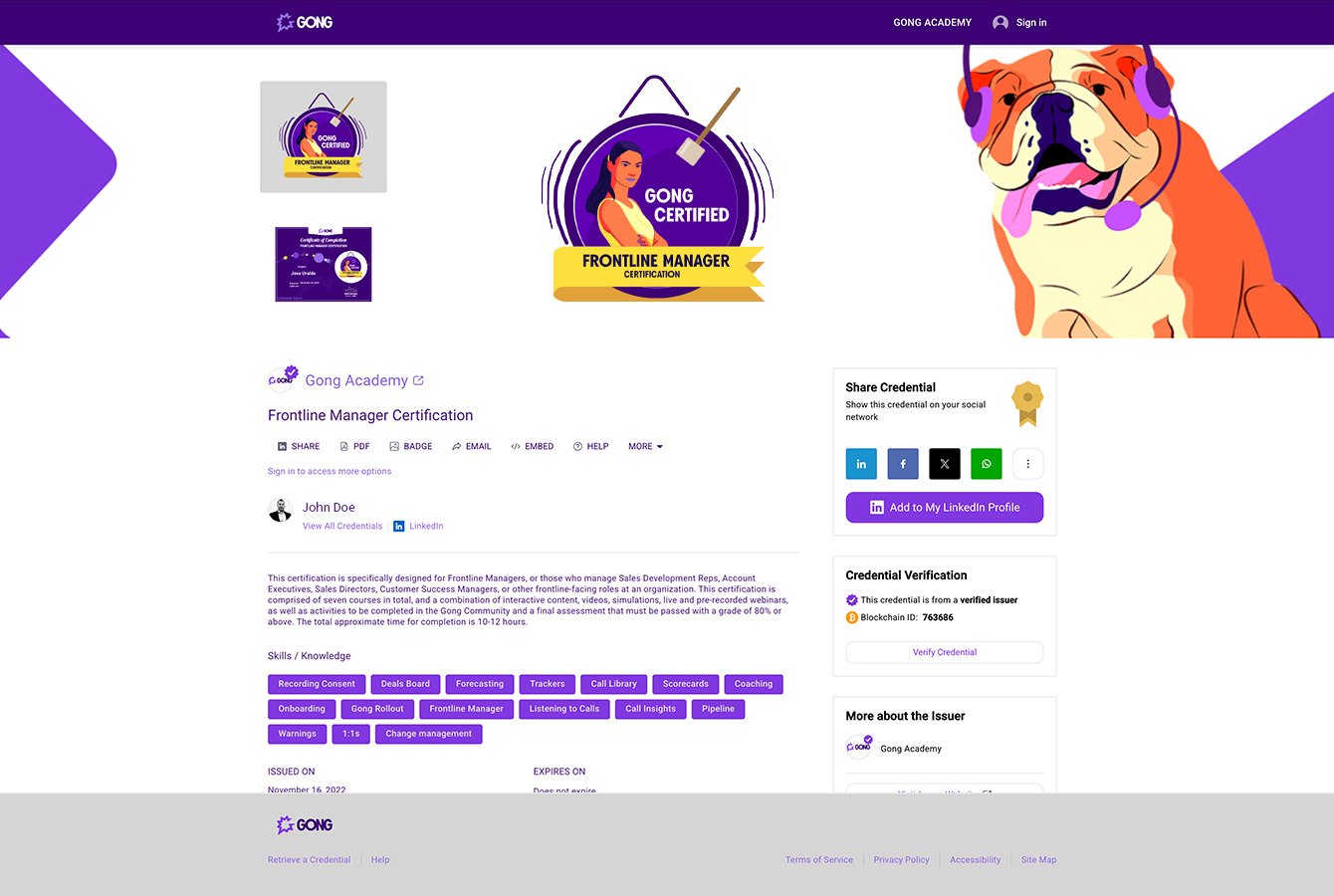
A drag-and-drop certificate and badge designer lets credentialing teams build polished, on-brand designs without design or development resources, using ready-made templates or uploading existing institutional branding. Frogames uses this to create and launch a new certification in around four minutes, end to end.
Badges built with proper metadata (earning criteria, skills demonstrated, issuing date) read as more credible than a generic graphic, both to the recipient sharing it and anyone viewing it on LinkedIn. Pairing a clean, branded design with that underlying metadata is what separates a credential that builds program reputation from one that just looks decorative.
White-labeling extends this further: a custom URL, a fully branded credential page, and white-labeled delivery emails ensure every part of the experience reflects the issuing institution, not a third-party platform.
“What stood out about Accredible was its automation features. Automatically awarding credentials is a game-changer for us.”
— Amanda Brantner, Senior Director of Content and Educational Portfolio Strategy, Gies College of Business
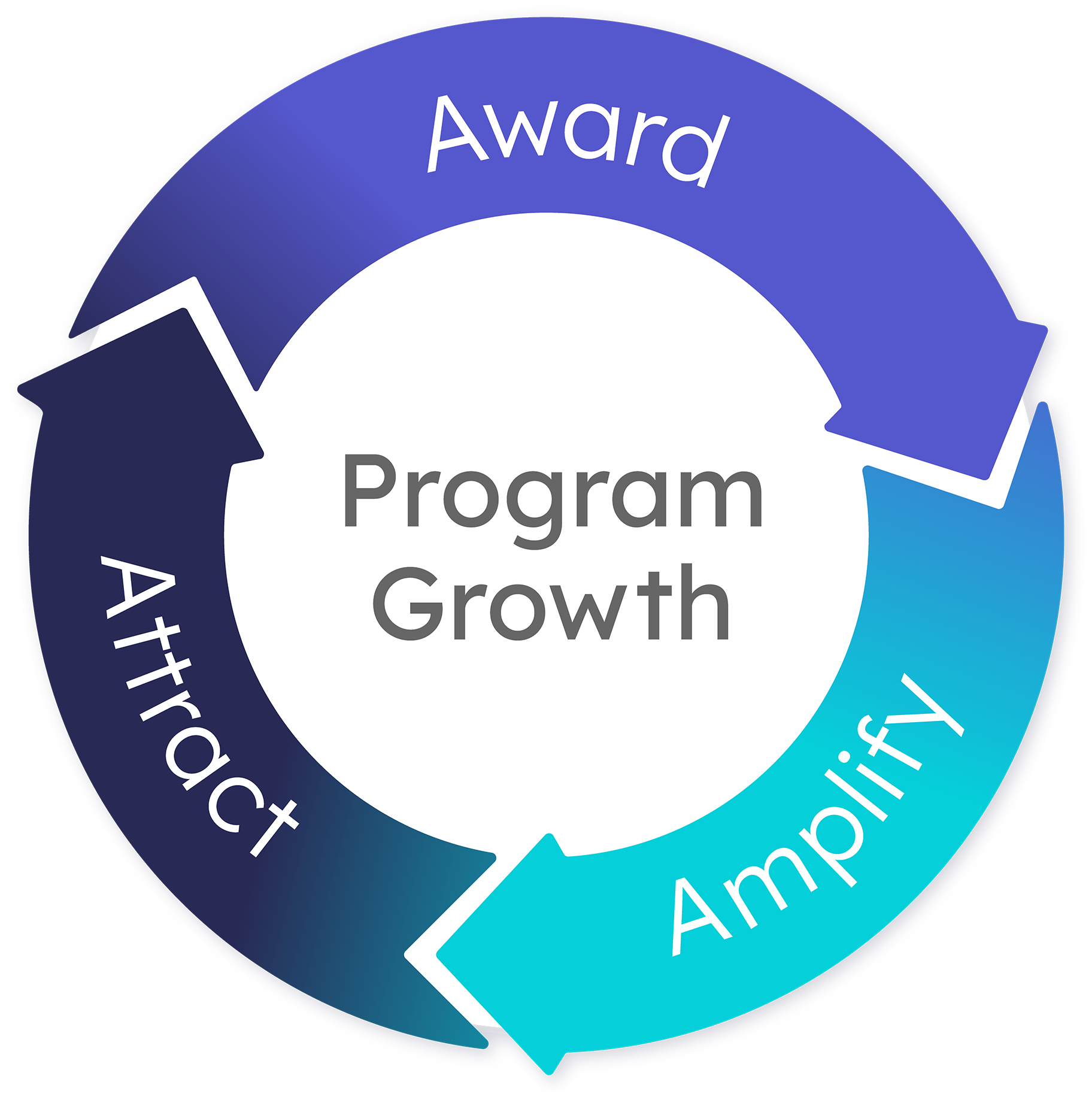
Digital credentials aren’t only an operational upgrade. For institutions running continuing education, microcredential, or executive education programs on a per-course or per-cohort basis, they’re a direct lever on enrollment and revenue. Digital credentialing has shifted from an administrative function to a program growth strategy, and the institutions seeing the biggest enrollment gains are the ones treating every credential as a referral opportunity, not just a completion record.
Learning pathways let institutions package related courses into a structured, visible journey — linear or nonlinear — so learners can see exactly what a full pathway includes and what they’ve completed toward it. Links to the next credential in a series, placed directly on the credential page and in the delivery email, turn course completion into a natural prompt to enroll in the next one.
“With Accredible, we have the ability to create completely custom learning plans based on a learner’s specific goals and objectives. That keeps people on the platform because it’s not just one-and-done; it’s an entire learning journey.”
— Chris Dutton, Founder & CPO, Maven Analytics
The data backs up what this looks like at scale. Gies College of Business has issued roughly 42,000 digital credentials since 2020, with 62% of learners earning more than one credential and engagement up 48% since 2022. MIT Professional Education lifted re-enrollment from 35% to over 50% after introducing Recommendations alongside its existing credential program.
Rolling out a credentialing platform across multiple departments or university-wide is rarely just a software decision. It touches IT, registrar processes, departmental autonomy, and institutional branding standards all at once. Syracuse University addressed this directly by building a university-wide digital badging council and a 24-page governance document before scaling credentialing across the Maxwell School, Whitman School of Management, Newhouse School, and other units. The result: new badges can now be created in days instead of weeks, with consistent standards applied campus-wide.
“I’ve spent 45 years in information technology, so I mean it when I say Accredible is highly sophisticated. It’s such high-quality software — that’s really what made the difference for us.”
— Arthur Thomas, Executive Director, Office of Professional Acceleration & Microcredentials, Syracuse University
For institutions where IT is a gate rather than a partner, low-code setup, CSV bulk imports, and pre-built LMS connectors matter as much as any front-end feature. They’re what let a credentialing program move forward without a lengthy procurement and development cycle.
Higher education institutions that move beyond static, manually-issued credentials unlock value across the entire student lifecycle: from reducing administrative burden and protecting against fraud, to giving graduates a credential they can actually use, to building a re-enrollment engine out of a community that already trusts the institution.
A purpose-built digital credentialing platform enables institutions to:
Ready to see what this looks like for your institution? Learn more about the platform or request a demo.
Employers keep calling our office to verify if job applicants actually graduated from our program. How do we automate this?
Move verification onto a digital credential platform. Each credential gets a dedicated, publicly accessible page that confirms authenticity in seconds, with optional blockchain backing for additional tamper-proofing, removing the need for employers to contact your office directly.
How can we keep our certified community engaged and advertise advanced courses to them after they graduate?
Use a combination of a branded Spotlight Directory, Recommendations surfaced on the credential page, and automated email campaigns that nudge graduates toward the next credential in their pathway. Segmenting your community by credential type or skill level makes those nudges relevant rather than generic.
How do we handle certificate expiration and ensure professionals retake their training on time?
Set expiration dates at issuance and pair them with automated renewal reminder emails sent ahead of the lapse date. Expired credentials display an automatic banner on their public page, so status is always clear without manual tracking.
How do institutions track continuing education units (CEUs) for compliance?
Credentials issued through a digital credentialing platform can carry CEU values alongside expiration dates, with the platform automatically tracking who has accumulated the required units and flagging those approaching a compliance deadline. Combined with automated renewal reminder emails, this removes manual spreadsheet tracking that most compliance teams currently rely on.
Is there a way to issue official student transcripts digitally so they are instantly verifiable?
Yes. Digital credential transcripts consolidate everything a student has earned into one verifiable, shareable record, removing the need for a new transcript request every time a third party needs proof.
How can I set up a structured learning path where students unlock achievements sequentially?
Pathways and tiered badge architecture let you build sequenced progressions, typically 100, 200, 300-level badges, or custom milestone structures, where each stage unlocks only once the prerequisite is complete, with automatic progress tracking for learners.
How can we design professional-looking student recognition graphics without hiring a graphic designer?
A drag-and-drop certificate and badge designer with ready-made templates lets credentialing teams build on-brand designs in minutes, without design or development resources.
How do background check companies verify someone's degree or certification quickly?
Background check providers can verify a digital credential directly from its public page in seconds, rather than submitting a manual request to the institution and waiting for staff to respond.
What's a QR code verification system for diplomas and how do I set one up?
Digital wallet cards include QR codes that link directly to a credential’s verification page, allowing anyone (an employer, a site security check, an interviewer) to confirm authenticity on the spot using a smartphone camera.
How do universities issue digital transcripts that students can share with employers themselves?
Once a transcript is issued through a digital credentialing platform, the student holds a permanent, shareable link they control, with no need to request a new copy from the registrar each time an employer asks.
What's the difference between a digital diploma and a digital transcript platform?
A digital diploma confirms one achievement. A digital transcript platform consolidates every credential a student has earned into a single, comprehensive, verifiable academic record.
How do learners add digital badges to their LinkedIn profile?
When a credential is issued through Accredible, the delivery email includes a one-click “Add to LinkedIn” option. Learners can add the badge or certificate directly to their LinkedIn profile’s Licenses and Certifications section without logging into a separate platform or creating an account. The credential links back to a live, verifiable page, so anyone viewing the profile can confirm it’s genuine.
Schedule a demo and discover how Accredible can help you attract and reward learners, visualize learning journeys, and grow your program.
Book a demo
Accredible is the world’s leading digital credential platform, enabling education and training leaders to increase learner engagement and drive program growth.


Accredible is the world’s leading digital credential platform, enabling education and training leaders to increase learner engagement and drive program growth.

