


Blockchain credentials are digital certificates or badges whose details have been permanently recorded on a blockchain: a tamper-proof, decentralized ledger. Once issued, the blockchain record can’t be altered, faked, or deleted, and can be instantly verified by any third party, even if the issuing organization no longer exists.
With 84% of employers having encountered misrepresented skills on resumes (2025 State of Credentialing), the ability to issue credentials that can’t be falsified is no longer a nice-to-have. It’s a practical response to a documented problem.
What is blockchain technology?
A blockchain is a decentralized digital ledger: a permanent record distributed across thousands of computers worldwide. It was originally built for financial transactions, but it works for any information that needs to be recorded and never altered: contracts, ownership records, and credentials.
Anything written to the blockchain can’t be altered in the future by any party. Accredible uses the Ethereum blockchain to store an immutable record of credentials, giving issuers the ability to verify credentials on the blockchain to help prevent fraud.
What are blockchain credentials?
A blockchain credential is a digital certificate or badge whose details have been recorded on a blockchain at the moment of issue. That record acts as a permanent reference point, a mathematical fingerprint of the credential’s contents that can be checked at any time by any third party.
Unlike a paper certificate or a standard digital file, a blockchain credential can’t be altered after the fact. If someone attempts to change the recipient’s name, the qualification earned, or the issuing date, the credential will fail verification. It no longer matches the original record on the blockchain.
This makes blockchain credentials particularly valuable in high-stakes contexts: university degrees, professional certifications, regulated qualifications, and any credential where an employer or institution needs certainty that what they’re reading is what was actually awarded.
How does the blockchain prevent credential fraud?
Different types of credentials have vastly different barriers to fraud. For paper credentials (certificates, diplomas), the barrier to fraud is understanding how to use Photoshop and printing tools. Secure digital credentials have a higher barrier to fraud, but require that the issuer has provided proper cybersecurity. Accredible offers bank-level digital security measures by default.
Blockchain credentials raise that barrier further. To forge or alter a blockchain-recorded credential, someone would need to simultaneously compromise more than half of all the computers holding a copy of that blockchain: tens of thousands of servers, distributed globally. In practice, this is not achievable.
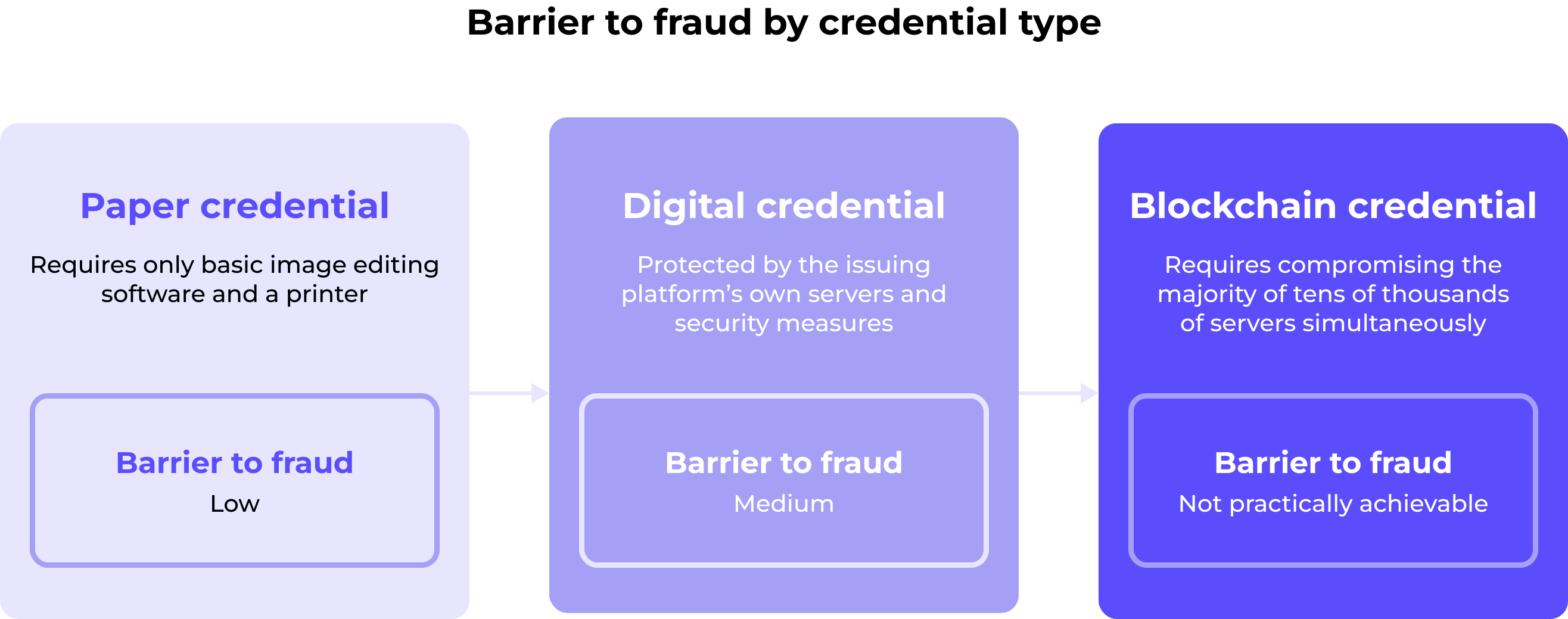
Blockchain-recorded credentials cannot be altered, faked, or spoofed. If someone does attempt to forge a credential, it won’t verify against the blockchain record. With blockchain security in place, third parties can be absolutely certain that a record hasn’t been altered since being issued. This dramatically improves fraud protection for any organization.
There is an additional benefit that’s easy to overlook: a blockchain credential remains verifiable even if the issuing organization closes. Because the verification record exists independently on the blockchain and not only on the issuer’s servers, the credential retains its integrity indefinitely. For university programs, professional bodies, or any organization that may change over time, this matters.
How do blockchain credentials work?
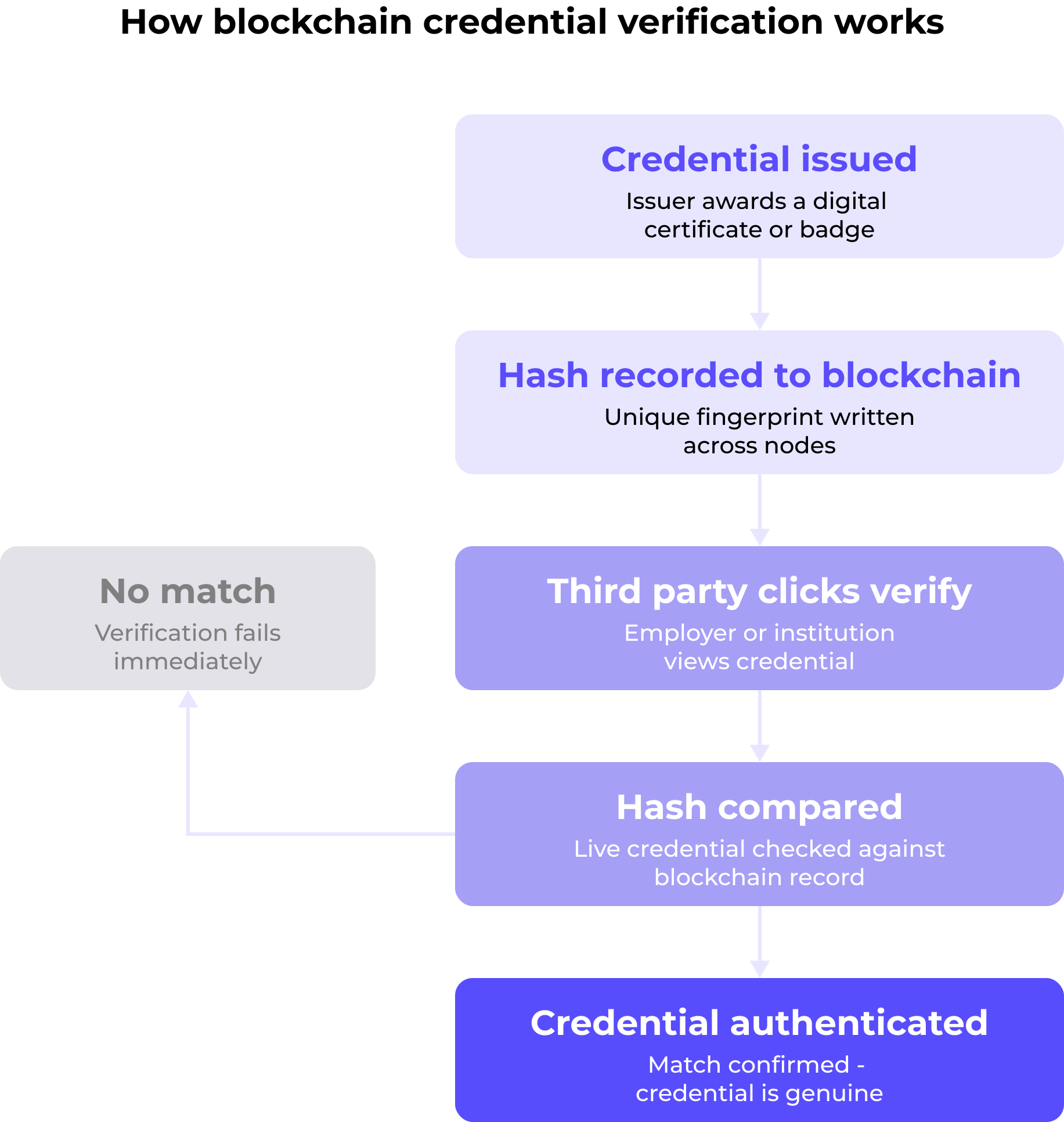
When you create a blockchain-enabled credential, Accredible uses the information provided to create a series of numbers that represent that information. Accredible sends this information to the blockchain and stores it there. Whenever someone goes to verify a credential, Accredible checks the stored series of numbers against what the credential information generates today and makes sure they’re the same.
In practical terms, the verification process takes seconds. An employer, institution, or any third party clicks the verify button on the credential. No account required, no manual process. The platform compares the credential’s current information against the record written to the blockchain at issuance. If the two match, the credential is authentic.
Blockchain credentials and open standards
Blockchain verification sits alongside open credentialing standards and increasingly integrates with them. Open Badge 3.0 (the current standard from 1EdTech) and W3C Verifiable Credentials both use cryptographic verification as their trust layer: a different technical approach to blockchain, but built on the same principle of tamper-proof, independently verifiable records.
Platforms that support these standards, including Accredible (which added Open Badge 3.0 and W3C Verifiable Credentials support in 2026), allow credentials to be portable, interoperable, and verifiable across systems, regardless of which platform issued them.
Is private information available on the blockchain?
No private or personal information is stored on the blockchain. The only thing stored on the blockchain is a series of numbers mathematically derived from the credential information. Accredible uses this series of numbers to verify that the content displayed matches the original record.
This is an important distinction. The blockchain record is transparent and permanent, but what’s recorded is an encrypted hash, not the recipient’s name, qualification details, or personal data. The actual credential information is stored securely on Accredible’s servers (SOC 2 Type II certified, with bank-level encryption), and is only visible when the credential owner chooses to share it.
Who uses blockchain credentials?
Blockchain credentials are used across education, professional certification, and workforce training wherever third-party verification of a qualification matters.
- Higher education institutions, including MIT, the University of Cambridge, and Syracuse University, issue blockchain-verified credentials for degrees, microcredentials, and continuing education programs.
- Professional associations and certification bodies use blockchain credentials to give members verifiable proof of qualifications for employers and regulators.
- Technology companies issue blockchain-verified product certifications to partners and customers, creating credentials that carry weight in hiring and procurement decisions.
- Workforce development programs use blockchain credentials to give learners a portable, tamper-proof record of their skills that holds its value across employers and over time.
Over 181 million credentials have been issued on Accredible, many with blockchain verification as a built-in layer of protection. For a deeper look at how blockchain security works in practice, see: How does the blockchain secure credentials?
Frequently asked questions
What is a blockchain credential?
A blockchain credential is a digital certificate or badge whose details have been recorded on a blockchain: a permanent, tamper-proof ledger. This creates an independently verifiable record that can’t be altered after issuance.
How do you verify a blockchain credential?
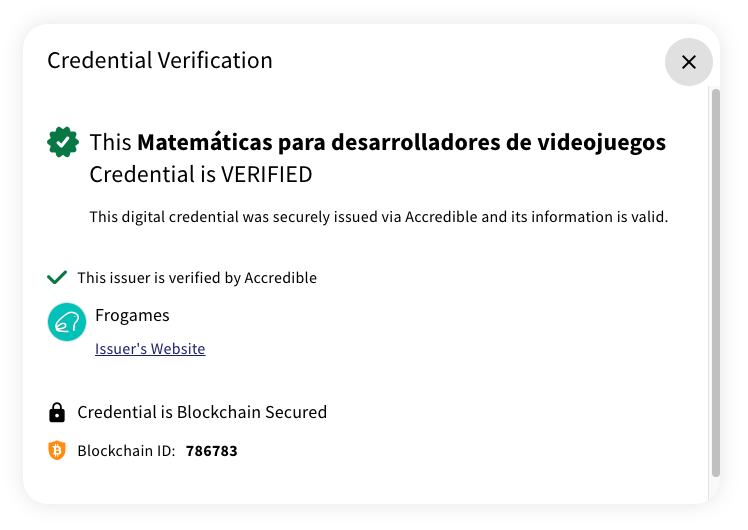
When someone clicks the verify button on a blockchain credential, the platform compares the credential’s current information against the record written to the blockchain when it was first issued. If the two match, the credential is authentic.
Can a blockchain credential be faked?
No. Because the credential’s details are recorded across tens of thousands of distributed servers, altering the record would require simultaneously compromising the majority of these servers. This is not practically achievable.
Is personal information stored on the blockchain?
No. The only information recorded to the blockchain is an encrypted numerical hash derived from the credential data, not the recipient’s personal details. The hash confirms authenticity without exposing personal information.
What’s the difference between a blockchain credential and a regular digital credential?
A regular digital credential is secured by the issuing platform’s own servers. A blockchain credential adds an independent, decentralised verification layer, so the credential can be verified even if the issuing platform changes or closes.
Further reading
Want to go deeper? Read how blockchain verification works in practice: How does the blockchain secure credentials?
See what a blockchain-verified credential looks like from a recipient’s view: View a sample credential.


