


In 2025, AI jumped from the No. 10 to No. 2 most-searched skill on CourseFinder, our search engine for courses and credentials. The momentum carried into 2026: Coursera and Udemy's Global Skills Report 2026 found AI micro-credential enrollments grew 122% year over year, nearly four times the rate for micro-credentials overall.
AI companies and educational providers are building AI-focused courses, certifications, and academies to meet that demand, and we see it up close. Leading organizations like OpenAI, NVIDIA, Google, Databricks, Snowflake, SpaceXAI, n8n, Asana, Elastic, and LangChain have all partnered with Accredible to issue more than 4 million verifiable digital credentials to learners so far.
Databricks, for example, went from about 7,000 digital credentials to more than 1 million. In the first half of 2026 alone, learners sharing those credentials drove more than 40,000 referral clicks back to Databricks Academy.
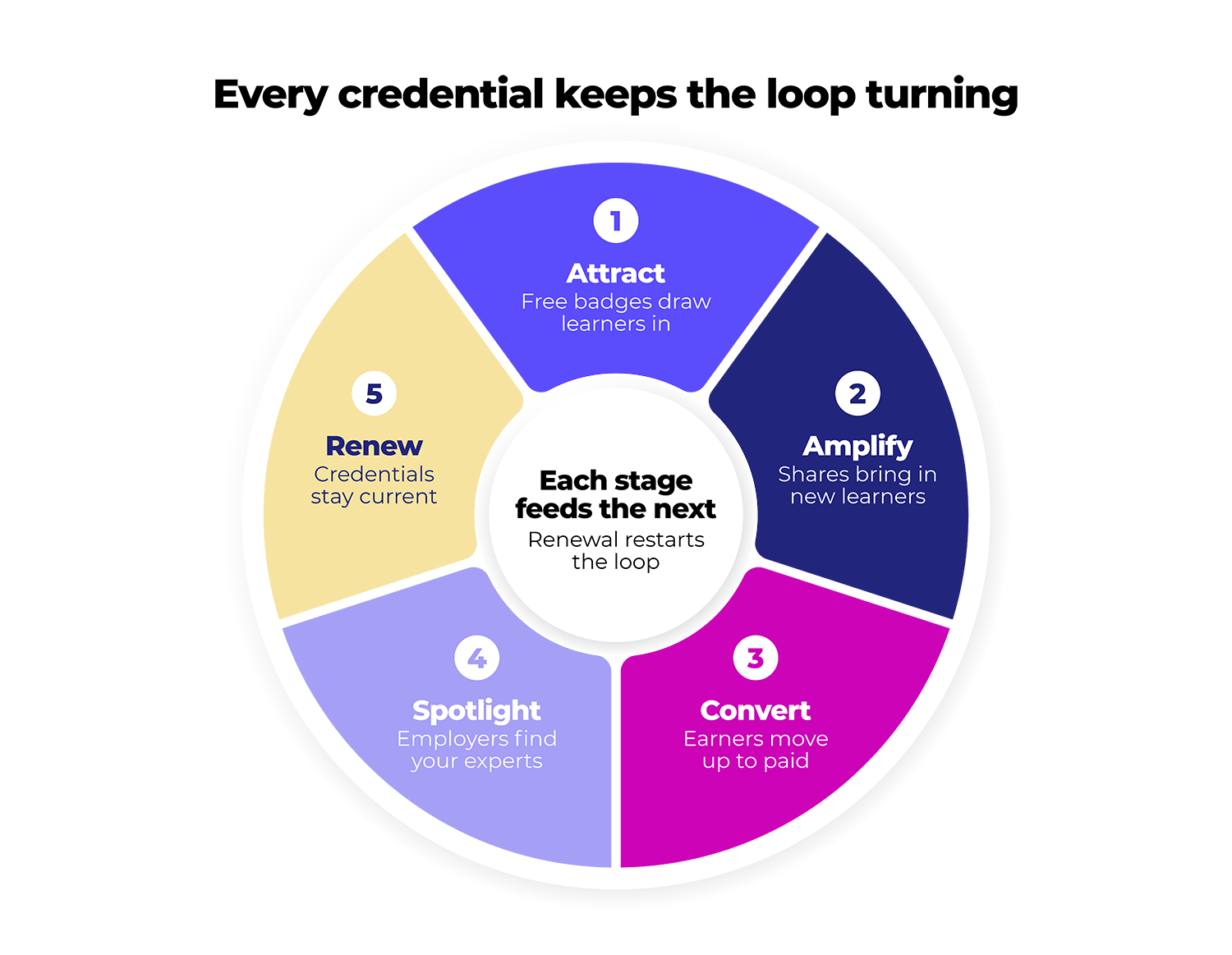
The fastest-growing academies have one thing in common. Every digital credential they issue is designed to keep a growth loop turning:
- It pulls in a new learner.
- It recruits the next one.
- It moves earners up to the next level.
- It connects them to opportunity.
- It keeps their skills current and renews their certification.
Before the stages, here's what the loop is worth to the business.
The Fastest-Growing Academies Turn Credentials Into Business Results
An academy does three jobs at once. It's a customer experience tool, a marketing channel, and a talent signal. The fastest-growing programs don't lead with how many credentials they issued. They report what those credentials did for the business.
Asana's marketing team got to that 5–6X figure by tracking learners from Academy registration into the sales pipeline. "ROI means a lot when you can put a dollar sign behind it," says JJ Janikis, Head of Customer Education at Asana.
One payoff never shows up in a quarterly report: credentials travel. A trained, credentialed user who moves to a new company often brings your product with them. Basia Bullard, Global Learning Solutions Director at Trimble, described the company's student credential programs as "seeding the market with future Trimble 'loyalists' who will likely become customers, partners, and even employees." When your credentials become how an industry proves skill, your brand becomes the standard.
Why the Credential Matters As Much As the Course
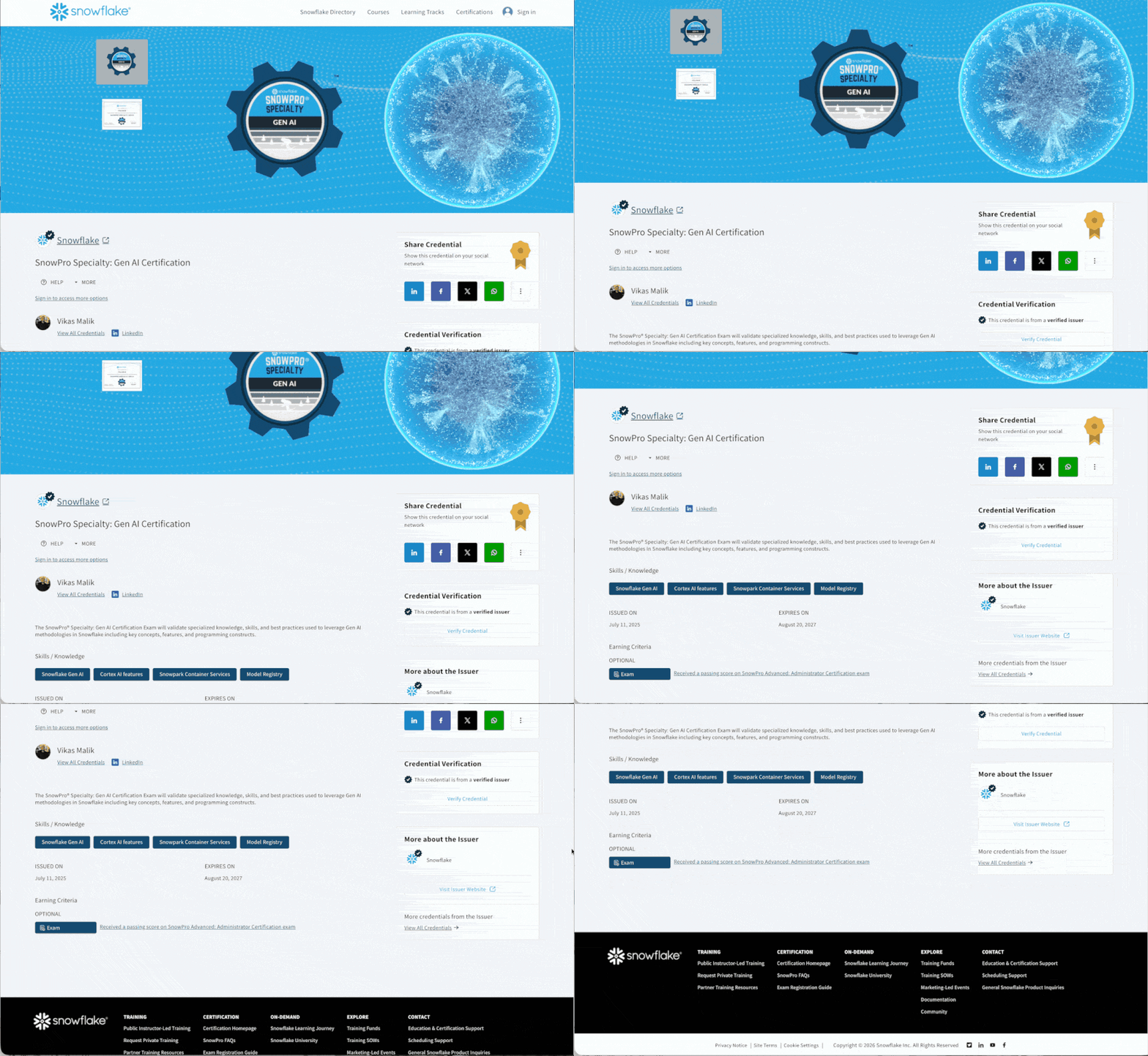
Most academies already issue something when a learner finishes, usually a PDF certificate or a badge built into the LMS. That works for internal recognition. It falls short once the credential has to do work outside your platform:
- Employers can't verify it. There's no instant, secure check, and little detail on what the learner did or how they were assessed.
- Learners can't easily share it. LMS badges usually aren't built for LinkedIn, so the credential never reaches the earner's network.
- It doesn't travel. If you switch LMS vendors or the learner changes jobs, the record can be lost.
- You can't see what happens next. Reporting stops at completion. You get no view into opens, shares, or referrals.
A digital credential platform that issues digital badges and certificates fixes all four. That's how the programs in the table above can prove their results. You don't have to replace your LMS to get there. Asana and Workato connect Skilljar to Accredible, and Trimble connects Docebo, so credentials are issued the moment a learner finishes.
Once the credential can do that work outside your platform, the loop can start turning, beginning with the first rung.
Attract: Build a Ladder with a Free First Rung
The best AI academies don't treat digital badges as one-off rewards. They design them as a ladder, and the first rung is free.
That free rung works two ways. To everyone in the earner's network, it's an ad for your program. To the earner, it's the first step toward a paid certification.
Demand supports the design. Coursera and Udemy's report also shows beginner AI enrollments grew 77% year over year, while advanced enrollments barely moved. Most people want a starting point, not a final exam.
Databricks built its framework on that idea. Its six-level star system gives every learner a clear next step, starting with a free Fundamentals badge:
"It's free training, they get a badge, and it also becomes a marketing lead for us for further training and certification," says Rachel Canetta, Senior Manager of Certification at Databricks.
Asana's ladder works the same way. Free courses and skill badges, starting with the Asana Foundation Skill Badge, are the entry point, and the Workflow Specialist Certificate sits above them.
Other AI academies start free, too. Snowflake's free Hands-On Essentials badges lead into SnowPro certifications. Elastic pairs a free GenAI accreditation with paid certifications. LangChain Academy's free foundation courses are the prerequisite for its Certified Agent Engineer exam.
The first rung has one design rule: make it worth sharing. Keep it short and tie it to a real skill someone would want to earn and show off. A badge that doesn't prove anything specific won't travel.
Amplify: Make Every Credential Recruit the Next Learner
A free digital badge only grows your program if people see it. Julien Clement, who led credentialing at HubSpot for eight years and then built Workato's program, described how sharing feeds the loop: someone finds your content, takes a course, earns a credential, and shares it. Then "you have people who see other people's shared credentials and then go and sign up."
The programs with the highest share rates remove the friction:
- Brand it as yours. Fully white-labeled digital credentials, issuer pages, and emails keep your program front and center. Across Accredible, branded credentials see 65% more sharing on average.
- Make sharing one click, with no login. Requiring learners to create an account can cut sharing by up to 75%, and a direct "Add to LinkedIn" button works better than written instructions. With Accredible, learners accept and share without creating an account.
- Give the credential page a next step. Link it back to the course, the next rung, or a demo request.
- Follow up. Send email and text reminders to earners who haven't opened their credential yet. Email Campaigns and SMS Engagement automate both.
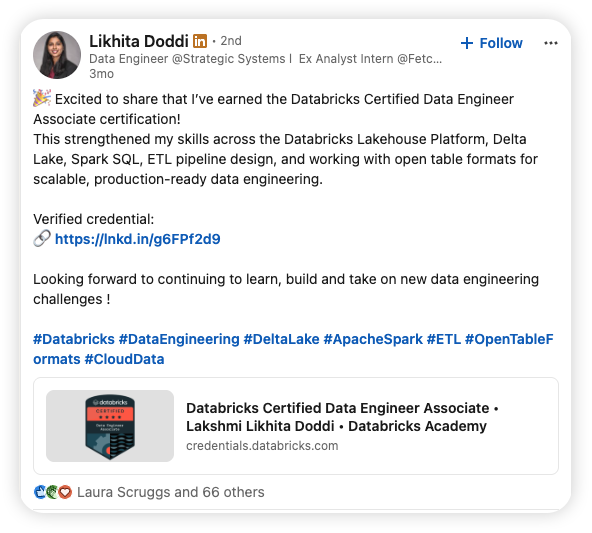
Databricks issues fully branded credentials that require no login and link each badge back to its course. Its certifications see a LinkedIn share rate above 81%. ServiceTitan, which runs a product certification program for its field service platform, shows where those shares can lead: more than 11 click-throughs a week to its product demo page. "We get real deals and sales from this," says Danielle Combs, Senior Program Manager for Customer and Partner Relations.
Both programs celebrate the people who share. Rachel comments on certification posts in her LinkedIn feed every day. At ServiceTitan, earners who show proof of a shared credential pick gear from a swag store, and the company's executives join in on LinkedIn too. "The great thing is execs like and comment on those posts, so our engagement doubles," Danielle says.
For more tactics, see our guide, How to Increase Credential Sharing: The Practitioner's Guide to Visibility, Referrals, and Program Growth.
Convert: Move Referrals and Earners Up the Ladder
Sharing creates two kinds of warm demand: people who click through from a shared digital credential, and earners who've finished the free first rung. Both are ready for what comes next. The strongest programs make that step obvious.
Recommend the next rung by name. Target earners by the credential they already hold, so each one hears about the rung directly above them. Most programs skip this step. In our 2026 State of Credentialing report, 38% of learners said they want guidance on what to learn or pursue next, but only 7% of issuers personalize their recommendations.
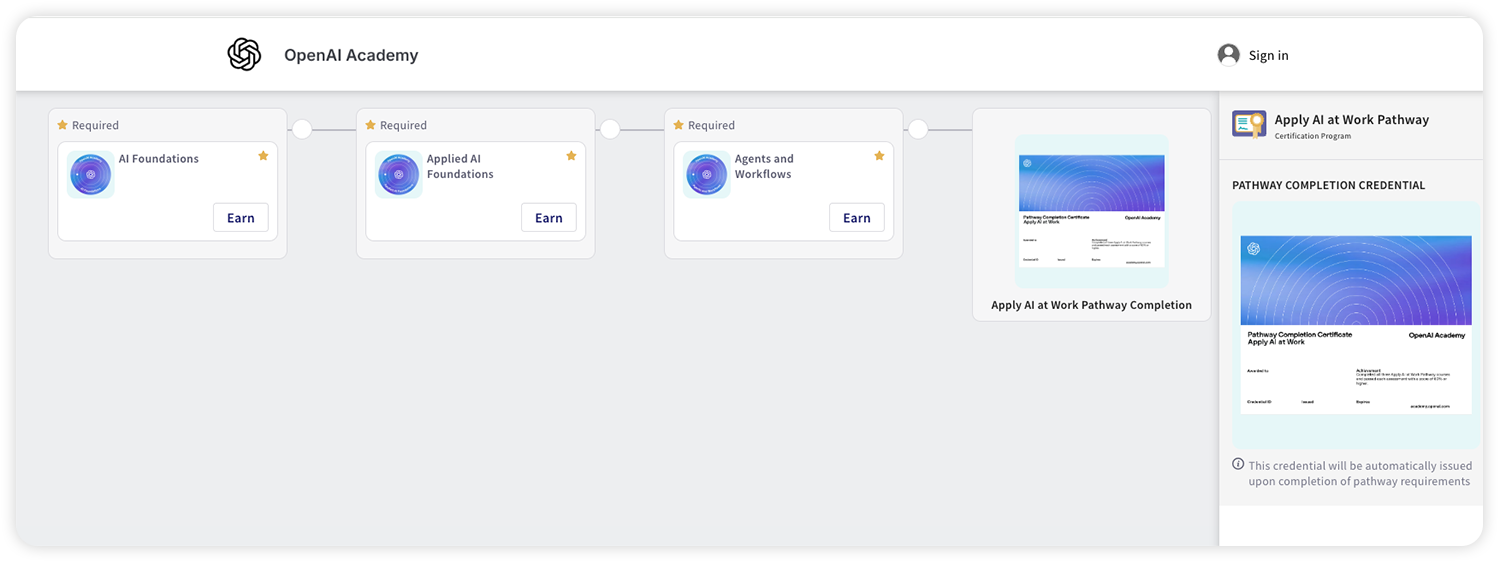
Show the whole ladder. Pathways make the progression visible. A learner who earns one credential can see the series it belongs to and what comes next. Maven Analytics built its guided learning experience around Pathways, giving learners concrete paths to prepare for specific roles in data. "It's not just one-and-done; it's an entire learning journey," says Chris Dutton, Founder and Chief Product Officer. "And we've seen really promising user retention and LTV numbers."
Advertise the next course where learners already are. Course recommendations on credential pages and across our network, including CourseFinder, turn every view into a possible enrollment. One research university added them and generated more than 5 million impressions and more than 18,500 referrals. The share of learners taking another course grew from about 35% to more than 50%.
Spotlight: Connect Credentialed Talent to Opportunity
People earn credentials to be seen. A searchable directory of credentialed professionals, like our Spotlight Directory, gives them that visibility. It also builds your company an ecosystem of experts that customers, partners, and employers can draw on.
Databricks' certified directory holds nearly 20,000 profiles, and Rachel knows who uses it most: "For people who are job searching, those are the ones that are going to the certified directory."
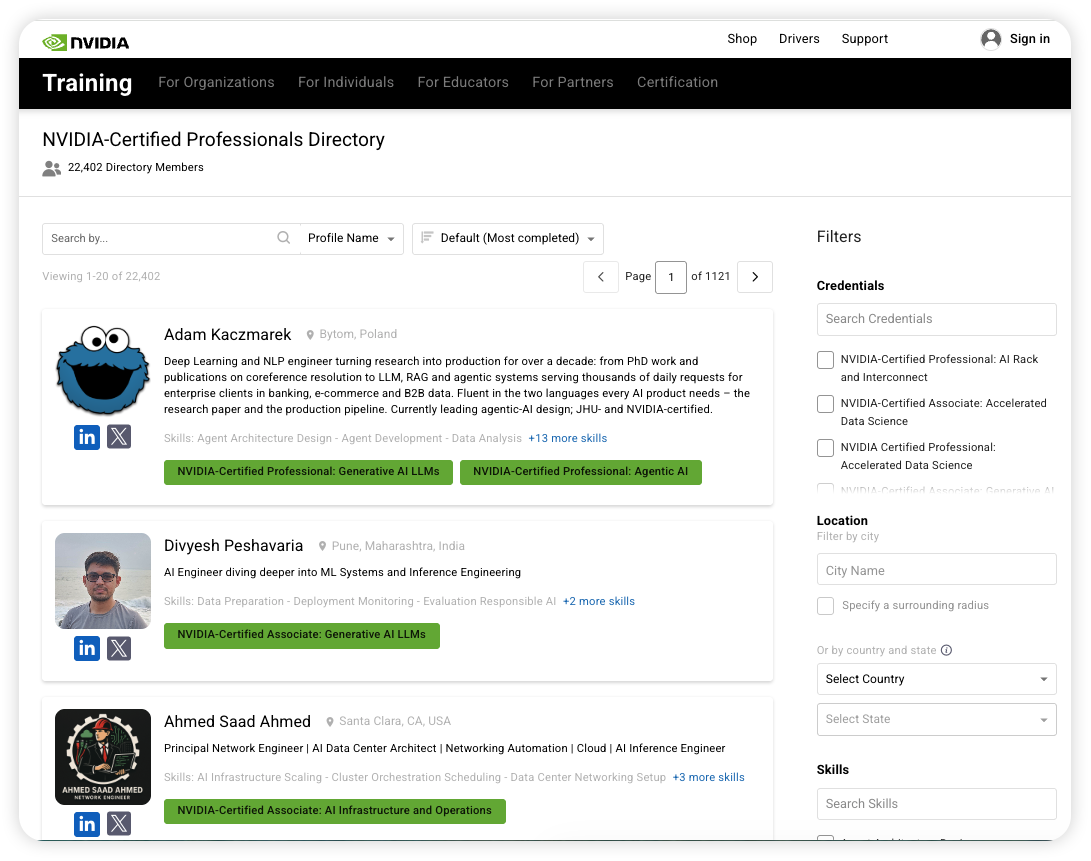
Workato built its directory to serve customers directly. "If someone needs an integration developer to build a Workato recipe, they can go to our directory and filter by role and credentials," Julien says. For an AI or automation platform, that directory becomes a marketplace of credentialed implementers.
Learners want this far more than most programs offer it. In our 2026 report, 91% of learners said they'd join a directory, but only 21% of issuers have one. Where directories do exist, employers use them. In 2025, more than 800,000 learners were listed in our Spotlight directories, up 167% from 2024. Over the same period, employer searches grew more than 5X.
Building one doesn't have to be a big project:
- Ask at the right moments. Databricks prompts earners to opt in when they pass the exam, and again in the email that delivers their badge.
- Make it searchable. Let visitors filter by credential, skill, location, and availability.
- Choose who can see it. Make it public for employers and customers, or keep it private for partners and internal teams.
A directory is only useful if the credentials in it are current. That brings us to the last stage.
Renew: Keep Credentials As Current As the Product
AI products change every quarter. A credential earned on last year's version of a platform means a little less every month it goes unrenewed. Renewal keeps credentialed users current on your product and the industry, and it's recurring revenue for the program.
AI programs are already shortening the cycle. Automation Anywhere's AI Automation Engineer certification is valid for one year, half the length of its core certifications. Snowflake released a new version of its SnowPro Specialty: Gen AI exam in March 2026.
Most programs still leave renewal to chance. Traditional recertification comes around once every few years, and it's easy for certified users to let it lapse. The programs that renew well run it as a campaign:
- Remind people before they lapse. Set an expiration date on each credential, then send a pre-expiry sequence by email and text, timed to its lifespan. Databricks sends certification expiration reminders at 90, 60, and 30 days out.
- Win back the ones who lapse. After a credential expires, send clear, simple steps to recertify.
- Point to the new version. When the product changes, send earners to the updated course or exam.
The next step is continuous validation. Instead of a renewal exam every few years, our Live Credentials validate real-world skill application against a rubric as the work happens, so renewal becomes an ongoing relationship instead of a cliff.
Renewal also closes the loop. Every renewed credential is another moment to share, which starts the loop again.
Six Questions to Audit Your AI Academy
The fastest-growing AI academies built a loop and kept it turning. Check your program against these six questions:
- Can you show leadership what your credentials drove, not just how many you issued?
- Do you have a free, short first rung tied to a real skill, with a clear ladder above it?
- Is every credential branded as yours and shareable in one click, without an account?
- Does every credential page and email point earners, and the people who see their shares, to the next rung?
- Can customers, partners, and employers find your credentialed people?
- Do your credentials renew as fast as your product changes?
You don't need a big team to get there. LogicMonitor rebuilt its certification program with three people and issued more than 3,000 badges in less than a year. "We reduced time-to-launch from months to weeks and were able to release multiple badges in parallel without sacrificing quality," says Kelley MacCoy, Certification Product Manager.
We've helped AI programs from OpenAI to Databricks build their loops. Talk to our team about your AI academy, or take the Credential Program Assessment to see where your program stands today.


