


It’s hard to think of any industry that doesn’t need to ingest, process, and analyze massive amounts of data. And the vast majority of that work is done on Databricks.
From Shell to Siemens to Santander, over 60% of the Fortune 500 rely on Databricks to turn their data into insights. To train all the data engineers, machine learning experts, and analysts building those workflows (and the partner ecosystem that supports them), Databricks turned to digital credentials, and they went all in.
Since Rachel Canetta, Senior Manager of Certification, arrived, Databricks has gone from issuing roughly 7,000 digital credentials to crossing the one-million mark. Today, they issue roughly 50,000 digital badges per month, and with 169,000+ referral clicks back to Databricks, those credentials have become a growth engine for the company in their own right. It's a scale that earned Databricks a spot among the top 10 credential issuers globally out of more than 2,300 organizations on Accredible's platform.
More importantly, though, Databricks credentials have become a tool for advancing people’s careers. 90% of earners say they’ve solved greater challenges at work, 89% report growing in their current role, and 73% have even received a promotion.
Credentials issued per month
LinkedIn credential share rate
Earners reported growth in current role
“I was getting badge requests for this, badge requests for that. And I thought to myself, ‘How do I do that without flooding the market with badges that don’t carry any weight?’”

Rachel Canetta, Senior Manager of Certification

When Rachel arrived at Databricks, her colleagues had already launched a credential program with three badges: Fundamentals, Certified Associate, and Certified Professional.
Fundamentals was more of a marketing, top-of-funnel badge that was great at getting folks in the door. But nudging them toward certification was hard — there was a lot of prep work they had to do in between that wasn’t being recognized. At the same time, she was being flooded with badge requests from partner, developer relations (DevRel), university alliance, field engineering, and marketing teams, with no principled way to say yes or no.
“I was getting badge requests for this, badge requests for that. And I thought to myself, ‘How do I do that without flooding the market with badges that don’t carry any weight?’” she remembers.
Her first order of business was convening a cross-functional stakeholder group. Their input would inform how she could logically expand the badging structure and make new badges meaningful both inside and outside Databricks.
“The core business logic here is that the more people who know the platform, the more they consume it, and the more we make. It’s a money-generation thing. We show, month over month, that credentials are what move learners along that path, from first awareness at Fundamentals, to capability, ultimately to consumption.”
Rachel Canetta, Senior Manager of Certification
Before Rachel and her team created any new badges, she wanted to organize her 10-person cross-functional squad around building a centralized credential framework that outlined:
“There's a lot of work that's done between a fundamentals-level badge and actually getting certified. So there's all this stuff in between that we could be badging — and that's what we turned our attention to."
“After weeks of discussion, we landed on a six-level structure,” Rachel shares. “Most of our Darabricks Academy offerings are either learning or labs, which naturally lent themselves well to Knowledge and Skill badges.”
From there, she and the team went back and re-leveled existing star ratings to showcase the rigor of each badge:
They even added a sixth star to give Databricks room to grow. “We knew there would be a need for one in the future,” she emphasizes. “Because on top of being certified, the learner could get an even higher-level specialization.”
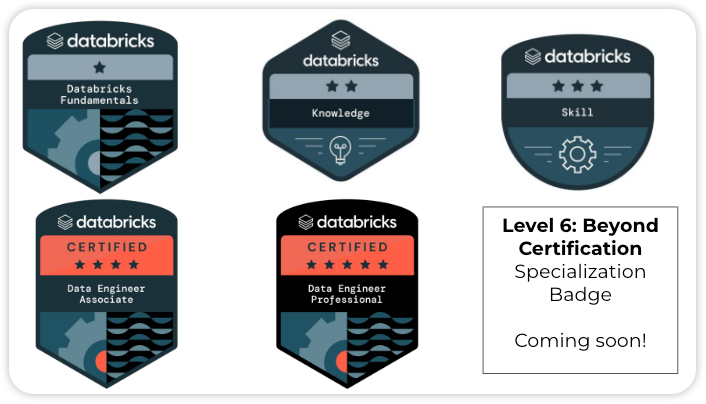
To ensure they could scale without creating badge chaos, Rachel drafted a badging governance policy with a very clear description of the purpose of badging — to provide digital proof of someone’s credentials — and how that differentiates Databricks badges from participation badges in the market.
“Having a set policy laid out is really helpful, because when someone comes to me and says, ‘I want a badge,’ I can say, ‘Here, read this first,’” she says.
Beyond written guidelines, Rachel knew credentials had to be tied directly to business outcomes to get the attention they deserved.
“The core business logic here is that the more people who know the platform, the more they consume it, and the more we make. It’s a money-generation thing. We show, month over month, that credentials are what move learners along that path, from first awareness at Fundamentals, to capability, ultimately to consumption,” she highlights.
In fact, at Databricks, active credentials have become an OKR (Objectives and Key Results) for the entire organization, not just L&D. “They’re not just badges; they’re metrics,” she highlights.
In her standard Monthly Business Review (MBR) deck, she includes credential-related KPIs — pulled straight from Accredible analytics — that show movement along that path:
Currently, Databricks is targeting 602,000 active (non-expired) badges. Thanks to Rachel’s policy, Databricks is 95% of the way to its OKR, while upholding the standards of its previously established credentials.
Though they had a new look, feel, and framework, badges were not new to Databricks customers, partners, and enthusiasts. Rachel didn’t want to disrupt an experience they already knew, so she worked with Accredible to white-label brand the credential page.
“Databricks Academy is where everybody who wants to learn Databricks learns it,” Rachel notes. “We wanted learners to have that familiarity and continuity.”
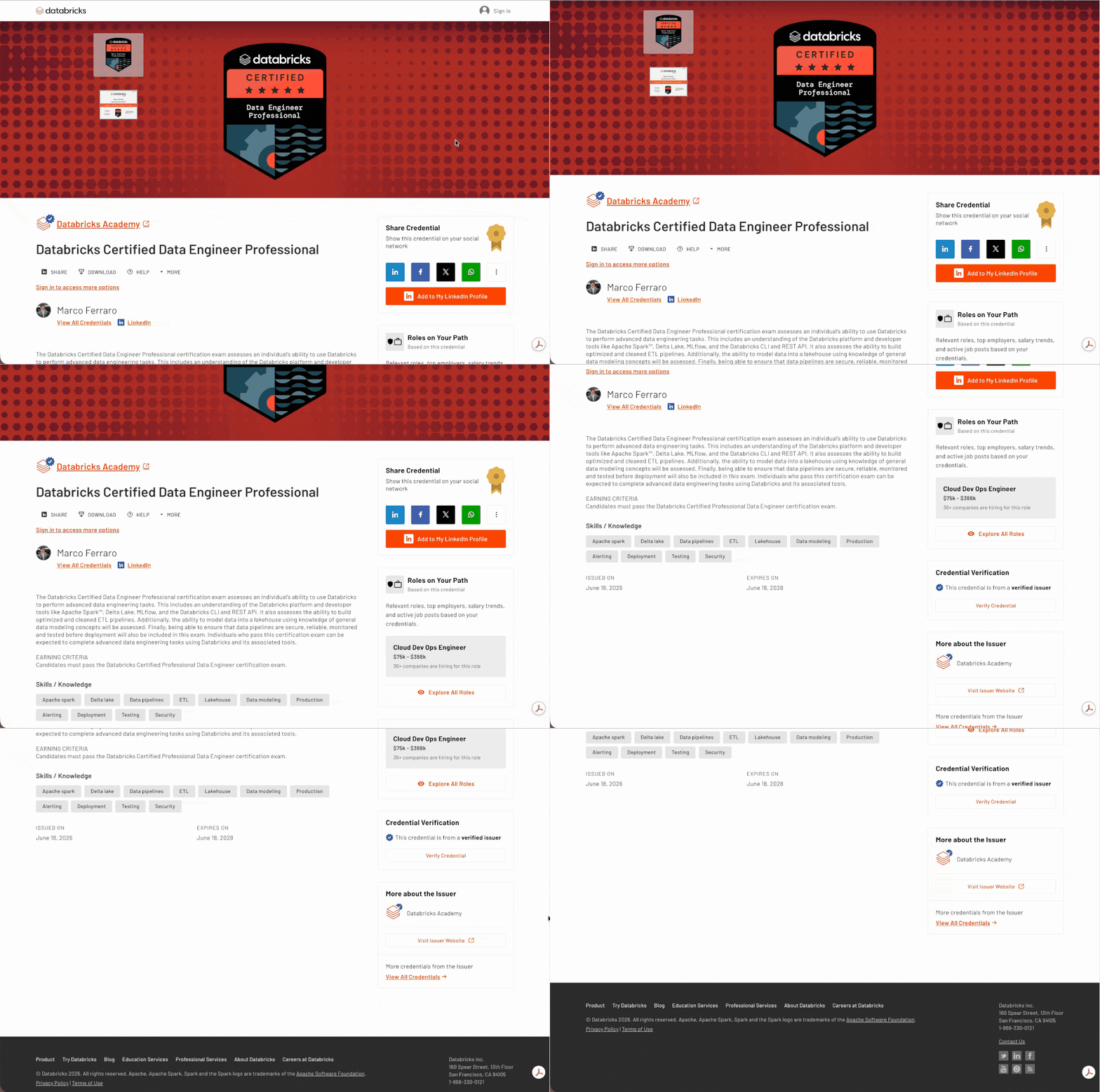
It has a custom domain (credentials.databricks.com), plus the Databricks logo and color scheme to match the style of Databricks Academy.
The Accredible API is hooked up to Databricks Academy, so learners receive their digital credential as soon as they’ve completed all the required courses and quizzes — with all the metadata employers might be looking for built in:
If the learner (or anyone else looking at the credential) wants to expand into certifications or earn a badge of their own, links to Databricks Academy are featured in multiple areas of each digital credential so that they can browse available training.
That alone has generated a ton of buzz for the program. Halfway through 2026, earners’ shared digital credentials have generated over 40,000 referral clicks to the Academy. “It’s a marketing engine in my mind,” Rachel explains.
Accredible digital credentials come with a one-click share-to-LinkedIn button so earners don’t have to create a new account or share their data. Removing that friction paid off for Databricks. Today, more than 81% of learners share their certification badges on LinkedIn.
“I had no idea it was going to blow up to this level,” Rachel says. Though she says sharing happened fairly organically, she’s gone to great lengths to encourage that engagement.
“Every day I go through my LinkedIn feed and celebrate and comment on people’s certifications,” she shares. Two of her exam developers picked up the habit on their own.
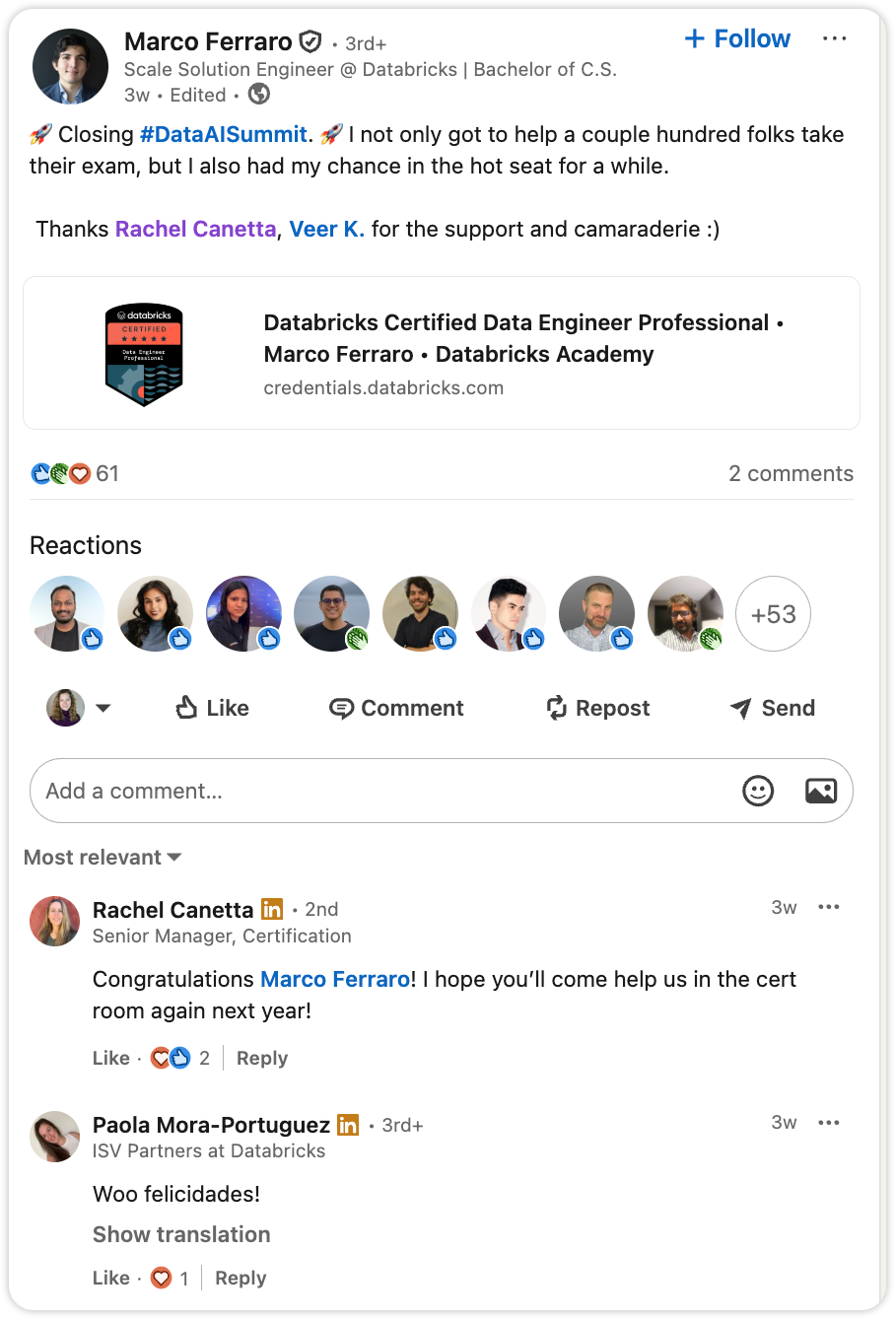
It doesn’t take them long, maybe ten to fifteen minutes, but the interactions go a long way. Learners feel special and accomplished, and the more eyeballs their credentials get, the more people find out Databricks Academy exists, and the badges along with it.
At this point, certification accounts for the majority of shares because it’s the clearest career signal. “There’s brand weight to being Databricks certified, which is fantastic,” says Rachel.
Databricks is also using a branded certified directory (powered by Accredible’s Spotlight functionality) to keep that momentum going and connect credential earners with opportunities. Nearly 20,000 earners have joined a searchable, employer-facing directory of certified professionals.
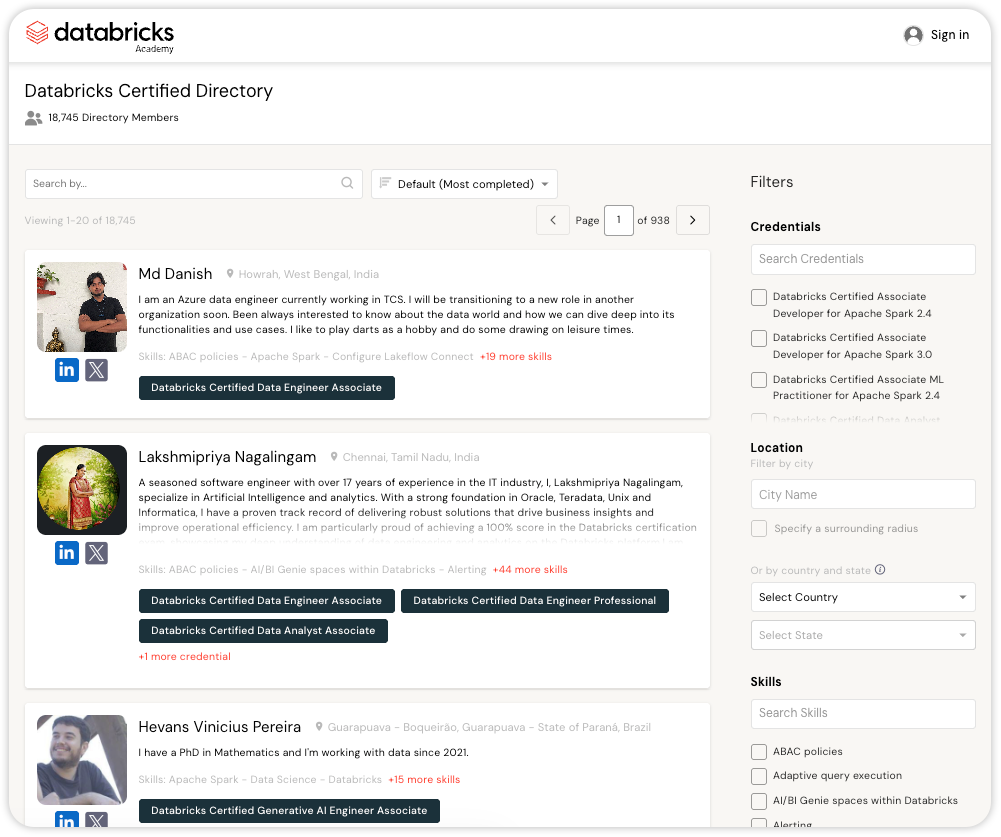
“I think it's a super important indicator — especially for people who are looking for jobs. When they pass their certification exam, we let earners know they can become part of the certified directory,” says Rachel.
Hiring managers can filter by credential, skill, location, and availability to find excellent candidates, and earners can use the directory to find new peers to learn from and network with — hopefully on a new Databricks customer or project.
Credential impact on the business is critical — after all, you can’t sustain a program without proving that — but, to Rachel, the human side of the story was perhaps even more compelling.
“I wanted to showcase the value of certifications to the people earning them. After showing the marketing team the kind of feedback we were getting from earners, they agreed to a formal survey of hundreds of certified customers and partners. The results blew my mind,” she says emphatically.
Two metrics, in particular, serve as evidence that Databricks credentials increase career opportunities:
A Principal Engineer at Nagarro, Sunil Gupta, shared, “Databricks certification contributed meaningfully to my promotion by validating technical depth and platform expertise. It also enhanced my credibility in stakeholder discussions and leadership forums, supporting my progression into a higher‑responsibility role.”
“Having this data is profoundly helpful, because it helps people see the value,” Rachel says. “If they don't see the value, they’re not going to pursue it.”
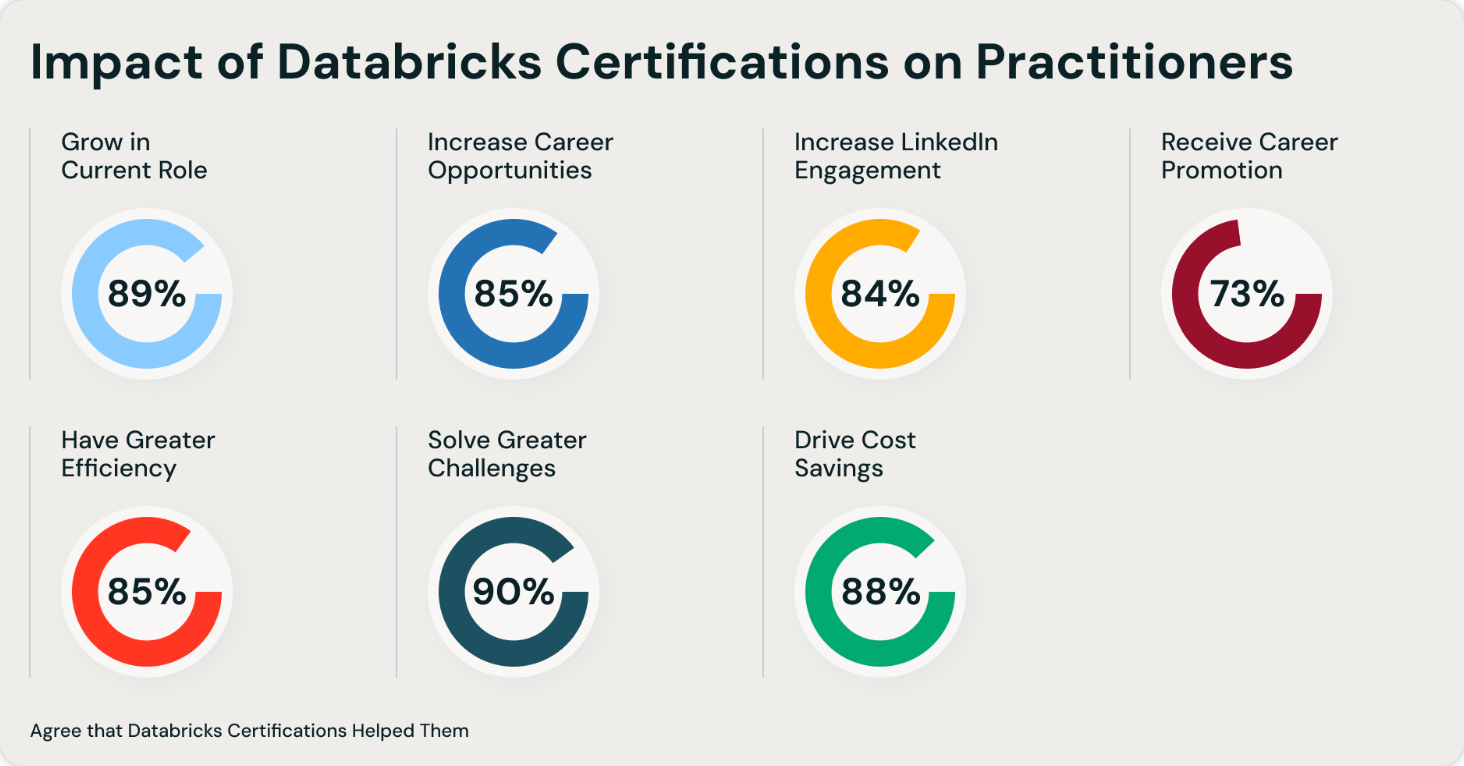
Credentials aren’t just impacting individuals. Per the Databricks analysis, teams with certified Databricks practitioners deliver projects more efficiently and at a lower cost.
“I wanted to showcase the value of certifications to the people earning them. After showing the marketing team the kind of feedback we were getting from earners, they agreed to a formal survey of hundreds of certified customers and partners. The results blew my mind.”
Rachel Canetta, Senior Manager of Certification
By now, Databricks has hit the one million lifetime credentials mark, but they’re not stopping there. Rachel’s hoping to make the directory even more useful for job seekers, get that level six badge ready, start rolling out even more badges to support her DevRel, University Alliance, and partner colleagues, and continue supporting the earner community in their careers.
What makes that expansion possible is how Accredible is structured for enterprise programs. Rachel has set up independent departments for each team so they can build their own badge programs within her governance framework without touching each other's work. "I don't want them messing with my departments," she says. "So I can kind of keep them separate."
It all comes back to the framework she built first. Her advice?
“Start the framework and governance before you issue a single badge. Think about the future, too, not just what you need now. Where are you going? Map it out from there.”
Get started on your million-credential framework. Book a demo with the Accredible team to see what that could look like for your program.
Schedule a demo and discover how Accredible can help you attract and reward learners, visualize learning journeys, and grow your program.
Book a demo
Accredible is the world’s leading digital credential platform, enabling education and training leaders to increase learner engagement and drive program growth.


Accredible is the world’s leading digital credential platform, enabling education and training leaders to increase learner engagement and drive program growth.


