


Hello and welcome to Certified Insights from your digital credential friends at Accredible. You’re in good company with 70K+ education and training leaders.
Each month, we share tips and strategies to help you grow your credentialing program. Let’s dive in!
Someone from another team wants "just a quick badge." Say yes, and the badge catalog fills with things that don't mean much. Say no without a clear reason, and it looks arbitrary. Can you relate?
Many credentialing leaders start in that gap. But the programs that scale aren't the ones that avoid it; they're the ones that build a framework and a set of rules before the requests pile up.
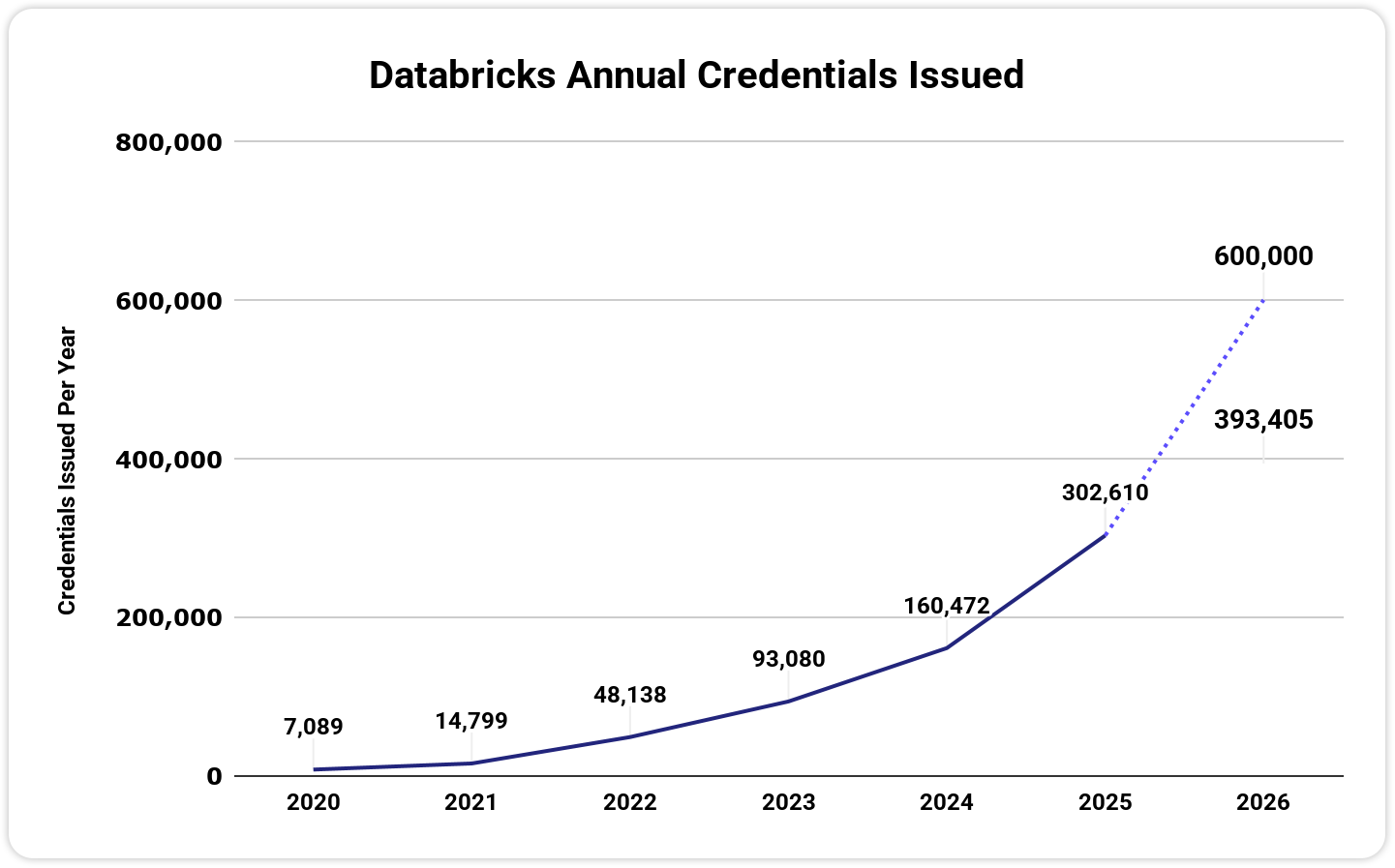
That's the position Senior Manager of Certification Rachel Canetta found herself in at Databricks. But now, past 1 million lifetime credentials, issuing 50,000+ a month, and 169,000+ referral clicks back to Databricks Academy, those credentials have become a growth engine for the company.
I recently sat down with Rachel in a spotlight webinar. What stood out was how deliberate the decisions behind it were.
Build a tiered credential framework
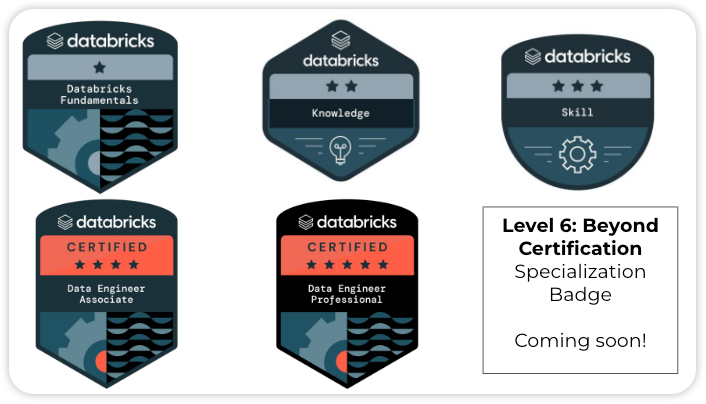
When Rachel inherited the program, Databricks had two credentials: Fundamentals and Certification, with nothing in between. Learners who finished Fundamentals had nowhere to go except a high-stakes certification exam they weren't ready for.
"There's a lot of work that's done between a fundamentals-level badge and actually getting certified," Rachel said. "So there's all this stuff in between that we could be badging, and that's what we turned our attention to."
She brought together a cross-functional group to design the fix: a six-level framework, with added knowledge and skill badges, and a sixth level reserved for whatever comes after certification. The middle two tiers gave learners a structured, badge-worthy path through everything they were already doing toward certification.
Try this: Map what a learner actually does between your entry-level credential and your capstone or certification. If there's no badge for it, there's no path for it either.
Write the governance policy before the requests pile up
Building the framework solved one problem. It didn't solve the other one: a steady stream of teams, partner enablement, Developer Relations, University Alliance, wanting badges of their own, with no principled way to say yes or no.
“I was getting badge requests, and I thought to myself, ‘How do I do that without flooding the market with badges that don’t carry any weight?’” Rachel shared.
Her fix was a written governance policy defining what earns a badge, built with the same cross-functional group. When someone asks for one, her answer is simple: "Here, read this first."
Try this: before your next request lands, write down what earns a badge and who approves it. A framework tells you what a badge looks like; a policy tells you who's allowed to make a new one.
Need help building a credential framework and governance model? Check out our guide, Why Your Credentialing Program Needs a Framework (Not Just Badges) →
Make credentials a business metric, not an L&D metric
Most programs treat credentialing as a learning function. Databricks made it a company-wide OKR: active badges are tracked against a 602,000 active (non-expired) target, currently at 95% attainment, and Rachel reports the number in her monthly business review to leadership.
"They're not just badges," she said. "They're metrics." That distinction is what keeps credentialing funded and visible, instead of quietly living inside L&D.
Try this: Start where Rachel did — put one number you already track in front of leadership every month. Connecting it to a business outcome is a design decision, so make it on purpose.
Want the deeper model? Our guide on tying credentials to business outcomes breaks down the three tiers most programs move through.
Design for badge sharing from day one
Databricks' credentials are fully white-labeled branded: no Accredible branding, a custom domain, one-click LinkedIn sharing (example credential). Badges are issued automatically the moment someone finishes a course or exam, when earners are most excited to share them. The result is an 81% credential LinkedIn share rate and 169,000+ lifetime referral clicks from shared credentials back to Databricks Academy.
As Rachel put it, "Someone shares out their badge, and then people see that and can actually click in and go to Databricks Academy and start looking at training themselves or find out more about certification. It's a marketing engine."
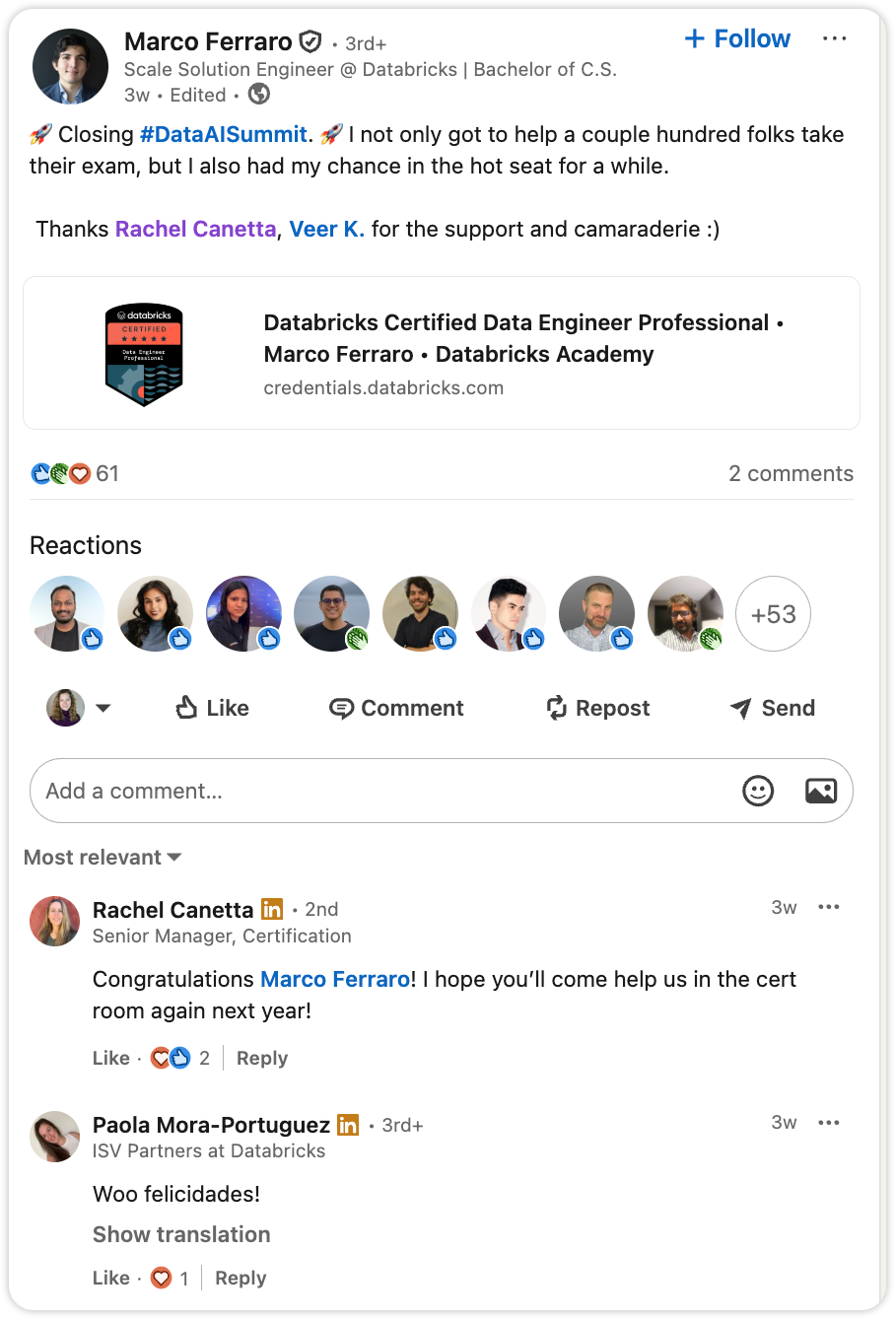
And she treats the engagement as part of the job: 10 to 15 minutes a day scrolling LinkedIn, congratulating and commenting on shared digital badges. Two of her exam developers have picked up the same habit.
Try this: Audit whether your credential looks like your brand or your vendor's, and whether it’s issued as close to completion as possible.
Measure what credentials do for earners, not just your program
Credential issuance numbers tell you program demand; they don't tell you whether it worked for the people who earned it.
After Rachel showed the marketing team the feedback they were getting from earners, they surveyed the certified community on real outcomes and career impact. When they finally did, 89% of certified professionals reported growth in their current role, and 73% received a promotion.
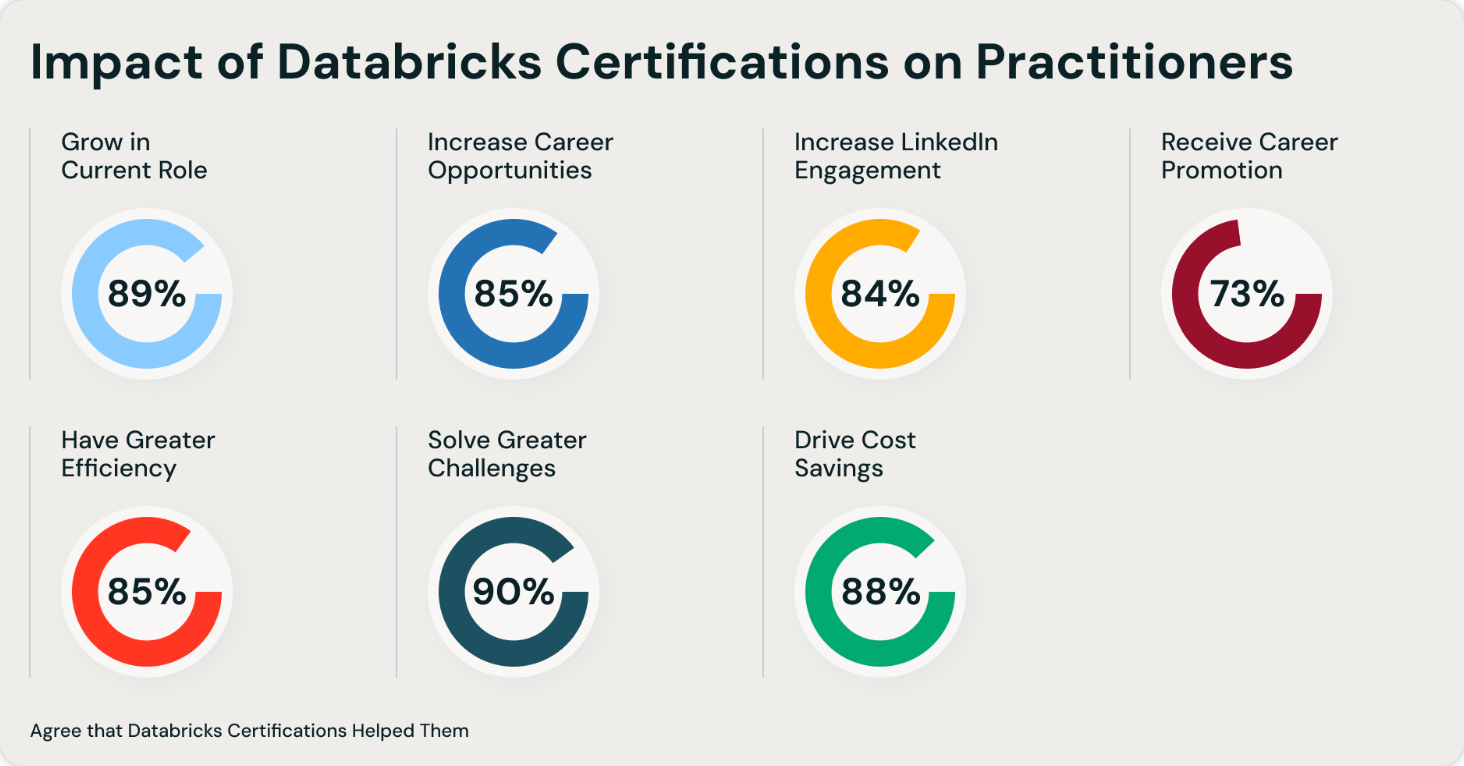
"It's profoundly helpful to have data like this, because it helps people see the value in it," she said. "If they don't see the value, they're not going to pursue it."
Try this: survey your certified community on outcomes, not just satisfaction. "Did this help your career?" is the question that sustains budget.
Want a ready-made version? Accredible's free Learner Outcomes & Experience Survey template is built for this. Get the guide + template →
What to take forward
Databricks reached 1 million credentials by deciding, early, what a badge was for, and holding that line even when everyone wanted an exception.
Want the fuller story, including how they connect certified professionals with opportunities via an online directory? Watch the on-demand webinar or read the full program spotlight.
Until next time,
Ryan
Senior Director @ Accredible
The Trust Gap: Connecting Assessment Integrity to Credential Defensibility — August 6, 2026
In today’s webinar, Brandon Smith (Integrity Advocate) and Dan Theckston (Accredible) will unpack the Credential Security Trifecta, connecting identity verification, assessment integrity, and credential issuance into one auditable, defensible workflow, drawn from a real-world Integrity Advocate–Accredible integration built for CE/T programs.
ASAE Annual Meeting & Exposition — August 15–18, 2026
The flagship gathering for association professionals. Strategy, membership, and the future of how associations deliver value to their communities.
Tired of juggling paper certificates, PDFs, and endless manual processes to track learner achievements?
Or running into scaling limitations with your current digital credentialing solution?
Accredible has you covered. Create and issue branded digital credentials that showcase skills and provide real value — without the hassle.
Know someone who'd find value in Certified Insights? Forward this email and invite them to subscribe.
Did a friend forward this email to you? Sign up to get this newsletter next month.

Accredible is the world’s leading digital credential platform, enabling education and training leaders to increase learner engagement and drive program growth.


Accredible is the world’s leading digital credential platform, enabling education and training leaders to increase learner engagement and drive program growth.

