


The ability to instantly deliver credentials via email is a key benefit of digital credentialing. Instant delivery reflects the professionalism of an organization and encourages recipients to share and celebrate in the moment, rather than forget about their achievement. In this post we discuss how to encourage recipients to open and engage with their new credentials and increase visibility for the issuer.
A credential email is the message an issuer sends when a learner or member earns a digital badge or certificate. It is often the only touchpoint between an issuer and a new recipient, which makes its open and engagement rate one of the clearest signals of program health.
How can you encourage higher credential email open rates?
Billions of emails land in inboxes every single day, and that volume keeps climbing. To stand out in a crowded inbox, your credential email needs to cut through the noise and earn the open.
Personalization
A key factor in encouraging receivers to open any type of email is personalization. Just like receiving mail to your home, you are more likely to open a letter addressed to you than one addressed to ‘the occupier’. Personalized email subject lines increase the open rate by 26% and result in 6x as many transactions compared to non-personalized emails. Personalized subject lines and body content also increase the click-through rate by an average of 139%.
Subject Lines
The subject line is the ‘first impression’ for a recipient when the email lands in their inbox and needs to grab their attention at first glance. It should be concise and clear in the messaging of what the email contains. A subject line of “Name, we’ve got something for you!” may entice the naturally curious individuals in the audience but is likely to be ignored by the majority. A clear subject line of “Congratulations on your new digital credential Name!” lets the recipient know what the email contains, that it belongs to them, and it encourages them to engage and celebrate.
Use the Brand
By default, emails are sent to recipients from the credential.net domain name. Without prior notification, recipients may not open emails received from the default address as they do not recognize it. To promote trust and increase visibility of the issuer’s brand name and domain, custom SMTP settings can be altered on the Launch, Connect, and Growth plan options. This allows issuers to send emails and host credentials on their own domain to provide a consistent recipient experience.
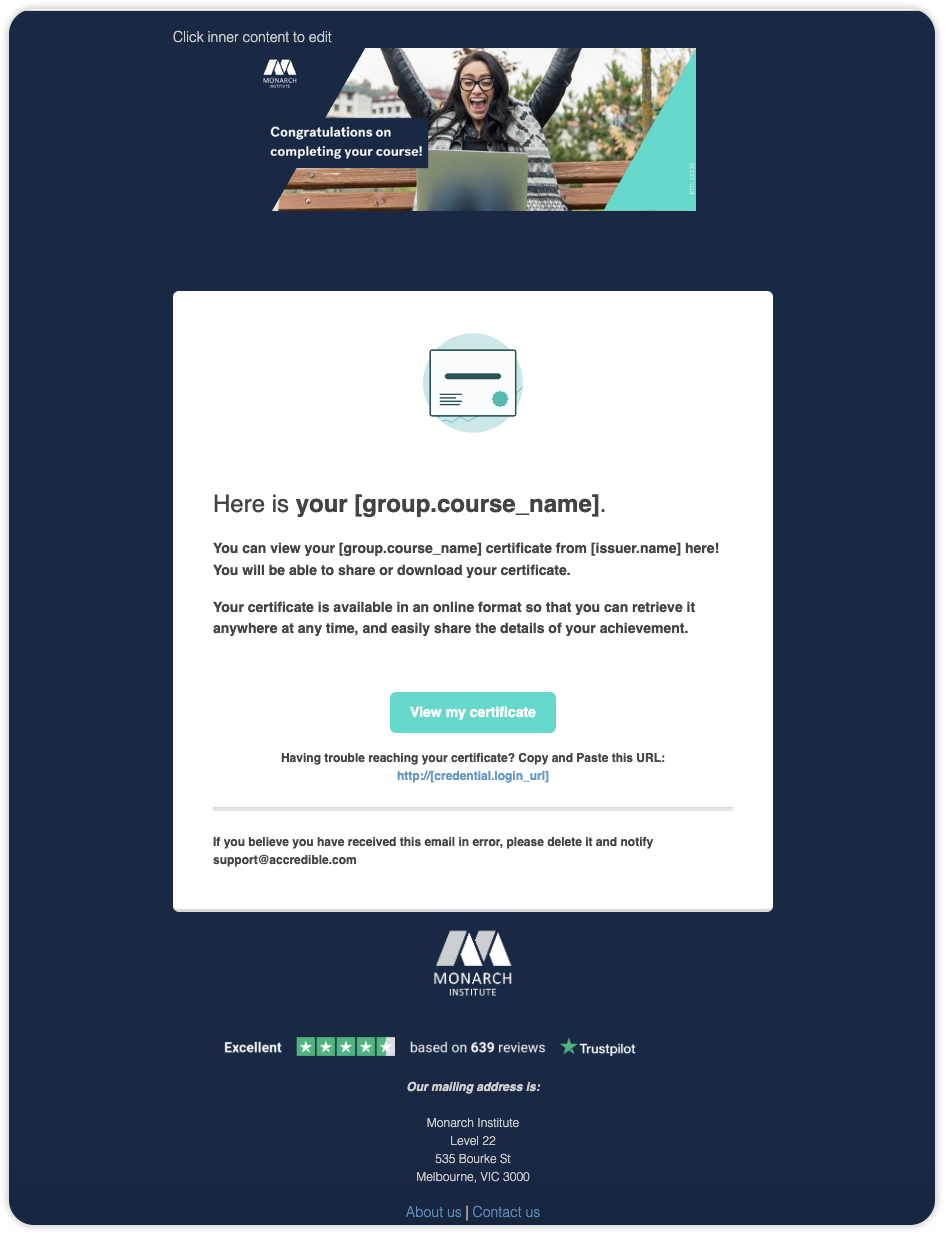
Brand recognition builds trust and drives real results: after launching branded, automated credential emails, George Washington University’s College of Professional Studies saw open rates climb 43.1%.
Follow-Up
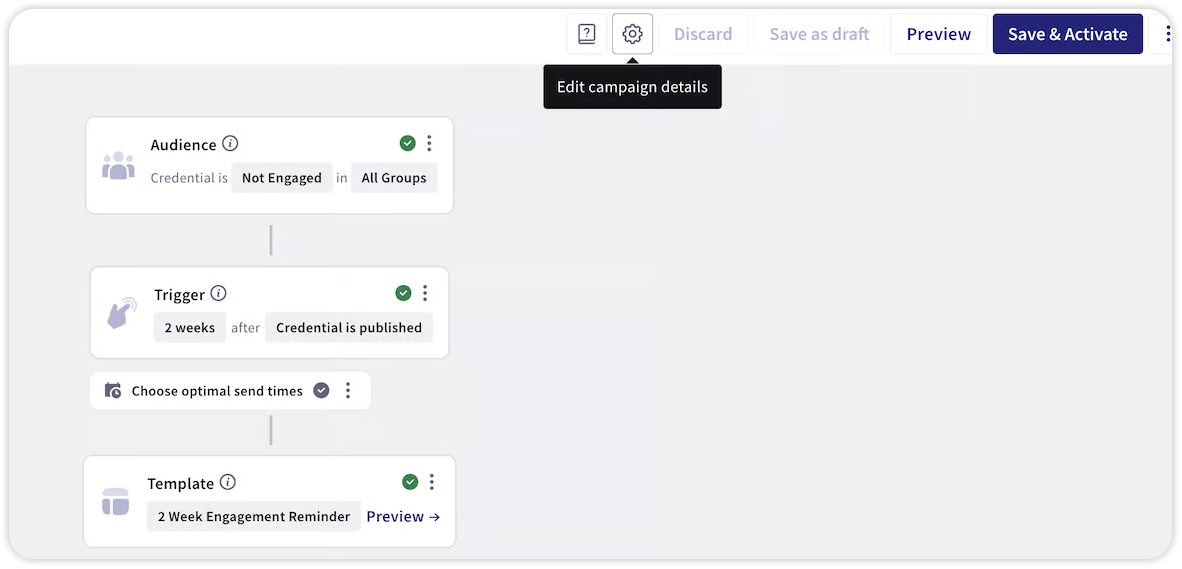
With so many emails sent every day, a single email easily gets lost in a busy inbox. A recipient might miss it entirely, or open it and get pulled into another task before finishing it. Follow-up emails catch these recipients with a reminder to open and engage with their digital credentials. On average, sales emails generate the highest engagement between the 6th and 12th follow-up.
Accredible’s Email Campaigns feature automates this sequencing for you, so recipients get a congratulations email followed by a timed reminder without any manual follow-up from your team. Iowa State University built this exact approach into its program, automatically sending a congratulations email and a follow-up one week later to any recipient who had not yet opened their credential.
How do you increase engagement once the email is opened?
Using the tips above, recipients are more likely to open their credential email. To encourage more than just a brief look, the email should be the right length, contain useful information, and a clear call to action in the email that ensures recipients understand the next step.
Explain Value
Digital credentials are rapidly growing in popularity, but this may be the first time the recipient has received a digital credential in this way from your organization. After a congratulatory intro, make sure to briefly explain the value of the credential they have received. For example, if the digital credential reflects a new skill, advise the recipient that this can be added to their resume or LinkedIn profile. If the digital credential represents association membership, provide some benefits of presenting their credential in relevant locations.
Explaining the value only works if recipients can act on it easily. When The Maker Group removed the login requirement that stood between recipients and their credential, its share rate rose from under 25% to over 80%.
Instruct Use
Provide clear guidance on how recipients can get the maximum use from their credential using a video guide or short snippet that links to a digital credential landing page or FAQ on the issuer website. Video is the most popular form of informational content, which can be embedded directly into the email. If choosing to include step-by-step instructions, ensure these are kept concise, and where necessary, link to an external page so the email doesn’t become too long.
The Accredible Knowledgebase provides a library of helpful instructional information that can be linked to from the delivery email or used to create help documents in the issuer voice. Examples include:
- How to embed a credential in an email signature
- How to embed a credential on a web page
- How to add a credential to LinkedIn
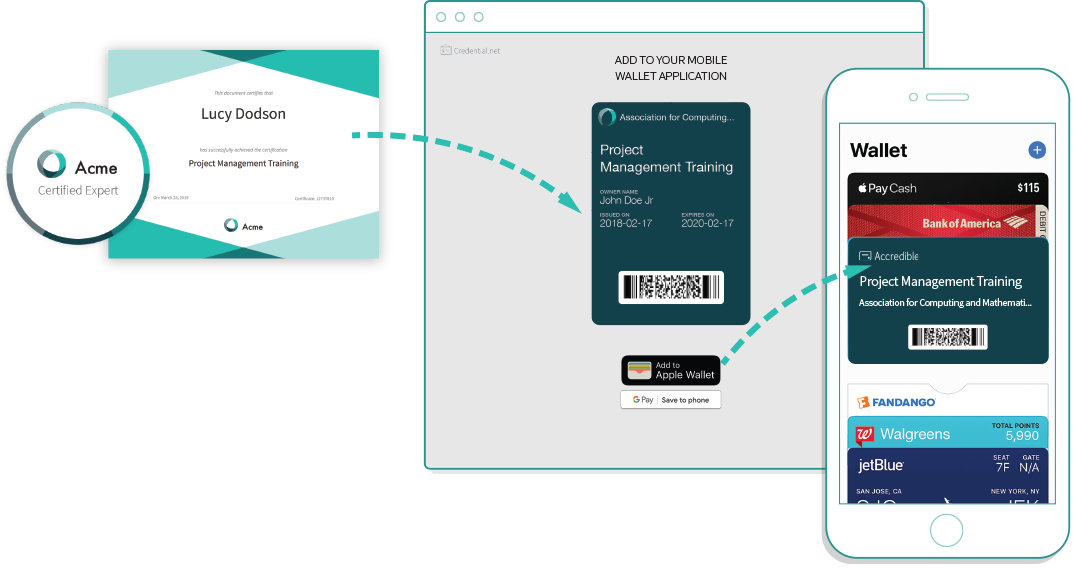
Recipients can also access their credential outside the email entirely. Accredible’s Digital Wallet Cards let them save it directly to Apple Wallet or Google Wallet for quick, on-the-go verification.
Ensure Access
Accessible emails are a necessity in today’s world where an estimated 41.9% of all emails are opened and viewed on a personal smartphone. If the email doesn’t appear or load correctly on the device, recipients are more likely to delete it and ignore further emails. Custom email templates on the Accredible platform have been built to work reliably across popular smart devices. When creating emails outside the platform, test across multiple devices to ensure recipients aren’t restricted from accessing their credentials.
Device access is only half the equation. The biggest barrier to engagement is often what happens after the recipient clicks through: many platforms require them to create an account before they can even view their credential. Accredible’s One-Click Acceptance removes that step entirely, so recipients can view, accept, and share their credential the moment they open the email.
Call to Action
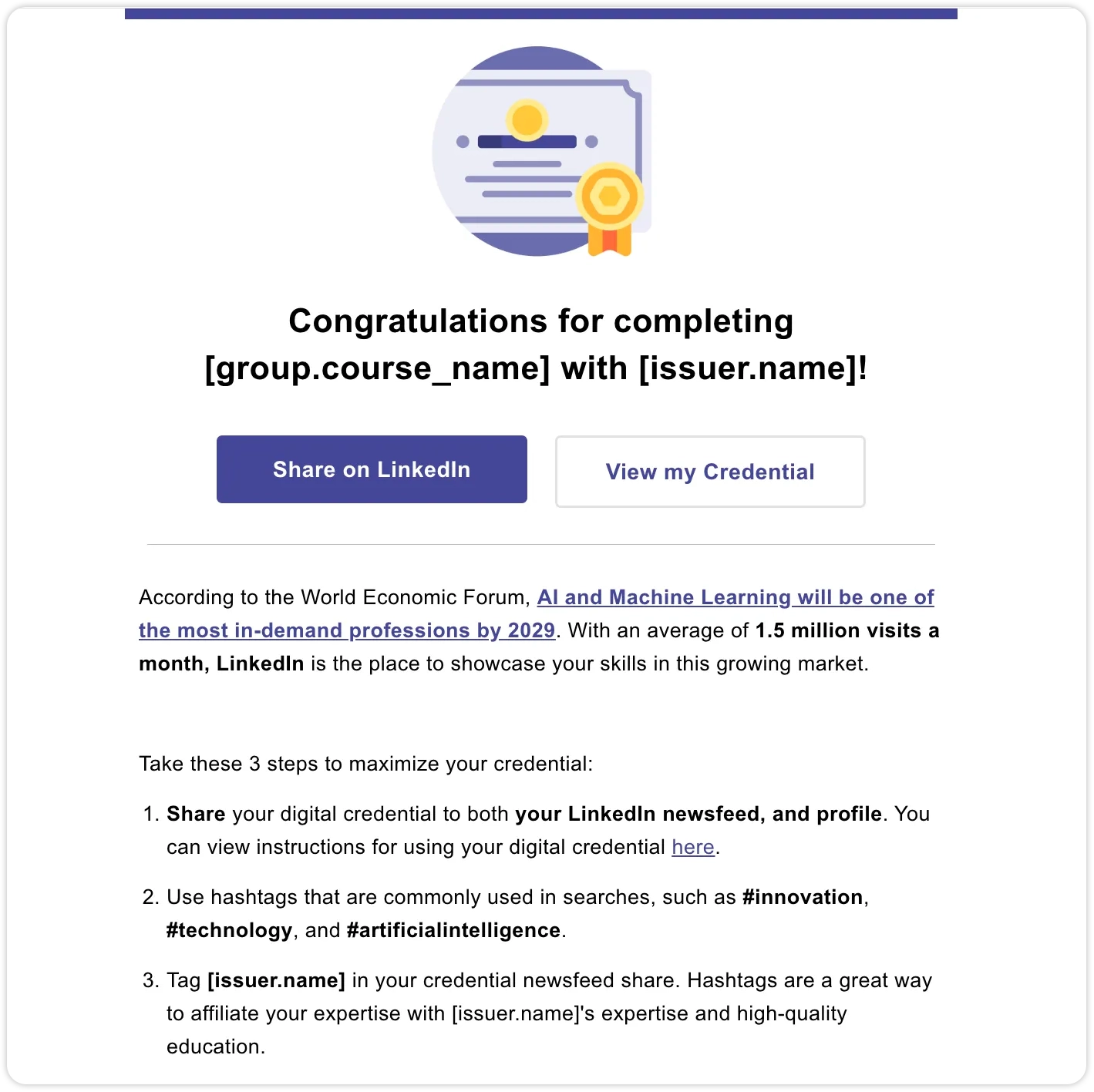
The CTA in a credential email tells recipients what to do next. Where that CTA points depends on the credential’s purpose and your organization’s marketing goals. You can add multiple CTA buttons to a single email, but design them differently so there is a clear primary action and a clear secondary action.
For example, if you are trying to grow your organization’s LinkedIn presence, the primary CTA would encourage recipients to ‘Share Credential to LinkedIn’, while the secondary action would be ‘View Credential’. A common design trend for primary and secondary action buttons is to use a solid color button for the primary action and an outlined button in a secondary color or simply a bold text link for the secondary action. The use of design elements in this way provides options to the recipient while directing focus on the preferred next step.
Don’t Rely on Email Alone
Email is not the only channel available to reach recipients. Accredible’s SMS Engagement feature lets issuers deliver key credential moments, like the initial delivery notification or a follow-up reminder, by text message. SMS open rates typically outperform email by up to 30%, making it a useful backup channel for recipients who are slow to check their inbox.
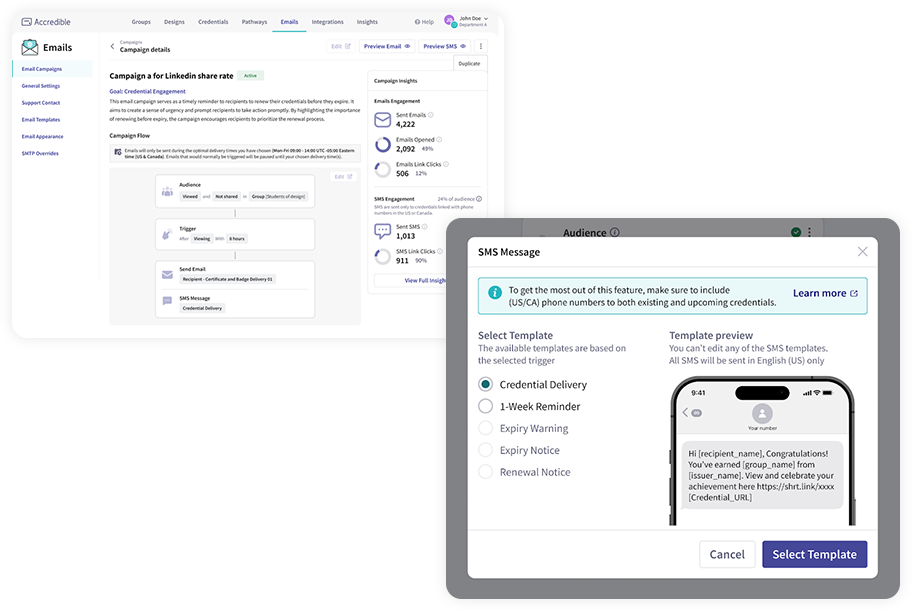
How does Accredible help increase credential email engagement?
Accredible gives issuers full control over the credential delivery email, from personalization and branding to automated follow-up sequences, without requiring recipients to create an account to open or share what they earned. Accredible enables organizations to:
- Send fully branded, white-labeled credential emails from their own domain
- Automate multi-touch follow-up sequences for recipients who have not opened their credential
- Personalize subject lines and body content with dynamic recipient, course, and skill data
- Let recipients accept and share credentials with One-Click Acceptance, with no login required
- Track open, click, and share rates in real time to see which emails are working
In Summary
The Accredible digital credential platform provides everything an issuer needs to create emails that encourage open and engagement rates from recipients. Customize the subject, body content, and CTA of the email and include automatically generated personalization that pulls through the relevant recipient details. In the email body, the issuer can easily embed helpful video content, link to informational pages on their own website, or include concise step-by-step instructions for using the new credential. Follow-up emails can be sent automatically to ensure recipients are encouraged to share and celebrate their accomplishment should they miss the first email.
Additional features and control are available depending on the chosen plan. Issuers can create an unlimited number of email templates for their credentialing programs on any of the available Accredible pricing plans. Custom SMTP settings are available on the Launch, Connect, and Growth plans. For increased levels of control over the appearance and customization of the credential email, issuers can choose a Connect or Growth plan.
New to digital credentials? Get started with a trial issuer account for up to 20 unique recipients.
For existing issuers, learn more about using advanced branding or white-labeling for emails and credential pages, or talk to us about your program today.
Frequently asked questions
What is a good open rate for a credential delivery email?
There is no universal benchmark, since open rates vary by audience and channel, but issuers who personalize subject lines, send from a branded domain, and automate follow-ups consistently see open rates well above generic marketing email averages. Track your own baseline first, then measure the lift from each change you make.
What is a certificate email, and how is it different from a credential email?
A certificate email and a credential email are the same thing: the message a recipient gets when they earn a certificate or badge. Some issuers use the terms interchangeably depending on whether their program issues certificates, badges, or both.
Why do email recipients ignore their credential email?
Email recipients typically ignore a credential email for one of three reasons: the sender address looks unfamiliar, the subject line does not clearly explain what is inside, or the email arrived once and was never followed up on. Each of these is fixable with branding, personalization, and automated follow-ups.
Should credential emails come from a branded domain instead of a default one?
Yes. A credential email sent from a recognizable, branded domain builds the trust needed for a recipient to open it in the first place. Emails from an unfamiliar default address are easy to mistake for spam.
Does requiring a login to accept a credential hurt open and engagement rates?
Yes, significantly. Any extra step between opening the email and viewing the credential, especially creating an account, gives recipients a reason to abandon the process. Removing that step is one of the most reliable ways to increase both open and engagement rates.
Further Reading
Ready to turn your credential emails into a stronger driver of program growth? Read our guide, How to Increase Credential Sharing, for a practical playbook on turning every credential into a referral opportunity, covering:
- Removing the friction that stops recipients from sharing
- Designing credential pages and emails that recipients want to share
- Turning shares into new enrollments and referral traffic
- Measuring the sharing behaviors that matter most


