


After 13 years and more than 208 million digital credentials, one thing has held true: each chapter has made credentials easier to trust and better at showing what someone can do. Digital credentials took us past paper, with verification, sharing, and room for real context. The chapter starting now is about credentials that keep up with the work.
Over the last year, the demand for credentials that keep up has become urgent. Products change faster than ever, and the skills to use them change right along. We see it most in product certification, and especially in software and AI academies, where the work people do is already recorded in the product. A certification does its job on exam day. Keeping it current is the hard part: we’ve found that product certification programs typically see recertification rates between 5% and 30%, which means most users don’t renew.
Today we’re announcing Live Credentials, and I believe they’re the next evolution of credentialing. A Live Credential stays current through real product use, so certified users renew by doing the work they already do, without retaking an exam. Our own platform certification already runs on one, and so does Asana’s Workflow Specialist Certificate.
What Is a Live Credential?
A certification shows someone met the standard. A Live Credential shows they’re applying it regularly. It’s a digital credential that updates as the person who earned it applies their skills, and the skills it shows are checked every day against real work.
Certifications recognize meaningful achievement. Live Credentials extend that value with continuous, verified evidence of real-world skill application. They join the digital certificates and badges you already issue, and you decide which fits each achievement.
Why Product Certification Renewal Breaks Down
New features launch every quarter, and rebuilding an exam at that pace isn’t realistic. With one to three years between checks, nobody knows how proficient a certified user is in the meantime. Each lapse also takes with it any signal about whether that person still uses the product.
Certified users run into the same problem from the other side. If you work inside a product every day, you’re asked to stop, re-study what you already know, and sit an exam much like the one you passed. Most people don’t, and I don’t blame them. Nobody wants learning a product to turn into a second job.
How Live Credentials Work
Typically, a person earns the certification a program already issues, then opts in to ongoing verification. A program can also issue a Live Credential on its own, with no exam. Either way, it works like this:
- The program defines a rubric: the behaviors that show someone is currently proficient, often drawn from the original certification standard.
- The program sends us activity data from its product through an automated feed. Our team configures that connection and handles the evaluation, so programs don’t have to build the measurement themselves.
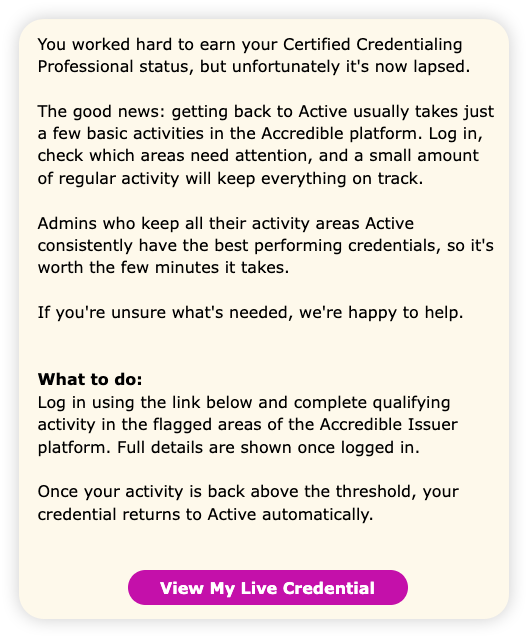
- Each skill carries a status of Active, At Risk, or Lapsed. When a certified user’s activity on a skill slips, its status moves to At Risk, and they get a reminder of what to do next.
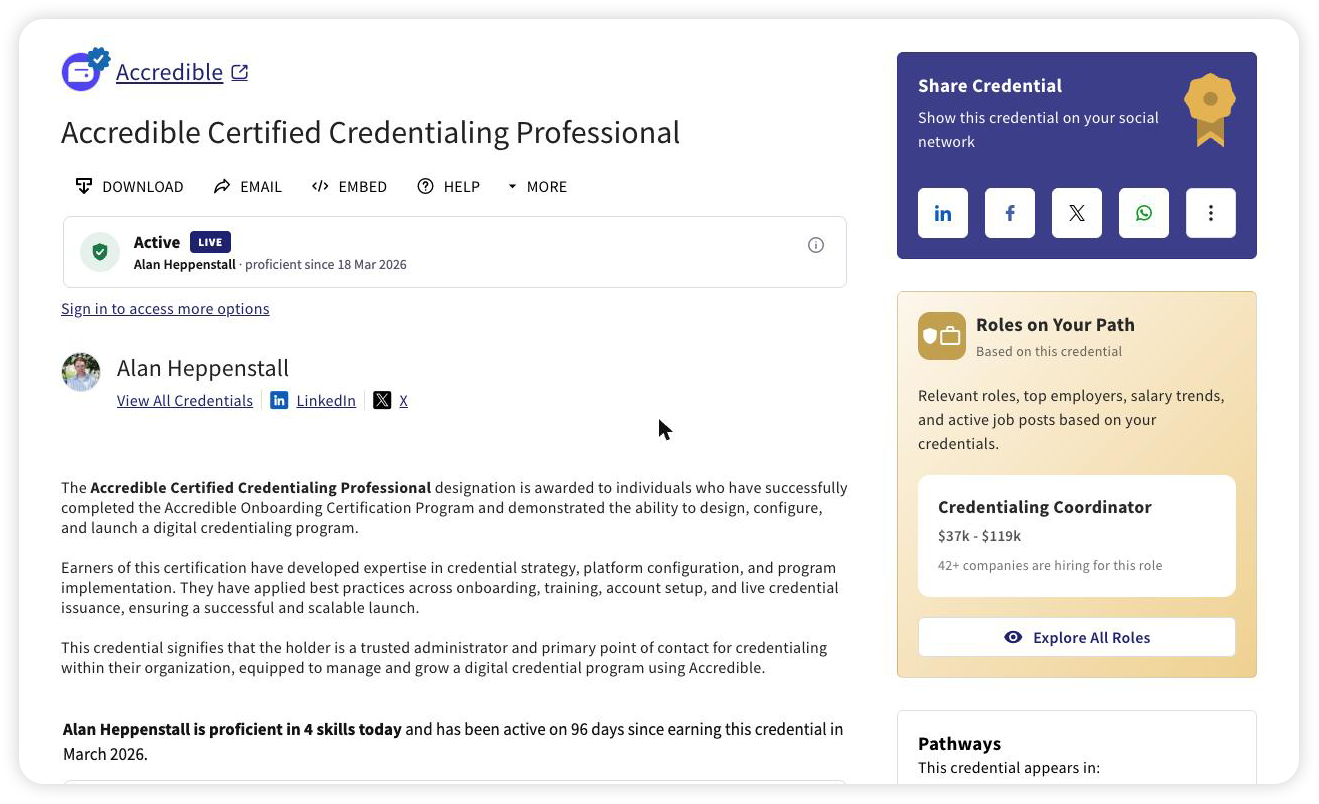
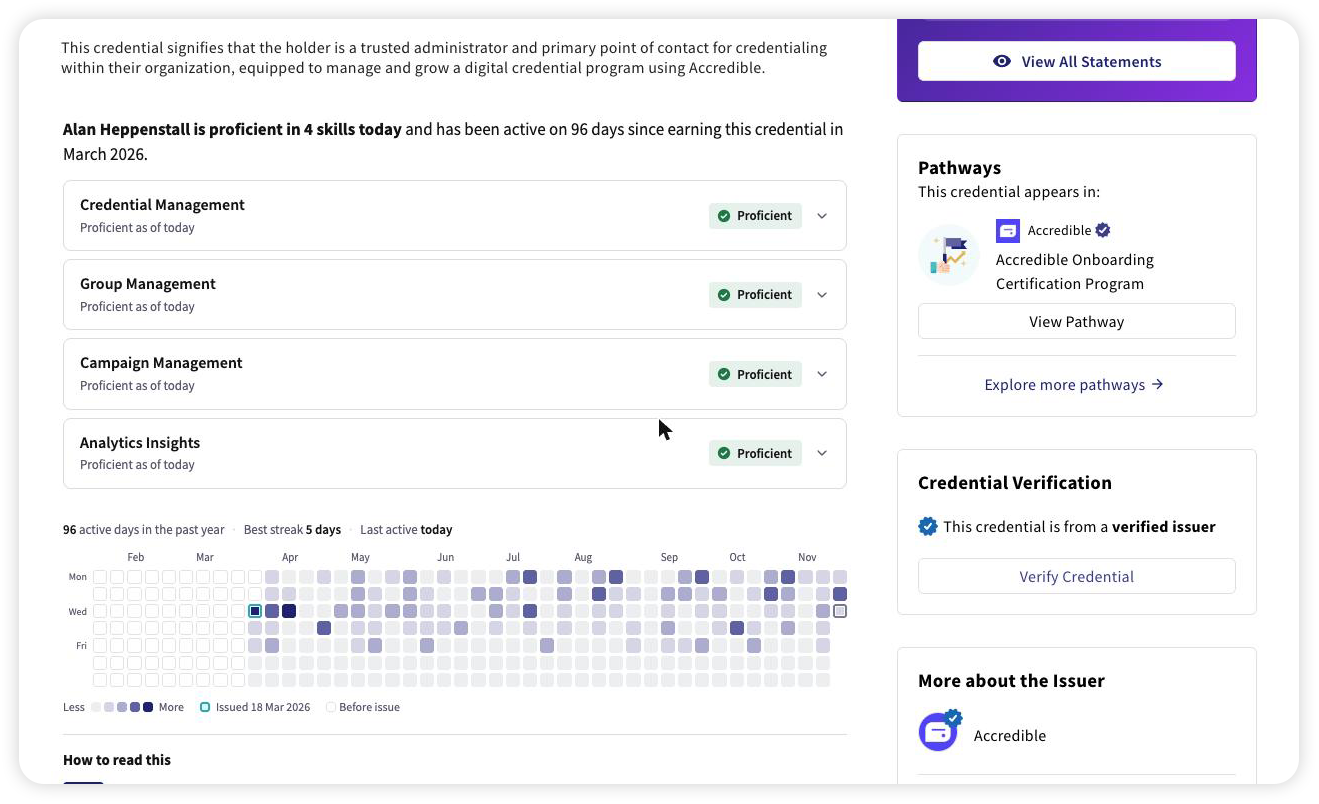
Certified users and programs see every skill’s status. Anyone who views a Live Credential sees which skills are current today. The page also shows an activity graph, so a visitor sees the evidence behind each skill. And when a new feature launches, the program adds it to the rubric and credentials start tracking it, with no new exam to build.
What Changes for Certified Users and Programs
For certified users. The credential reflects work they’re already doing, and renewing a certification no longer means retaking an exam. They can see which skills need attention and what to do next, so staying certified comes from using the product.
For programs. Each skill’s status shows who is slipping before it lapses, which gives you a reason to reach out while it still matters. You also get a signal that used to disappear at renewal: whether certified users still work in your product. And because certified users see which skills need attention and what to do next, you can point them toward the features you want them using, including new ones.
See Live Credentials in Action
Our own certification. We issued our first Live Credential in March 2026 for our own platform certification, the Accredible Certified Credentialing Professional. Its rubric covers four areas: credential management, campaign management, group management, and analytics, each tied to what people do in the platform. You can view our CTO Alan Heppenstall’s Live Credential and see that he has been proficient since March 18, 2026, and which skills are current.
Asana. Asana, named Program of the Year in our 2025 Certified Impact Awards, has issued more than 3,000 Live Credentials to holders of its Workflow Specialist Certificate in the first month of its beta, with plans to expand access to the wider community in the coming weeks.
“Our most active Workflow Specialists are already proving their skills in Asana every day,” said JJ Janikis, Head of Customer Education at Asana. “A Live Credential lets that work count toward their credential.”
View an Asana Live Credential to see one in use, hosted on Asana’s own domain.
What Stays the Same
Your current program keeps running as it does today. Credentials you’ve already issued stay as they are.
Whether an exam is part of earning a credential is up to you. A Live Credential can sit on top of a certification you already issue, or stand on its own with no exam, and many programs will use both. You can start with a single certification and expand from there.
Where Live Credentials Go Next
Proof of skill has mostly come from stopping work to take a test. Tests will keep their place. With Live Credentials, the work itself can also become the proof.
We’re starting with product certification, where the work people do is already recorded in the product.
The same approach applies anywhere ongoing proficiency matters. Professional associations, for example, can track continuing professional development from real activity, such as events attended and courses completed, instead of reviewing submissions by hand. We’re building this with early programs, and what we learn from them will shape what comes next.
Get Started with Live Credentials
We started Accredible because a name or a grade never told the whole story of what someone could do. Live Credentials are the biggest step we’ve taken toward telling that whole story.
To see what a Live Credential could look like for your certification, visit accredible.com/live-credentials and request a demo. If you’re already a customer, reach out to your customer success manager.
Frequently Asked Questions
What is a Live Credential?
A Live Credential is a digital credential that updates as the person who earned it applies their skills. Each skill carries a status of Active, At Risk, or Lapsed that changes with real product activity, and anyone who views the credential sees which skills are current today.
Does a Live Credential replace the certification exam?
No. Whether an exam is part of earning a credential is up to the issuer. Typically, a person earns the certification a program already issues, then opts in to ongoing verification, and a program can also issue a Live Credential on its own, with no exam. Live Credentials add to the digital credentials and digital badges a program already issues; they don’t replace them.
How is a Live Credential different from an expiration date?
An expiration date marks when a credential would stop being valid. A Live Credential checks each skill against real activity every day, so it shows which skills are current today, and qualifying activity moves the expiration date forward. The date then shows when the credential would expire if no further qualifying activity is detected. Programs can also revoke, reinstate, and renew credentials; our post on credential statuses covers when to use each.
How does a Live Credential stay current?
Certified users typically opt in after they earn the certification. The program defines a rubric of the behaviors that show current proficiency and sends us activity data from its product through an automated feed. We evaluate that activity against the rubric. Our team configures that connection and handles the evaluation, so the program doesn’t need to build the measurement itself. When a new feature launches, the program adds it to the rubric and credentials start tracking it.
What does a program need to get started?
A program brings a rubric, an automated data feed, and approval to share the data. The rubric defines the skills the credential stands for and what counts as evidence for each. The feed carries activity data from your product to us through an API, a webhook, or a data platform such as Snowflake or Databricks, and it has to cover your whole certified cohort before launch. Your security, legal, and privacy teams approve sharing it.
The feed is the main lift, so bring whoever will build and run it in early. We handle the configuration, credential issuance, emails, and reporting.
What happens when a certified user’s activity slips?
The skill’s status moves from Active to At Risk, and the certified user gets a reminder of what to do next. The program sees who is slipping before the skill lapses.
Who are Live Credentials for?
We’re starting with product certification programs. Professional associations can also use Live Credentials to track continuing professional development from real activity, such as events attended and courses completed.
How do I get started?
Live Credentials are available now. Visit accredible.com/live-credentials and request a demo. If you’re already a customer, contact your customer success manager.


