

Hello and welcome to Certified Insights from your digital badging friends at Accredible. You’re in good company with 50K+ education and training leaders.
Each month, we share tips and strategies to help you grow your credentialing program. Up next:
📣 3 findings from the 2026 State of Credentialing, and what to do about each
💬 What would do the most to settle the value question?
📚 Certified Reads on Georgetown's middle-skills springboard jobs, Education Design Lab's skills validation stories, and Workforce Pell's slow rollout
Nearly every learner wants to know where their credential can take them. Few programs show them.
It's the widest of several gaps in this year's data, and all of them matter more now that leadership, funders, and future learners want proof.
This issue pulls three findings from the 2026 State of Credentialing report, built on surveys of 1,000 learners and 200 credential issuers. Each comes with something you can act on now:
Claim what you deliver
We asked learners what they expected a credential to help them do, then whether it happened. Among those who expected each outcome, the ones nearest the learning land most reliably: 89% came away more confident in their skills, and 82% proved their expertise to an employer. The further out you go, the lower it gets: for a new job, 53%.
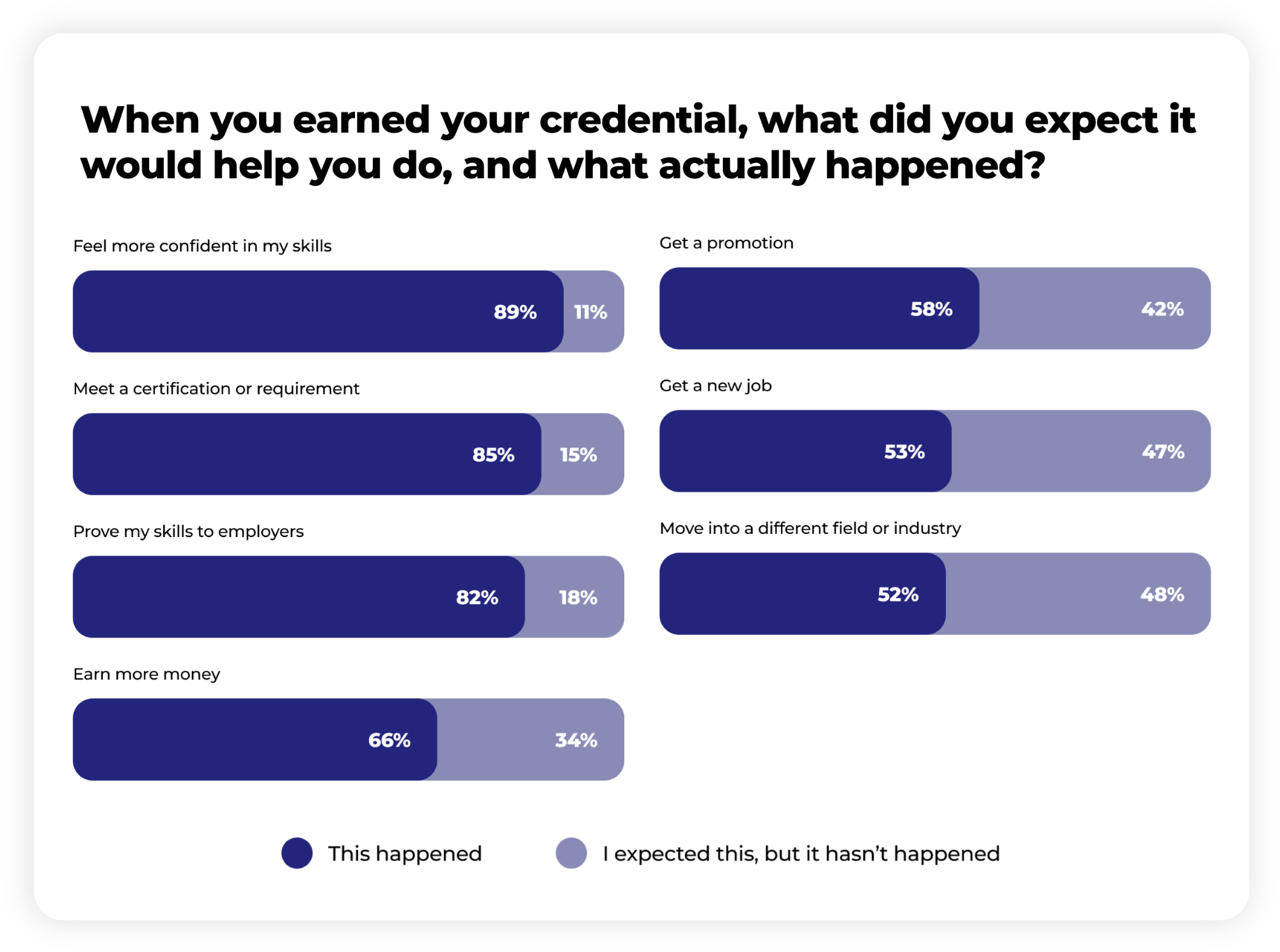
Learners don't read that as falling short. Asked how much their credential contributed, 84% called it the primary driver or a significant contributor. The credential mattered. It usually wasn't the only thing that mattered.
That's how to talk about your program. Promise the outcomes nearest the learning: skills, confidence, and proof an employer can check. Present jobs, promotions, and raises as outcomes you contribute to. That's the same distinction your learners make.
Frank Sorokach, Associate Teaching Professor of Business and Economics at Penn State University, has watched that play out with his students. One, with no work experience, added a rigorous supply-chain credential to his LinkedIn profile. Within two weeks, three Amazon recruiters reached out, and he landed a job there. The credential got him noticed. He did the rest. It's why Frank pushes every student to post what they earn: "If they don't signal that they have this skill, they essentially don't have the skill."
Answer learners’ four questions
Some good news first: 67% of learners received guidance on sharing or using their credential, up from 57% in 2024. Sharing was the easier problem. After earning a credential, learners still have four questions, and each has a gap with a fix you control.
What did I prove? 44% of learners want a clearer description of the skills they learned. Stacy Caldwell, President and CEO of CredLens, traced it to language on our webinar panel. Employers and educators describe the same skills differently, "and we're sort of relying on the individual to have to do the translation."
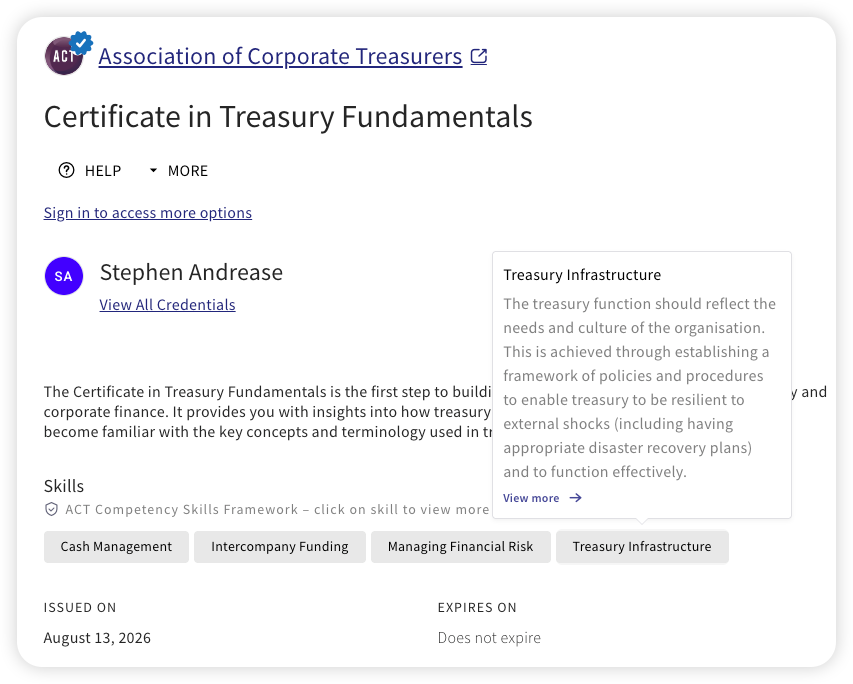
The fix is describing skills in terms employers already use, often by tying each one to a recognized framework. The Association of Corporate Treasurers (ACT) links every skill on its credentials to its competency framework, so someone hovering over "Treasury Infrastructure" sees what it means without knowing ACT's programs.
Where can this take me? This is the gap I opened with: 99% of learners want to see how their credential connects to career opportunities, and 21% of issuers help them make that connection.
Learners were specific about what they'd want to see: career paths, the job titles tied to their skills, companies hiring for those skills, and typical salary ranges. The most persuasive version is what people like them went on to do. Only 14% of issuers share outcome examples, and that evidence comes from the follow-up below.
What should I do next? 85% of learners plan to earn another credential in the next two years. Only 7% of issuers offer personalized recommendations, the least common form of support we measured. The fix is putting a relevant next step in front of learners at the moment they earn. One professional education program at a major research university added relevant next courses to its credential pages and digital credential delivery emails, and the share of earners who took another course grew from roughly 35% to over 50%.
How does opportunity find me? 91% of learners would opt into a searchable online directory of credential holders to connect with future opportunities. Yet only 21% of issuers offer one. Don't assume your learners are too private for it. The North American Veterinary Community expected low opt-in from an audience reluctant to publicize its achievements, and 97% opted in.
All four questions depend on the same thing: staying in contact with learners after issuance. And the follow-up that answers the learner's question also produces the evidence leaders are asking for.
Ask, and keep asking
In the same year demonstrating value became the top priority, the share of issuers with a structured process for tracking learner outcomes fell by nearly half, from 33% to 17%. They're separate measures, and I'd stop short of calling one the cause, but that's the bind: asked to prove more, with less measurement to do it.
Six months after issuance, 49% of issuers know whether it was viewed or shared. 32% know nothing at all. Visibility is strongest for what happens automatically and fades toward the outcomes people ask about.
Asked to demonstrate value, issuers lean most on platform engagement data and learner surveys, 52% each. Near the bottom: employer feedback, hiring data at 13%, wage data at 10%, and labor market data at 9%.
The top of that list describes what the credential did: opened, shared, completed. The bottom describes what happened to the learner. The people asking for proof mostly want the bottom half. Most programs are answering with the top. One source from the bottom, like employer feedback or placement data, changes the conversation with leadership.
That evidence lives with learners. In the six months after earning a credential, 45% of learners were never asked what happened, and another 31% were asked once. One issuer described the rhythm: "Establishing defined touchpoints — 6 months, 12 months, 2 years — to ask the same questions and rate how they attribute their credential to outcomes." A free post-completion survey template makes the first of those asks a small one.
Most programs issue credentials directly to their learners. City & Guilds issues through colleges and training centers. Alexandra O'Connor, Senior Manager, Skills Solutions: Service Delivery & Design, surveyed those earners anyway and came away with about a dozen case studies. Her manager had been asking for them, but her own reason went further: "We could talk all day about how good credentials are, but we couldn't put a learner voice to it."
Close the loop
Here's what changes when a program does this:
Together, they make a loop. Define what the credential delivers, show learners where it leads, ask what happened, and what they tell you becomes what you show the next cohort. Keeping that loop running is where the strongest programs pull ahead, and it's where I'll pick up next month.
Your learners already say the credential mattered. The next step is making sure your program can say it, too.
Read the full 2026 State of Credentialing report →
Missed the panel? Watch the on-demand webinar with Stacy, Alex, and Rochelle.
Until next time,
Ryan
Senior Director @ Accredible
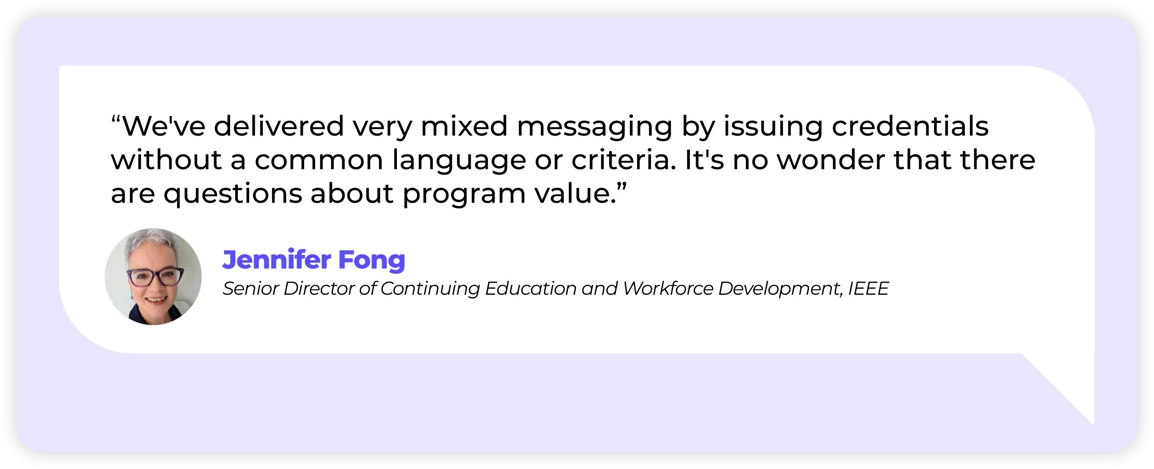
Jennifer's point is uncomfortable because it includes all of us: some of the pressure to prove value is pressure we created. What would fix it most: shared skill language, common quality criteria, employers in the design room, or outcome data? 📩 Reply with one. I'll share the results next month.
Making Skills Visible — Education Design Lab
Three learner stories from the Lab's Walmart-supported XCredit pilots find confidence and professional identity arriving before job offers do. One career changer is still interviewing for a cybersecurity role, and already reports clear gains in confidence and interview performance
Springboards to Opportunity — Georgetown University Center on Education and the Workforce
CEW identifies 159 middle-skills "springboard" occupations with high starting pay and strong wage growth for certificate and associate's holders, and projects credential production will fall short of demand in all 55 of the largest US metros.
Workforce Pell's Slow Rollout — The Chronicle of Higher Education
Five programs had federal approval as of mid-September. Colleges point to 70% completion and placement thresholds, state-by-state approvals, and thin noncredit data. One state official: "the noncredit crew kind of was just off in the corner… but no tracking."
2026 Convergence — October 13–15, 2026
UPCEA and AACRAO's conference on alternative credentials, built for institutional strategy leaders, registrars, and anyone working in credential innovation.
I.C.E. Exchange — October 19–22, 2026
The annual gathering for certification and credentialing bodies — program operations, standards, and the business of certification.
RevUP Summit 2026 — November 3–5, 2026
A summit for association leaders who own revenue, focused on how to price, package, and design programs members will pay for.
Tired of juggling paper certificates, PDFs, and endless manual processes to track learner achievements?
Or running into scaling limitations with your current digital credentialing solution?
Accredible has you covered. Create and issue branded digital credentials that showcase skills and provide real value — without the hassle.
Know someone who'd find value in Certified Insights? Forward this email and invite them to subscribe.
Did a friend forward this email to you? Sign up to get this newsletter next month.

Accredible is the world’s leading digital credential platform, enabling education and training leaders to increase learner engagement and drive program growth.


Accredible is the world’s leading digital credential platform, enabling education and training leaders to increase learner engagement and drive program growth.

