


Adding skills to credentials is one of the most meaningful upgrades an issuer can make — moving from "this person completed something" to one that says "here are the specific skills they developed." According to the 2025 State of Credentialing Report, 91% of HR and talent leaders look for digital credentials when reviewing candidates, and 86% say credentials showing key skills make them more likely to interview.
But leading programs often take a next step: tying those skills to a recognized framework. Whether that's an external standard employers already reference in hiring decisions (e.g., O*NET, ESCO, NACE) or a taxonomy the organization has built and wants to make visible on their credentials, the goal is attribution. When skills point to a recognized source, the credential doesn't have to explain itself. Employers and evaluators see what the learner developed and the framework that defines what it means.
The gap between intention and infrastructure is real. According to our 2025 Skills Frameworks Survey, more than 80% of Accredible issuers already use or plan to use a recognized skills framework, and 65% rate skills alignment as very important to their program's credibility. Until now, the platform support hasn't matched that.
Today, that changes.
Accredible’s Skills Frameworks capability lets issuers align credentials to recognized external frameworks — O*NET, ESCO, and NACE Career Readiness Competencies at launch, with more to come — or upload and manage their own. Available on our Connect and Growth plans.
It builds on the skills capability already in Accredible, extending what those skills can mean once a credential leaves your program.
What Skills Frameworks Does
When a skill is tied to a recognized framework, it carries that framework's authority on the credential itself. A learner shares a credential with an employer who doesn't know your program intimately — attribution explains the skill without anyone having to translate it.
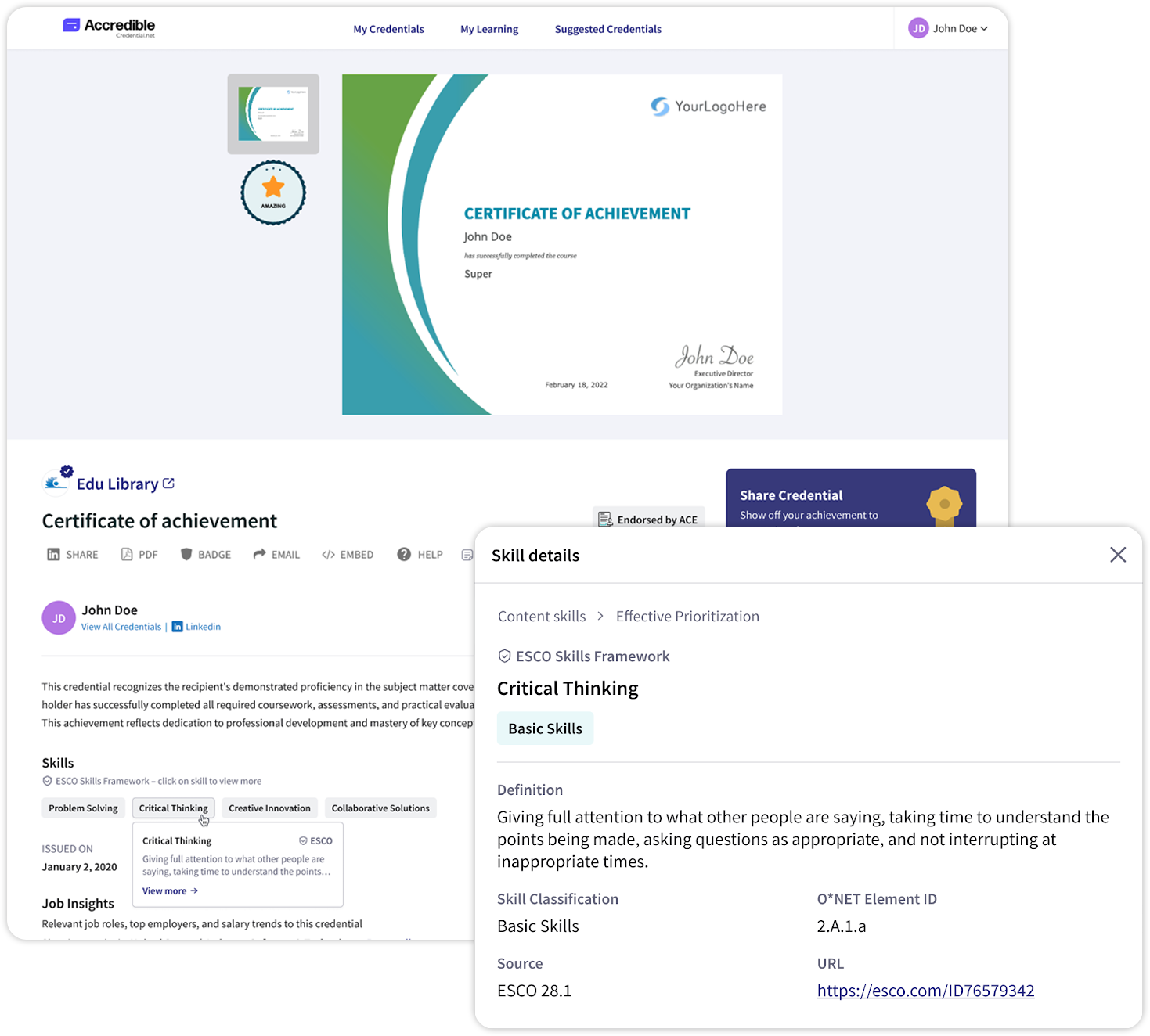
For organizations that have already built their own taxonomy, the dynamic is the same, but the framework is yours. Issuer-uploaded frameworks apply the same attribution structure to competencies you've defined, giving your vocabulary the same visible, verifiable presence on the credential as any external standard.
Setup works at the group level. Org admins choose which frameworks are available and which departments can configure them. Departments select the framework that fits their scope. Skill selections apply across all credentials issued from that group — including credentials already issued, which update automatically.
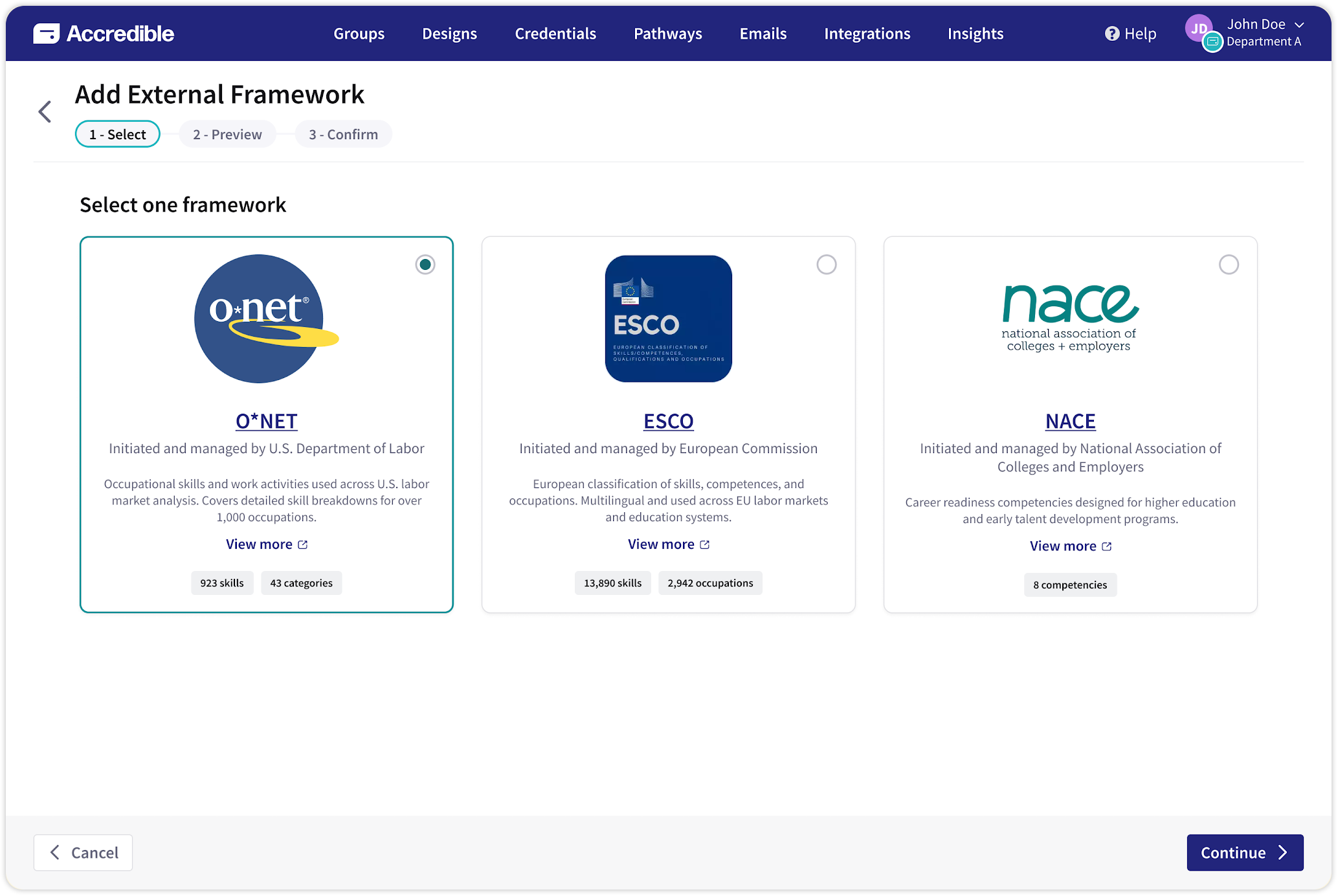
What doesn't change: the standalone skills your program already uses. Framework-aligned skills and standalone skills coexist in the same account. Different groups can use different sources. The decision lives at the group level, on your timeline.
Sherri Place, Director of Instructional Design and Content Strategy at Wharton Executive Education, put it this way: "While the Wharton name is recognizable, our learners also need digital credentials that showcase the skills, abilities, and habits of mind they develop in Wharton Executive Education programs. Skills Frameworks gives us a way to do that consistently, across everything we issue, so learners don't have to rely on our name to prove it."
The Part That Often Gets Missed
A landmark 2026 study by OneTen and Burning Glass Institute found that firms in the top 10% of "credential fluency" — defined as mapping credentials to roles, embedding them in hiring systems, and training managers to evaluate them — hire non-degree credentialed workers 11 percentage points more often than firms in the bottom 10%. Dropping degree requirements alone moved the needle by just 2 points.
The difference isn't policy. It's recognition infrastructure. A credential tied to a framework an employer already uses is a credential that can be evaluated without a translator.
That's a different ceiling for what your credential program can do in the market.
What's in This Release
External frameworks: O*NET, ESCO, and NACE Career Readiness Competencies at launch, with more frameworks to follow. Framework skills carry authoritative definitions and attribution visible on every credential.
Issuer-uploaded frameworks: Upload your own taxonomy — names, definitions, versions, retirement — and apply it the same way as any external framework. Draft, publish, and manage in the dashboard.
Org and department-level configuration: Enable frameworks at the org level, make them available or required by department, and lock settings to prevent override where needed.
AI-assisted tagging: When migrating a group to a framework, AI suggests skill matches. You review and confirm before changes apply.
Audit history: Every change logged — who made it, what changed, which groups were affected, when.
See Skills Frameworks in Action
Skills Frameworks is available now on our Connect and Growth plans. To learn more about how it works in the Accredible platform, watch the overview below.
You can also join us live on August 26 for "Align Your Credentials to the Frameworks Employers Already Trust," a group demo covering Skills Frameworks, Job Market Insights, and how to ensure a framework-backed skill actually builds trust with the people evaluating it. Reserve your spot.
Not on an advanced plan yet? Talk to us about upgrading.
Not yet an Accredible customer? If getting your credentials recognized by the employers and systems your learners are walking into matters to your program, let's talk. Schedule a demo today.
The first frameworks are live. More are coming. The goal stays the same: make credentials more meaningful to the people who receive them — and to the people who need to evaluate them.


