


Hello and welcome to Certified Insights from your digital credential friends at Accredible. You’re in good company with 70K+ education and training leaders.
Each month, we share tips and strategies to help you grow your credentialing program. Up next:
📥 The career outcomes learners will share, and why so few programs ask
💬 What's the real blocker to measuring outcomes in your program?
📚 Certified Reads on Accredible's new Skills Frameworks, 1EdTech's priorities for higher ed, and Burning Glass's mobility research
I've had some version of the same conversation a dozen times this year. A certification director at a software company. A dean running noncredit programs. An association education lead. Different sectors, different vocabularies, same question: how do we prove this program is working?
Most of them can't, at least not yet. And nearly always for the same reason: answering it properly sounds like it takes a research study, a labor market analyst, and a budget line nobody's going to approve.
I think the difficulty is real and the shape of it is wrong. Most of what's being asked for is closer to a collection problem than a research problem — cheaper, though never free, and rarely anyone's job.
The same question everywhere
Our 2026 State of Credentialing research (register to receive the report September 23) shows how widely that pressure is landing: 55% of credential issuers report rising demand to demonstrate value and outcomes.

The share of issuers naming it a top priority doubled year over year, from 22% to 44% — the fastest-growing priority in the study.
In U.S. higher education, the demand arrives with a date and a rulebook. On August 4, the Department of Education approved the first Workforce Pell program, a 14-week emergency medical technician program at Iowa Central Community College. To qualify, a program must meet benchmarks for earnings, job placement, and completion. Financial Value Transparency and Gainful Employment requirements are already in effect, with final reporting for past cycles due January 15, 2027.
Institutions see it coming. In UPCEA’s State of Continuing Education 2026, 67% said they're at least somewhat likely to expand short-term, workforce-aligned programs, while 42% said they aren't prepared for the data collection and reporting those programs require.
Michelle Van Noy, Director, Education and Employment Research Center at Rutgers, put the difficulty plainly: "Everybody's under the most pressure to… show labor market returns in some fashion… but that's one of the hardest things to get."
Most programs will never face a federal reporting deadline. They'll face a executive or board meeting instead.
The willing, unasked population
Here's the pair of numbers I keep returning to. Only 13% of issuers know whether a learner landed a job or a promotion connected to their credential. In a companion survey of 1,000 learners, 93% said they'd share their career outcomes with the organization that credentialed them.

Read those side by side. The evidence sits with people who have already said they'd hand it over. No study to commission, no budget to approve. Nobody is asking them.
I realize stated willingness isn't a response rate. Survey learners, and you'll hear from a fraction of that. But a fraction of 93% is still a great deal more than 13%.
Wendy Palmer, Founder and Principal Consultant at Lifelong Learning Practice, has made this point for a while: "People are sort of focused on the point of issuance… but you've actually got a relationship with the person." She's blunt about what it would take: "Reaching out to someone six months later, a year later, would be incredibly easy."
And the outcomes you'd collect don't only answer upward. Learners have more credentials to choose from than ever, and 37% say they want to see what happened to people who earned the one they're considering. Only 14% of issuers show them. The same evidence that satisfies a board is what makes a program stand out to future learners.
Why the asking stops
If the willingness is there and the ask is cheap, the trend should be moving one way. Unfortunately, it's moving the other. Outcome tracking fell over the past year, from 61% of issuers to 48%.
That's what happens when teams are asked for more evidence as the hours to gather it get thinner. Noah Geisel, Micro-Credentials Program Manager at the University of Colorado Boulder, hears that reasoning around the industry: "Nobody's asking for this. I'm not resourced to gather it. Why should I take it on to go and do it?"
Van Noy's answer to that runs six words: "That doesn't justify not doing it."
Both of them are right, which is the uncomfortable part. Geisel's own diagnosis is that this is rarely about will: outcome tracking sits in nobody's job description. Cheap and owned aren't the same thing. Work that belongs to nobody doesn't get done at any price.
There's a quieter reason it gets deferred, too. Many teams are waiting for the definitive measure — one clean number that settles the value question for good. It doesn't exist, because different credentials serve different purposes. Waiting for it is how programs end up with nothing.
Someone made it count
Some programs decided not to wait. Databricks can answer that question because someone went and got the data. Their own research with certified professionals found that 89% report growth in their current role and 73% have been promoted.
Those figures didn't fall out of the issuing process. Someone decided the question mattered enough to answer. That's the difference I keep seeing between programs that can speak to outcomes and programs that can't. Not better tools — a decision about whose job it is.
What the best programs build
The pressure to show evidence isn't going back down, and more of what's being asked for is closer to hand than the field assumes. Most programs haven't gotten there yet, and the ones who have share a few things in common. That's what I've spent this year trying to pin down.
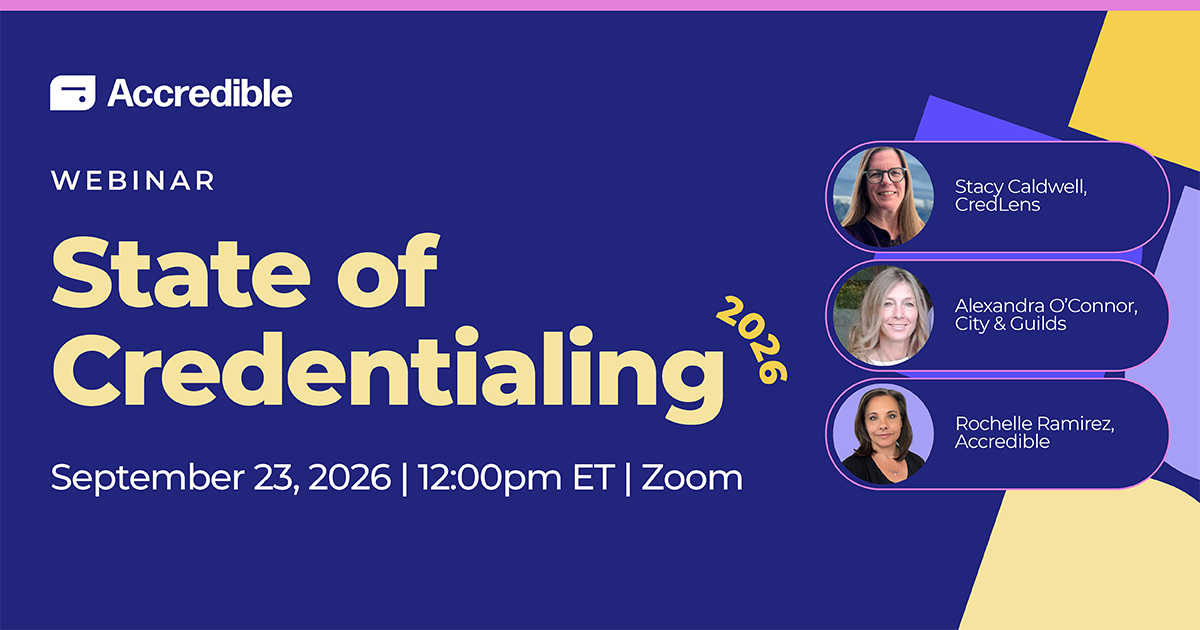
Join me and a panel of credentialing leaders on September 23 for the 2026 State of Credentialing webinar. We'll unpack new data from 1,000 learners and nearly 200 credential issuers, look at what separates the programs that can answer the value question, and get practical about what to build first.
🎙️ Panelists include:
By registering, you’ll also be the first to receive the full report when it’s published. Grab your spot today →
Until next time,
Ryan
Senior Director @ Accredible

That's a 55-point gap, and not a gap in intent.
What's the real blocker in your program? The systems, the budget, privacy and consent, or the fact that it's nobody's job? 📩 Reply and tell me. I'm bringing the most useful answers to the September 23 panel.
Introducing Skills Frameworks: Choose Your Framework or Bring Your Own — Accredible
80% of Accredible issuers use or plan to use a recognized skills framework. Now they can — O*NET, ESCO, NACE, or their own taxonomy, applied across every credential in a group, including ones already issued.
Sidetracked: The Hidden Crisis in Mid-Career Mobility — NYU SPS and Burning Glass Institute
24.2% of mid-career professionals are stalled: five-plus years, no promotion, flat wages. High-quality, market-aligned credentials cut that risk by 52%, against 29% for the average one.
Higher Ed Can Close the Skills Gap—But Only by Rethinking Digital Credentials — evoLLLution
Higher ed collectively employs millions, yet most institutions still hire on resumes and degrees alone. 1EdTech's Rob Coyle argues the fastest way to make credentials count with employers is to start using them in your own hiring.
The 2026 State of Credentialing Webinar — September 23, 2026
New data from 1,000 learners and 200 credential issuers on the rising pressure to prove program value and what the most successful programs do differently, with Stacy Caldwell (CredLens), Alex O'Connor (City & Guilds), and Rochelle Ramirez (Accredible). Register, and you'll be first to receive the full report.
2026 Convergence — October 13–15, 2026
UPCEA and AACRAO's conference on alternative credentials, built for institutional strategy leaders, registrars, and anyone working in credential innovation.
I.C.E. Exchange — October 19–22, 2026
The annual gathering for certification and credentialing bodies — program operations, standards, and the business of certification.
Tired of juggling paper certificates, PDFs, and endless manual processes to track learner achievements?
Or running into scaling limitations with your current digital credentialing solution?
Accredible has you covered. Create and issue branded digital credentials that showcase skills and provide real value — without the hassle.
Know someone who'd find value in Certified Insights? Forward this email and invite them to subscribe.
Did a friend forward this email to you? Sign up to get this newsletter next month.

Accredible is the world’s leading digital credential platform, enabling education and training leaders to increase learner engagement and drive program growth.


Accredible is the world’s leading digital credential platform, enabling education and training leaders to increase learner engagement and drive program growth.

