

Hello and welcome to Certified Insights from your digital credential friends at Accredible. You’re in good company with 70K+ education and training leaders.
Each month, we share tips and strategies to help you grow your credentialing program. Up next:
📣 4+ decisions that turn every credential into a growth channel
💬 How does your program recognize learners who share?
📚 Certified Reads on 1EdTech's latest credential adoption research and Coursera's Micro-Credentials Impact Report
What happens to a credential after someone earns it?
For some programs, not much. It sits in an inbox or an LMS that no one outside the program opens. The learner moves on. So does the program.
The best programs (and my fellow marketing pros) see something different in that same moment: a credential someone's proud of is also the cheapest marketing channel they have. With learner acquisition costs rising and competition for attention only getting louder, that gap matters more than it used to.
In 2025, Accredible customers saw learners engage with 6.8 million credentials — downloading them, adding them to resumes, sharing them across professional networks — a 25% year-over-year increase. Those shares generated over 900,000 referral clicks, up 34%. That's more than one in four credential shares turning into referral traffic from a real person — a potential customer, student, or member discovering a program they'd never heard of before.
None of that happened by accident. It's the result of specific decisions made before a credential goes out, the moment it arrives, and after someone shares it.
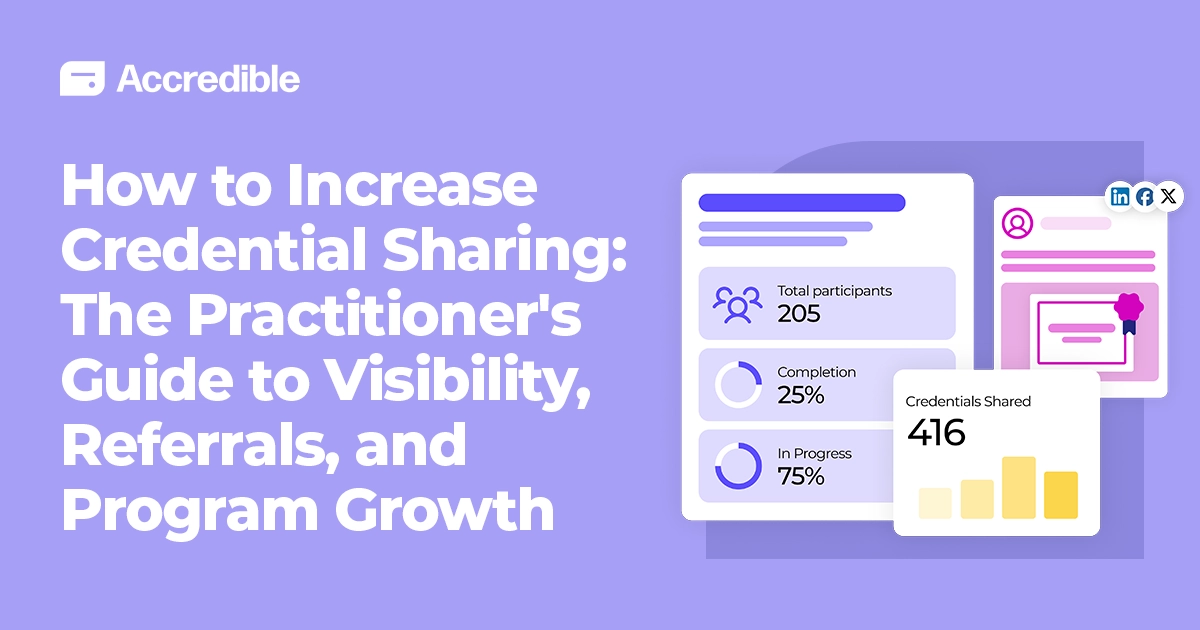
Today, we published a new guide on exactly this, How to Increase Credential Sharing, with the full data and real examples behind every tactic below, plus several more we don't have room for here. Here are four of those decisions.
Most programs explain what a digital credential is and why it's worth sharing in the delivery email. By then, the earner is hearing it for the first time in the same message that says "congratulations," with no time to build any anticipation for it.
The programs with the highest share rates start earlier, so earners understand what they're working toward and get excited to share it well before they've earned it. Amanda Brantner at Gies College of Business at the University of Illinois put it plainly: "We get questions from learners like, 'How do I share this?' or 'What should I do with it?' Helping them understand not just what a credential is, but how to use it, is really important." That's the sign that the groundwork happened during the course, not after it.
The mechanism is simple: a dedicated learner-facing page, on your site or inside your LMS, showing what the credential looks like, what it took to earn, and why it's worth sharing — not just that they'll receive one. Publish it before the first credential goes out. By the time someone earns theirs, sharing isn't a new idea you're introducing. It's something they already decided to do.
Every shared credential links back to the same place: the credential page. That's where the colleague who saw a LinkedIn post lands, where a hiring manager clicks through from a profile, where someone who's never heard of your program ends up without meaning to.
Many programs treat this page as a static record of achievement. But the page becomes an asset the moment it has somewhere to send people — enrollment, a demo request, a program directory — and the moment you can measure what that link is doing.
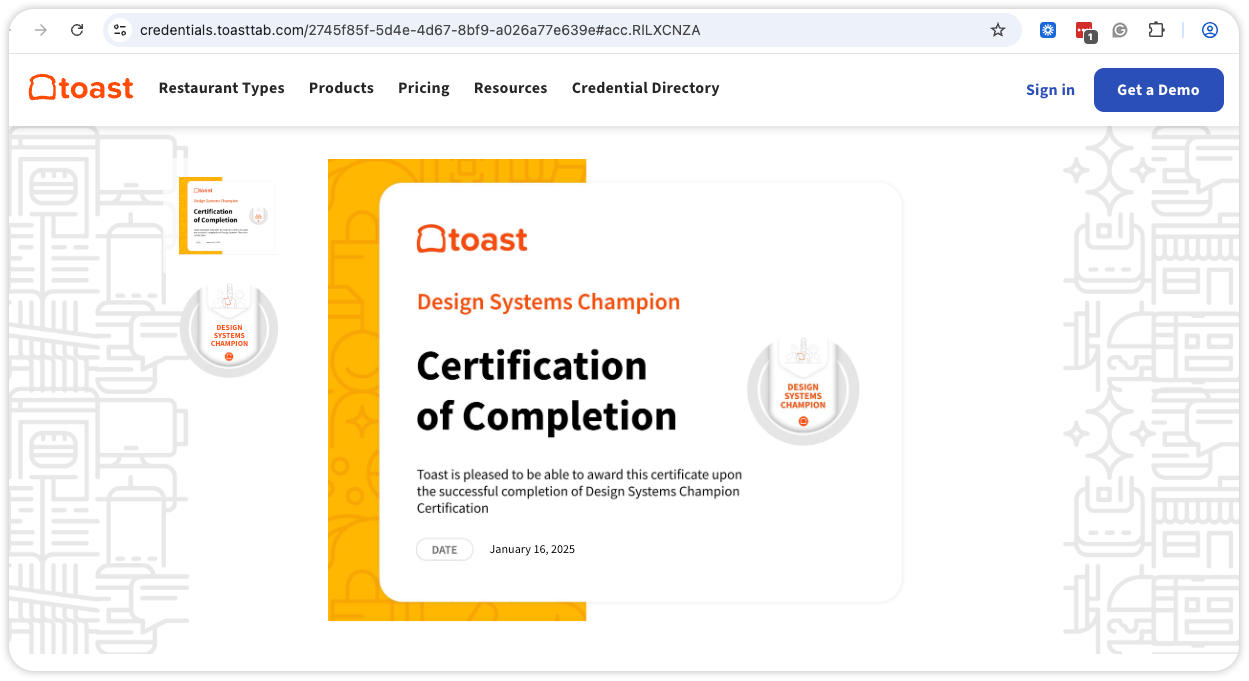
Danielle Combs, Senior Program Manager for Customer and Partner Relations at ServiceTitan, described the moment her marketing team realized credential pages were generating weekly referral traffic: "We never saw it when we first went into it as an asset to us. I was absolutely amazed at the number of click-throughs we get on credential referral links to our prospect demo site. We're actually getting deals; we're getting sales from it.”
Similarly, a major research university added UTM tracking (simple tags that identify where website traffic originates) to any link on their credential pages to start attributing referral traffic directly to credential shares, pulling Accredible engagement data into Salesforce from day one. The result: a 127% credential referral rate — meaning every shared credential generated more than one referral back to their program pages — and reenrollment growing from 35% to over 50%.
The delivery email is the first moment an earner actually holds their credential, and most programs spend it on "View Credential." That's a link, not a reason.
The College of Professional Studies at George Washington University rewrote its delivery email with a specific LinkedIn share call to action and why it matters to your career, and saw LinkedIn sharing increase by 581%. Not a new platform. Not a redesign. One clear ask, replacing an implied one.
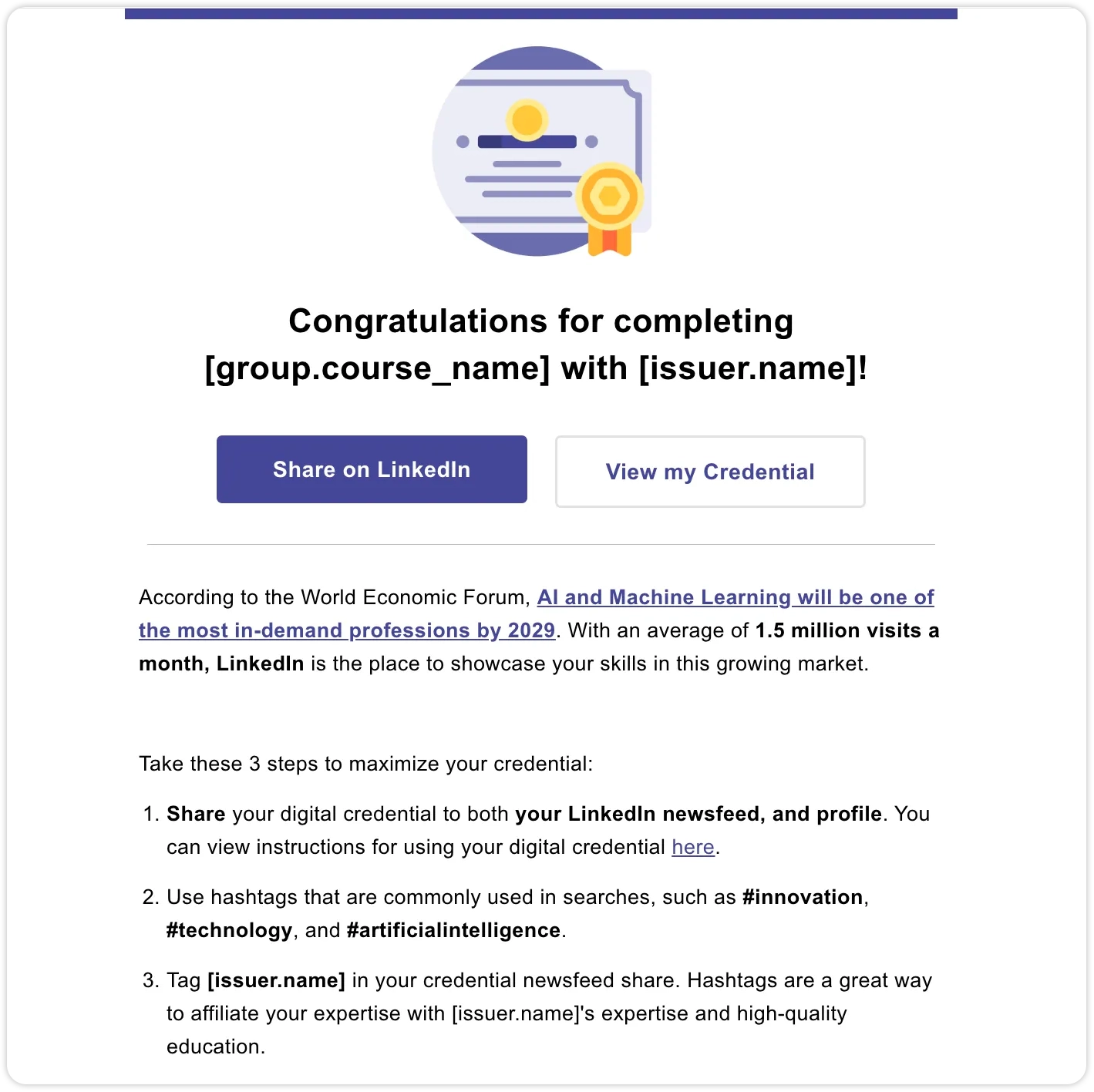
If your delivery email doesn't tell someone where to share and why it's worth their time, you're counting on earners to invent that reasoning themselves. Most won't.
Once sharing starts, how you respond shapes whether it continues. Programs that engage with early shares — a comment, a reshare, actual acknowledgment — see more of them.
ServiceTitan built this into an actual loop: earners who share their credentials and send in a screenshot or link get access to a swag store only certified earners can reach. Its share rate has held between 90% and 94% since 2023. "Sharing is so organic at this point that we don't even have to prove to our executive team that our programs are working," Combs said. "They see experts in the trades sharing their credentials on LinkedIn, Facebook, everywhere."
None of this requires a large budget. It requires someone deciding a share deserves a response.
While 71% of issuers send an email to award a credential, only a third send a reminder to open and share it. A single reminder to non-openers or non-sharers, sent about two weeks later, compounds with everything above instead of replacing it. GWU's 581% lift became a 580.6% increase in sharing, alongside a 43.1% increase in opens, once a follow-up sequence joined the specific ask.
That's four of the decisions in the guide. The rest — what makes a credential worth sharing in the first place, how to remove friction from the sharing flow itself, how to time issuance so it lands at the moment someone's proudest — matters just as much, and we didn't have room for it here.
The credential you issued this month is either working for your program right now or sitting in an inbox. That's not a platform question. It's whether anyone decided, on purpose, what happens after "congratulations."
Until next time,
Ryan
Senior Director @ Accredible

69% of high-performing credentialing programs actively recognize learners when they share a credential — a comment, a reshare, a shoutout. Only 45% of other programs do. That gap compounds every time someone posts.
Do you recognize learners when they share their credentials, and if so, how? 📩 Reply and tell us.
Bridging the Gap: Aligning Education and Workforce Adoption of Digital Credentials — 1EdTech
Employers aren't short on credential data. They can't interpret or trust it fast enough to use it. 1EdTech proposes a minimal data model built for real hiring workflows.
Micro-Credentials Impact Report 2026 - Coursera
Global survey: 94% of employers would offer higher starting salaries to graduates with micro-credentials, and 92% say these hires perform better in year one.
Digital Credential Transport Mechanisms Survey — 1EdTech
72% of credential platforms say employer systems simply aren't ready to consume what they issue — the top barrier between education and hiring.
The Credentialing Playbook: How Databricks Scaled to 1 Million Credentials (On-Demand Webinar)
Databricks issues 50,000+ credentials a month and built one of the industry's highest share rates along the way. Rachel Canetta, Sr. Manager of Certification at Databricks, walks through the six-level framework and governance model behind that scale and what it took to get there.
Badge Summit — July 13–15, 2026
Join credentialing leaders across higher ed, workforce, and industry shaping badge and microcredential strategy.
ASAE Annual Meeting & Exposition — August 15–18, 2026
The flagship gathering for association professionals. Strategy, membership, and the future of how associations deliver value to their communities.
Tired of juggling paper certificates, PDFs, and endless manual processes to track learner achievements?
Or running into scaling limitations with your current digital credentialing solution?
Accredible has you covered. Create and issue branded digital credentials that showcase skills and provide real value — without the hassle.
Know someone who'd find value in Certified Insights? Forward this email and invite them to subscribe.
Did a friend forward this email to you? Sign up to get this newsletter next month.

Accredible is the world’s leading digital credential platform, enabling education and training leaders to increase learner engagement and drive program growth.


Accredible is the world’s leading digital credential platform, enabling education and training leaders to increase learner engagement and drive program growth.

