


Hello and welcome to Certified Insights from your digital credential friends at Accredible. You’re in good company with 100K+ education and training leaders.
Each month, we share tips and strategies to help you grow your credentialing program. Up next:
📊 Connecting credentialing to impact
💬 From “what I did” to “why it matters”
📚 Certified Reads on skills-first hiring, microcredentials hitting a scaling wall, and learning as workforce infrastructure
Every credentialing leader eventually walks into the same kind of meeting.
In one version, the team presents completion rates, credential volume, and learner satisfaction. The numbers look strong. Leadership nods and moves on — same budget, same headcount, same level of organizational attention as before.
In another, the team shows that new hires are reaching full productivity in 35 to 41 days instead of 90. Or that credentialed partners generated $36 million in pipeline last quarter, with deal sizes running 2.3 times higher than their non-credentialed peers.
That second room leans in. The program gets scrutinized, but it also gets invested in. It becomes a strategic lever instead of a line item.
The difference isn't team size, platform, or budget. It's that the second set of teams — Toast and Elastic — started with a question before they built anything: What does our organization need this program to prove, and to whom? Then they designed measurement to answer it.
That sequencing — business question first, measurement second — is what separates programs that earn sustained executive attention from those that don't. And it's a decision any program can make, at any scale, starting now.
Most credentialing programs don't lack data. They lack connection between the systems that hold it. Learning data lives in the LMS. Revenue lives in the CRM. Retention lives in HR. Program leaders are measured on what they can reach — participation, satisfaction, completion — so that's what they report.
According to our 2025 State of Credentialing research, only 41% of credential issuers track learner outcomes in any form. If your program reports completions and share rates and stops there, you're in that majority. That's not a failure of ambition. It's a structural default.
The risk is real, though. A program that can only report activity is permanently vulnerable — one leadership change, one budget cycle, one "but what did it actually change?" away from having no answer.
The programs that can answer that question are built differently.
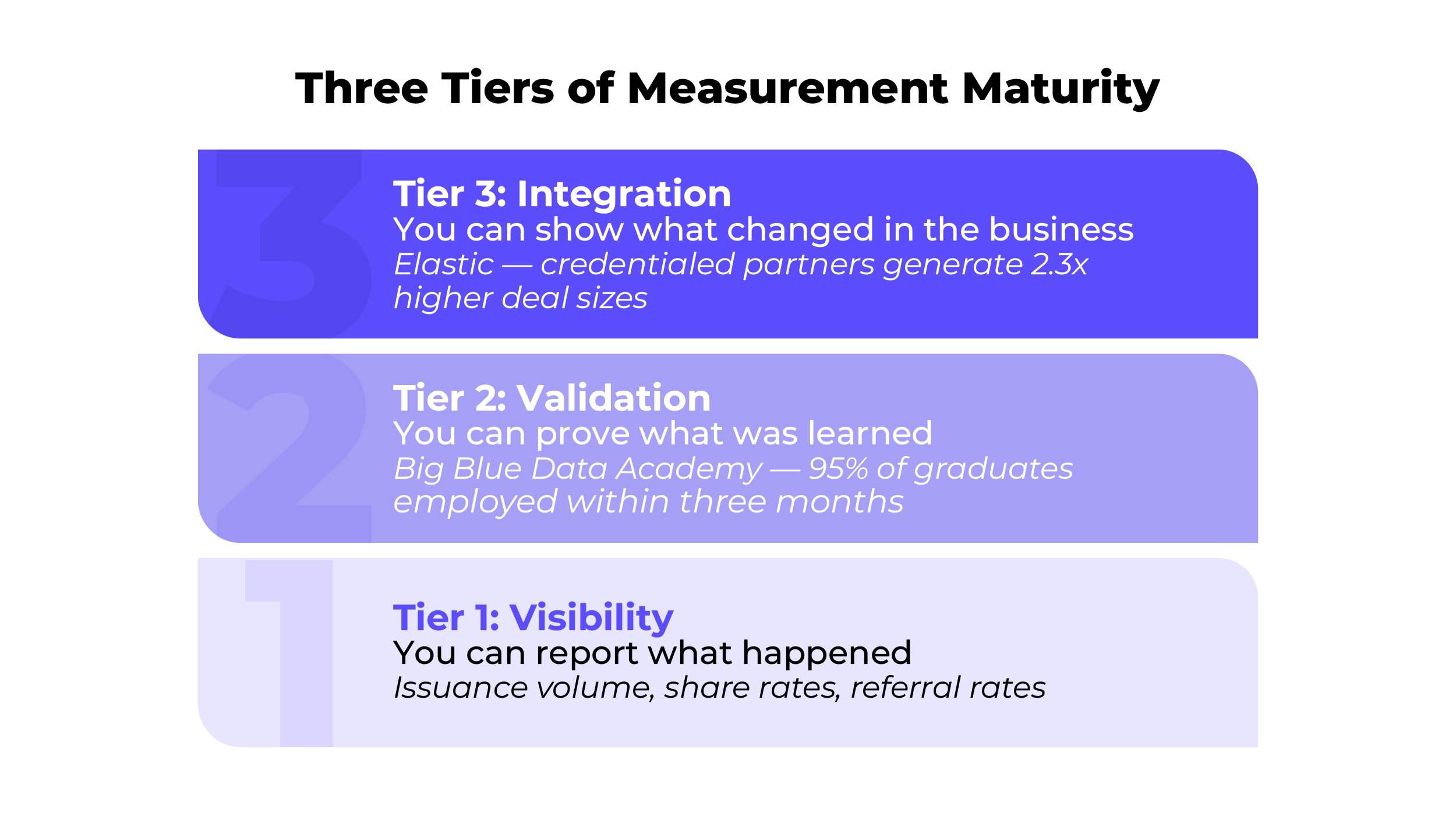
The programs that earn sustained executive attention operate at one of three tiers — and most are stuck at the first one longer than they need to be.
Tier 1 — Visibility
You know what happened. Completions, shares, referrals, satisfaction. Most programs live here. The data is more valuable than most realize — credential referral rates, top sharers, sharing channel breakdowns — but most programs aren't reporting it in language their leadership recognizes.
Tier 2 — Validation
You know what someone can do. Big Blue Data Academy built their entire program around one standard: graduates needed to be employment-ready within three months. Every design decision — curriculum, projects, the credentials issued for each core skill — was engineered to produce that result. Over 95% of graduates are employed as data analysts within three months. That number exists because the program was designed to produce it, not because someone went looking for proof afterward.
Tier 3 — Integration
You can show what changed in the business. Before Toast, a restaurant technology platform, wrote a single piece of curriculum, they defined what "ready" looks like for each role at specific milestones. New hires now reach full productivity in 35 to 41 days — down from roughly 90.
Elastic, the search and observability company, made their Salesforce integration a design decision before the program launched. Seismic became the hub for partner learning, triggering Accredible to automatically issue digital credentials upon course completion. Salesforce captured those completions, tagging credentialed partner contacts to deals and pipeline records. The result: $36M in pipeline last quarter, deal sizes 2.3 times higher than non-credentialed peers.
One decision — about what to connect, made before launch — is what made those numbers reportable. Most programs have more runway to get there than they think.
If your program is already live, the path forward isn't rebuilding from scratch. It's finding the minimum viable connection between your credential data and the outcome your leadership already cares about.
A professional education program at a major research university made that decision deliberately. Enrollment was the metric their leadership tracked. So when they launched digital credentials, they added UTM tracking (simple tags that identify where website traffic originates) to their credential page links and pulled Accredible engagement data into Salesforce from day one — attributing net-new leads back to credential shares.
The result: a 127% credential referral rate — meaning every shared credential generates more than one referral back to program pages — and reenrollment growing from 35% to over 50%. Neither metric required new infrastructure. Both required a tracking decision made at setup.
Your credential analytics are the right place to start. Referral rates, top sharers, sharing channel data — that's not just engagement reporting. It's audience development data. Every referral is a potential new learner your existing earners generated. Most programs have this data and aren't reporting it that way.
As David Leaser, who helped architect IBM's digital badge program, put it: "A lot of it's correlational. But frankly, that's enough to show the value."
You don't need a perfect causal chain. You need a consistent signal, reported in terms your stakeholders already care about. The question to bring into your next planning conversation: what outcome does my program sit closest to — and what would it take to draw a line between my credential data and where that outcome is measured?
The guide we released yesterday goes deeper on all of it, including how Asana, a work management platform, wired attribution before issuing a single credential, what cross-system integration actually looks like at different program sizes, and the full measurement framework behind the tiers above.
If you're not ready for system connections yet, we also put together a free Learner Outcomes & Experience Survey. It's a practical starting point for capturing what happens after the credential is issued — skill application, career impact, outcomes your program currently has no visibility into.
Both are worth your time. One of them you can put to work this week.
Every program has a consequence worth proving. The question is whether you've built the path to prove it.
Until next time,
Ryan
Senior Director @ Accredible
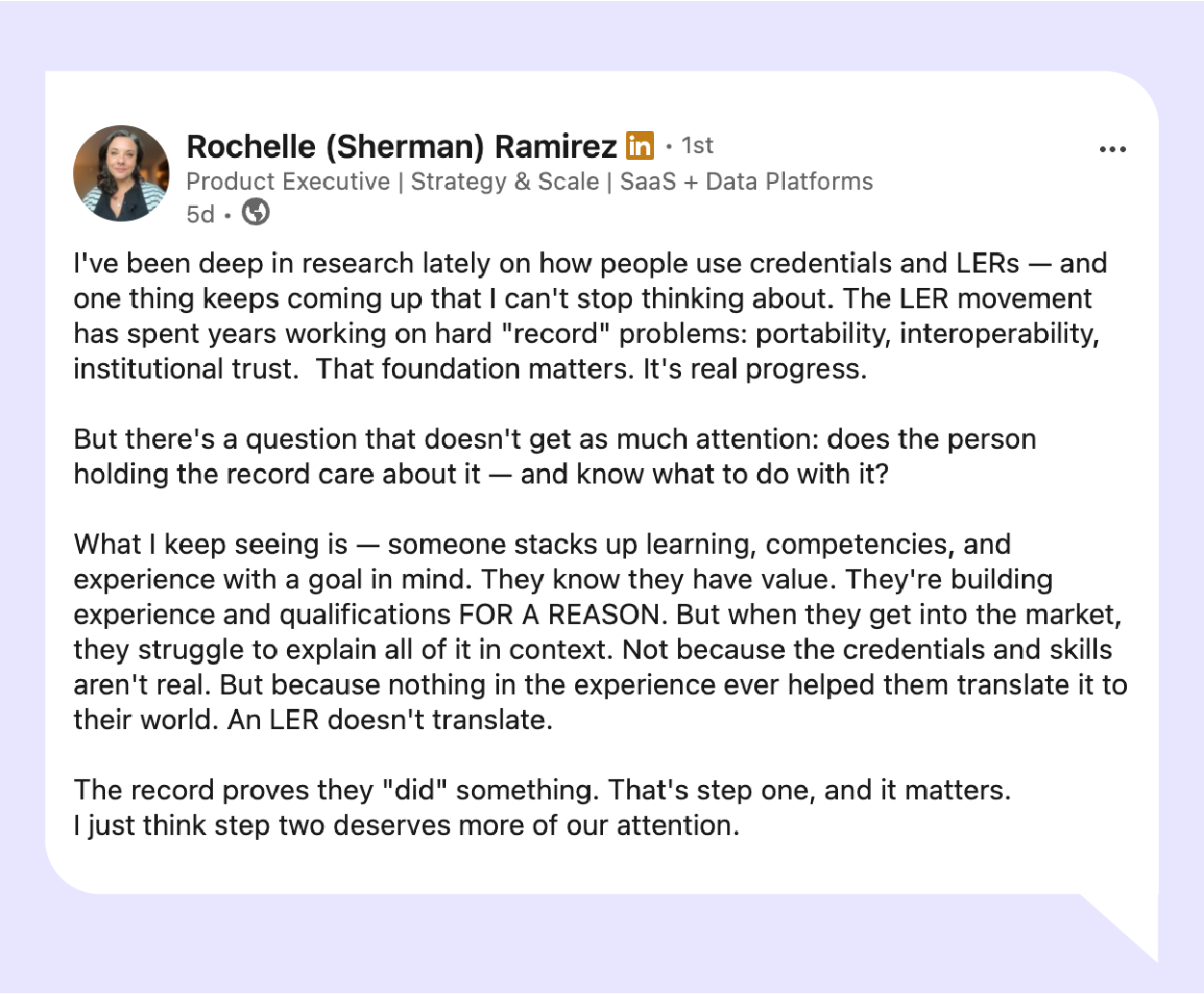
Issuing the credential is only step one. Accredible’s SVP of Product Rochelle Ramirez asks the harder question: are we helping learners translate what they’ve done into language employers can actually use?
🔗 See how others are answering and add your perspective →
The Skills-First Movement: Redefining How Organizations Hire and Grow — SHRM
SHRM’s new research shows skills-first hiring is moving from concept to operating model. Employers are prioritizing demonstrated skills over degrees and tying that shift to stronger financial performance, culture, and retention.
2026 Institutional Perspectives on Microcredentials Report
New research shows microcredentials are widely adopted but not scaling institution-wide. Engagement is up, but alignment, funding, and systems lag — a signal that impact depends less on innovation and more on integration.
The Future of Learning Looks Like Workforce Infrastructure — Workshift
Learning is moving out of programs and into the systems where work happens. This piece argues that impact will come from embedding learning into hiring, workflows, and advancement — not layering on more courses or credentials.
ASU+GSV Summit — April 12–15, 2026
Global leaders convene to explore AI, workforce learning, and scaling innovation across education and skills.
2026 UPCEA Annual Conference — April 15-17, 2026
Explore new ideas, collaborate, and advance the impact of online and professional continuing education.
AAC&U CLASS Conference — April 15–18, 2026
Explore data-driven practices and cross-campus strategies to improve student success at scale.
Tired of juggling paper certificates, PDFs, and endless manual processes to track learner achievements?
Or running into scaling limitations with your current digital credentialing solution?
Accredible has you covered. Create and issue branded digital credentials that showcase skills and provide real value — without the hassle.
Know someone who'd find value in Certified Insights? Forward this email and invite them to subscribe.
Did a friend forward this email to you? Sign up to get this newsletter next month.

Accredible is the world’s leading digital credential platform, enabling education and training leaders to increase learner engagement and drive program growth.


Accredible is the world’s leading digital credential platform, enabling education and training leaders to increase learner engagement and drive program growth.

