


Hello and welcome to Certified Insights from your digital credential friends at Accredible. You’re in good company with 58K+ education and training leaders.
Each month, we share tips and strategies to help you grow your credentialing program. Up next:
🏆 What the best credentialing programs do differently
🔮 What’s your bold prediction for credentialing in 2026?
📚 Certified Reads on shared language, Workforce Pell, and UK’s digital badge strategy
In rural Indiana, I grew up watching pro sports with an obsession. Not just to see who would win, but to study what made the best athletes different.
Even now, I still tune in to PGA tournaments trying to crack the code behind consistent performance. (Spoiler: It hasn’t helped my game.)
But it has shaped how I think about credentialing.
When we analyzed the top-performing programs in our 2025 State of Credentialing report, the same question kept surfacing:
What do the best programs do differently, and how can the rest of us learn from them?
Across the various types of education and training programs, a few consistent patterns emerge. Here are five factors that top-performing programs share and how you can apply them.
1. Build a strong framework
Successful programs are 50% more likely to have a documented credential framework (65% vs. 42%).
This isn’t just a design system. It’s the operational backbone for how credentials are created, governed, and mapped to meaningful outcomes — turning scattered badges into a coherent, credible system. At a minimum, it covers:
Syracuse University offers a great example. Their 24-page governance framework lays out badge formats, taxonomy, and approval processes.
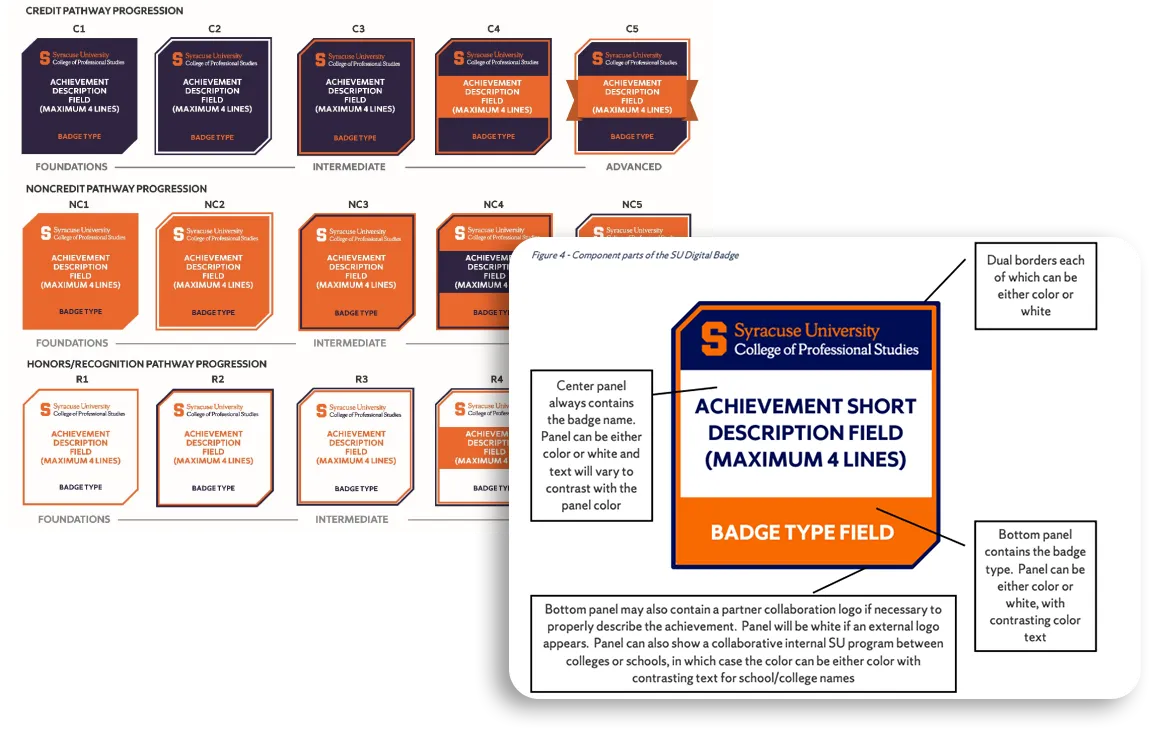
By investing in a documented framework with clear governance, issuers create the consistency, scalability, and credibility that learners and employers value most.
Explore the Why Your Credentialing Program Needs a Framework (Not Just Badges) Guide →
2. Guide learners forward
Top programs proactively recommend what’s next, keeping learners moving and momentum high.
Our 2024 research found that 96% of learners want clear pathways to help them master a skill, making guided progression no longer optional. Our 2025 data shows that successful issuers consistently outperform their peers in driving continued learning. They are far more likely to:
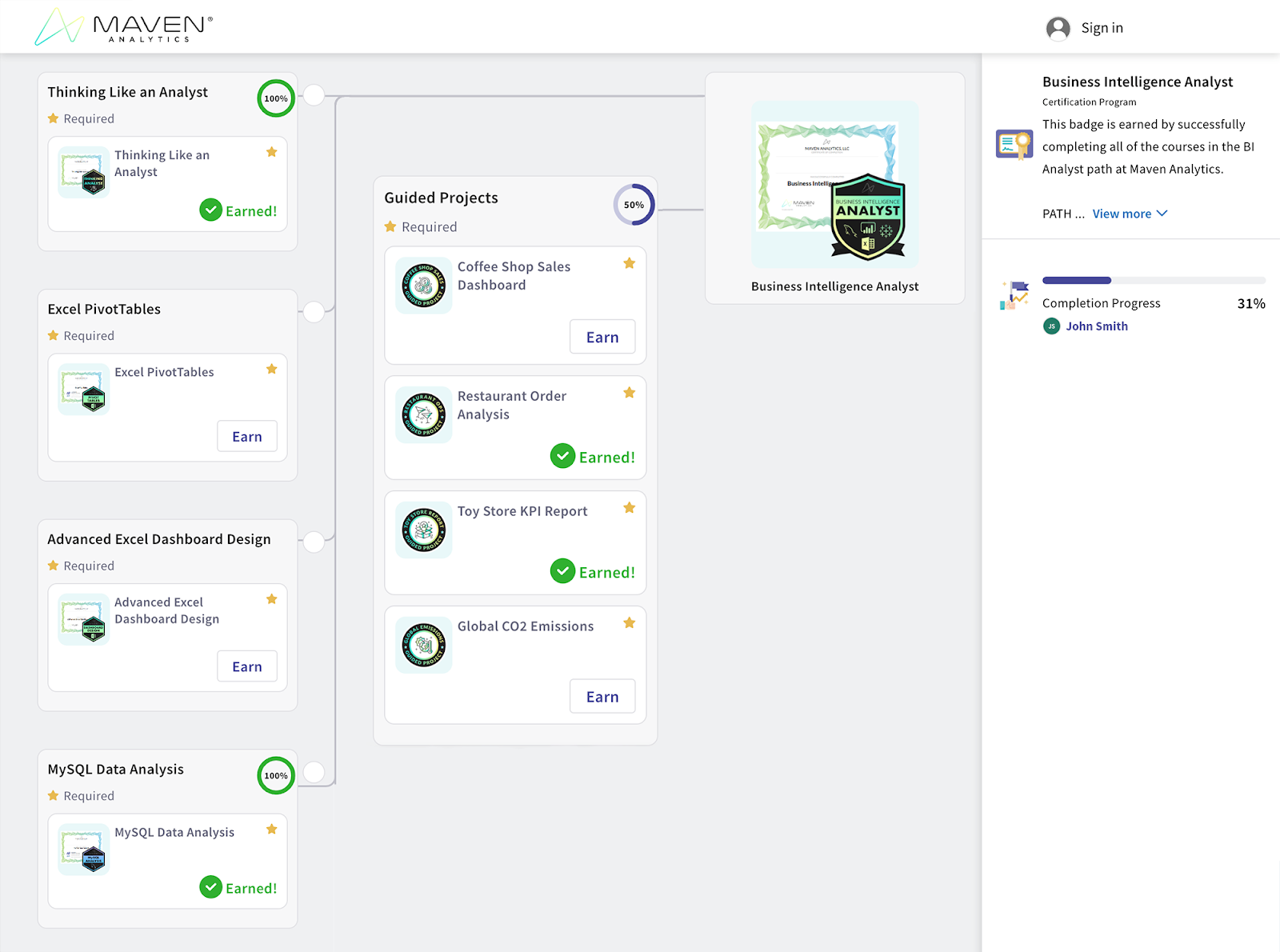
Maven Analytics is a strong example. They designed their Business Intelligence Analyst Certification as modular courses, where learners solve real-world business problems and earn stackable digital badges toward a mastery certificate. This approach has helped Maven increase completion rates and achieve promising retention and lifetime value (LTV) metrics.
3. Connect learning to careers
Top issuers are twice as likely as their peers to connect learners directly to job opportunities (40% vs. 24%) — whether via job board partnerships, employer networking events, career coaching services, or direct introductions to hiring partners. When done well, they create a self-reinforcing ecosystem where:
4. Measure what matters
Most programs measure completions. Top programs go deeper.
They align with key stakeholders on program success, track the full learner journey, and use that data to improve outcomes. Here’s what sets them apart:
By combining self-reported feedback with behavioral and performance data, these programs create a fuller picture of learner outcomes and stronger evidence to prove impact.
But the biggest difference? They do it systematically. While only 1 in 3 issuers has a structured process to track outcomes, the top programs lead by a wide margin (44% vs. 18%).
5. Communicate value to leadership
Top issuers are 2.5x more likely to have their program considered a strategic initiative by senior leadership (54% vs. 22%).
That kind of visibility doesn’t happen by accident. It’s built through consistent, strategic communication.
The best programs:
David Leaser, VP at MyInnerGenius and Co-Founder of the Digital Badge Academy, captured it perfectly: “When I was doing the badge program at IBM, I thought everybody cared about badges. Turns out no one cared about badges. What they cared about was what they had to do before 5 o’clock that day. When I told them I had a way to increase leads and reduce support costs, that’s when they listened.”
The takeaway: Strong foundations = lasting impact
Top programs don’t reach the top by accident. They do the hard, operational work that leads to higher learner engagement, measurable impact, and long-term growth.
The encouraging news: None of these practices require massive budgets or advanced technical expertise. What they do require is disciplined, learner-focused execution.
Want to hear from one of the rising leaders putting this into practice?
→ Join me Nov. 12 for a 30-minute spotlight webinar with Iowa State University’s Tanya Austin. We’ll explore how her team has launched one of the most ambitious campus-wide microcredentialing programs — issuing 600+ digital badges across 80+ microcredentials and 11 learning pathways in its first year alone. Register here →
Until next time,
Ryan
Senior Director @ Accredible
Last year’s Future of Credentials was one of our most-read pieces — with predictions from 1EdTech, UPCEA, Junior Achievement, Wharton Online, and more. Now it’s your turn.
Submit your 2026 prediction by Nov. 14 to potentially be featured in this year’s roundup.
From Skills to Growth: A Plan for Digital Badging in the UK — Digital Badging Commission
The UK’s current skills system is fragmented, opaque, and leaves too many learners invisible. This report lays out a plan for national digital badge infrastructure — from skills wallets to credential registries — designed to unlock inclusion, mobility, and £ billions in economic value.
Building a Shared Language for Learning and Employment Records — LER Accelerator
Acronyms like LERs, CLRs, and VCs can create more confusion than clarity. But at its core, the goal is simple: help people tell their full story of learning and connect that story to opportunity. This article introduces the Common Terms and Definitions, advancing a shared language as essential infrastructure for mobility, transparency, and trust.
Making Workforce Pell Work — National Skills Coalition
Workforce Pell is now law — expanding Pell Grants to short-term training programs for the first time. But how it’s implemented will shape whether it drives equity, mobility, and real results. This breakdown from NSC lays out what the law changes, why it matters, and how state and federal leaders can turn policy into progress for learners and employers alike.
From Badges to Pathways: Iowa State’s Microcredentialing Playbook — November 12
Go behind the scenes with ISU as they build one of higher ed’s most ambitious credentialing programs. In this 30-minute spotlight, learn how ISU designed a learner-first framework, launched 80+ microcredentials in year one, and used stackable Pathways to connect skills, confidence, and career relevance.
I.C.E. Exchange 2025 — November 17-20
This flagship gathering of the credentialing community brings together program leaders, psychometricians, marketers, and innovators to explore standards, operations, and emerging models — including microcredentials and stackable pathways.
Microcredentials: Sharing Global Insights and International Perspectives — November 24
Hosted by the Australasian Microcredential Network, this interactive session explores key takeaways from global conferences on digital learning and credentialing, with lessons for local strategy and cross-border collaboration.
Tired of juggling paper certificates, PDFs, and endless manual processes to track learner achievements?
Or running into scaling limitations with your current digital credentialing solution?
Accredible has you covered. Create and issue branded digital credentials that showcase skills and provide real value — without the hassle.
Know someone who'd find value in Certified Insights? Forward this email and invite them to subscribe.
Did a friend forward this email to you? Sign up to get this newsletter next month.

Accredible is the world’s leading digital credential platform, enabling education and training leaders to increase learner engagement and drive program growth.


Accredible is the world’s leading digital credential platform, enabling education and training leaders to increase learner engagement and drive program growth.

