


What do learning hours, course completion rates, and satisfaction scores tell you?
They’re valuable signals, but they don’t tell the whole story.
Based on those metrics alone, you don’t know if employees retained the information. You don’t know whether they were tested on it, how it’s being applied on the job, or what outcomes it’s driving. Yet these are the metrics L&D teams often present to the C-suite.
According to Boston Consulting Group, only 4% of L&D leaders report on the outcomes of their skill-building programs — whether in terms of business results (like productivity or tool adoption) or talent outcomes (like employee engagement or career mobility).
In today’s climate — with budgets tightening and AI reshaping workflows — that disconnect is a liability. If learning teams can’t show impact, they risk being cut. But it doesn’t have to be that way.
The opportunity for L&D is to move beyond tracking activity and start demonstrating strategic value. When L&D connects learning to outcomes, results follow: One company found sales reps who passed two courses with 82%+ scores closed more deals, and stayed longer.
In a recent discussion with Maise Hunns, Director of Professional Services at Accredible, and David Leaser, VP at MyInnerGenius and Co-Founder of the Digital Badge Academy, we explored what high-impact L&D really looks like and how leaders can start building it today. Below, we outline six steps to elevating L&D from transactional training to strategic, data-driven leadership.
6 Steps to Make Skills Visible, Measurable, and Actionable
Step 1: Align KPIs to Monday Morning Problems
L&D leaders tend to focus on activity because most learning systems are designed to track participation and compliance. But to earn a seat at the table, you need to move away from operational metrics and connect L&D outcomes to “Monday morning problems” — things like revenue growth, NPS scores, competitor differentiation, customer churn, and employee retention.
“When I was doing the badge program at IBM, I thought everybody cared about badges,” says David. “Turns out no one cared about badges. All they cared about was what they had to do before 5 o’clock that day. When I told them I had a way to increase leads and reduce support costs, that’s when they listened.”
Dig deep to figure out exactly what keeps your leadership up at night. Talk to leaders across the organization, review corporate reports, and pay close attention during all-hands meetings. Then, start to adjust your KPIs to reflect these priorities. For example:
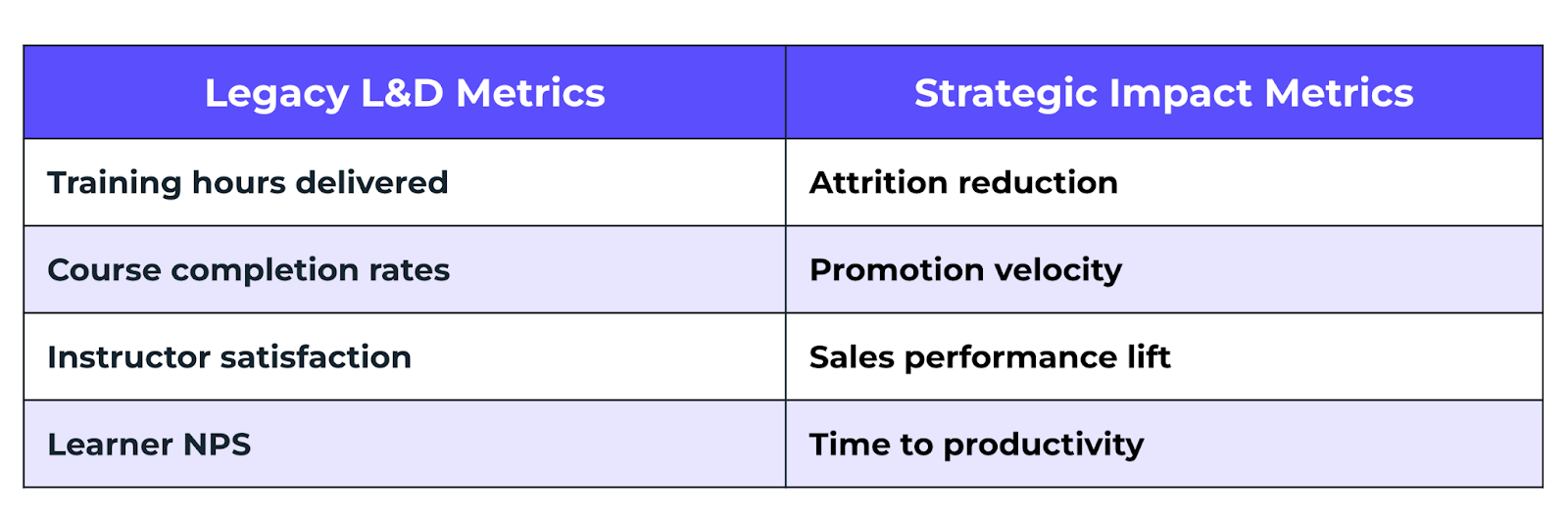
You can and should keep those legacy metrics, but if you’re not linking learning to business outcomes, you’ll stay invisible to the business.
Step 2: Identify and Assess What You Need
After identifying your top strategic priorities, the next step is pinpointing the durable, transferable skills employees need to solve those Monday morning problems.
You’ll notice these capabilities don’t translate to highly technical skills, and that’s intentional. David points out, “In this day and age, focus less on the hard skills — AI will continue to change our work rapidly — and more on the durable, transferable skills, the mindsets you want and need in your employees to hit your organization’s goals.”
Avoid boiling the ocean — focus on the capabilities that truly drive performance and mobility. Use stakeholder interviews across departments to align on shared language and expectations.
When we talk about making skills data actionable, the first step is defining it in a structured way. That’s where taxonomies and ontologies come into play.
- A taxonomy is a hierarchical list of proficiencies. Think of it as a spreadsheet that captures skill names, proficiency levels, and their importance to the business. It's foundational and gets everyone using a shared skills language.
- An ontology takes it a step further — it captures the relationships between skills, roles, and even other roles. For example, if someone is strong in one role, an ontology helps identify what adjacent roles they might be ready for or what additional skills they need to develop.
This shift from taxonomy to ontology is what makes mobility, personalization, and advanced analytics possible. It’s what allows you not just to describe skills, but to predict and plan based on them. Many organizations are still working toward a complete ontology, and that’s okay. Start with a practical taxonomy to make skills visible and structured. Even that creates massive value:
- For individuals: They see their progress, get motivated, and can begin to map career pathways.
- For the organization: You can spot hidden talent, benchmark skills across teams, and guide investments.
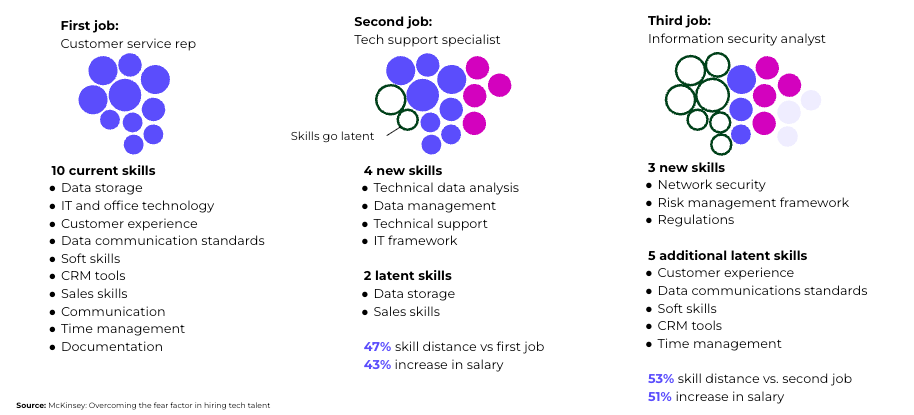
In this example from McKinsey, traditional role-based thinking sees these three jobs — customer service rep, tech support, and security analyst — as vastly different. But when we break it down into skills, we see something else:
- Many core skills are transferable
- Some go latent — not lost, just unused
- And only a few new ones are required for each move
This underscores a huge opportunity: redeployment, not replacement. These kinds of skill-path insights build the case for L&D as a talent partner, not just a training provider.
Step 3: Credential with Metadata and Endorsements That Matter
Some employees already have the skills to drive meaningful change, you just can’t see them yet. “They’re hidden in LMS logs, spreadsheets, or buried in HR tools,” says Maise. “That makes it tough to understand not only what skills a person has, but their proficiency, and the additional skills they may need to keep moving up in their career.”
The more visible these capabilities are, the more opportunities people have to move into new roles, get promoted, and help push the organization forward. At Accredible, we call this the Capability Visibility Ladder:
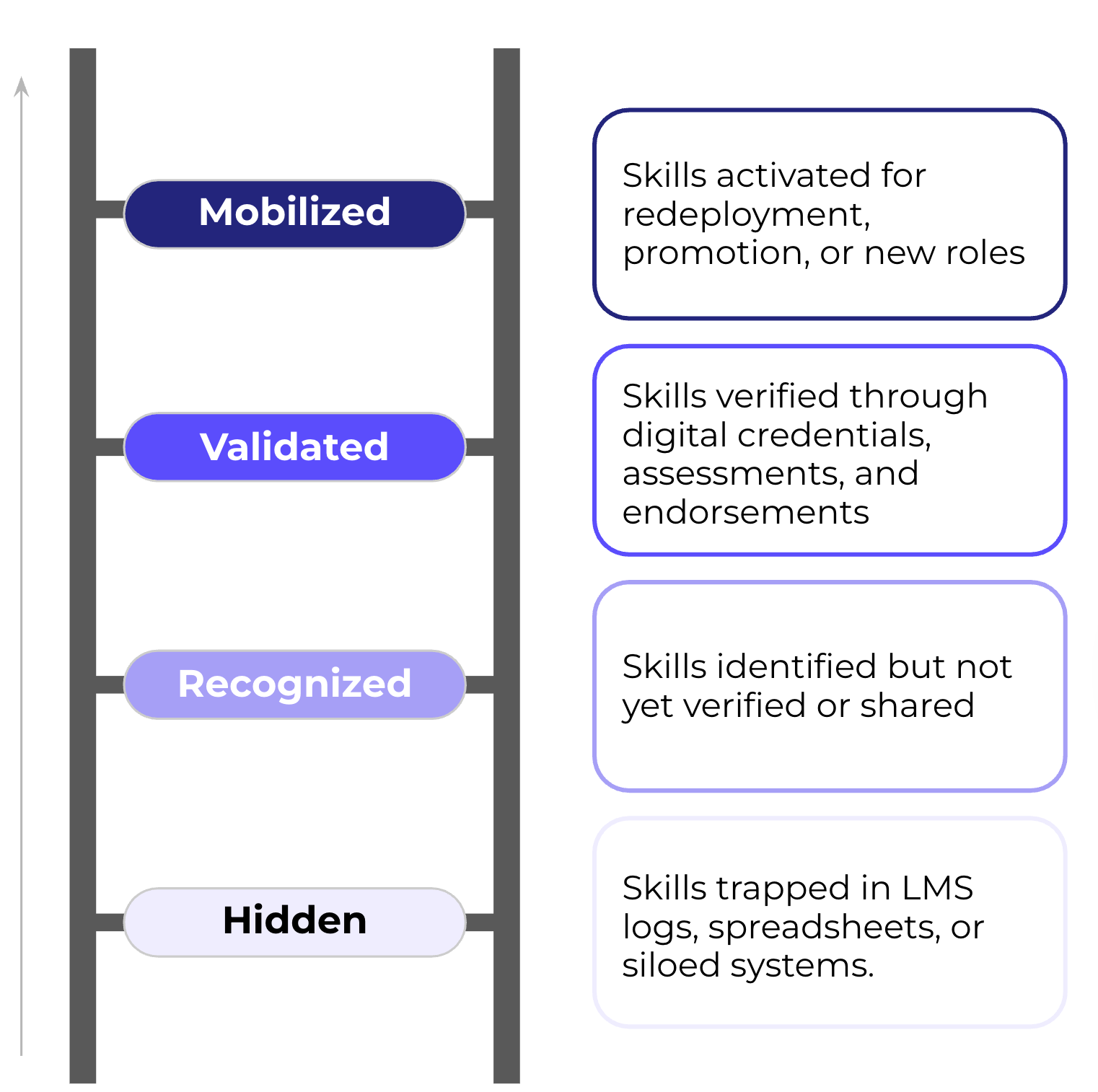
Most people think of digital credentials as certificates or recognition tools. But for high-impact L&D teams, they’re structured, machine-readable sources of truth. The real value comes from the rich metadata included in digital credentials — skill tags, learning evidence, third-party endorsements, etc.
David suggests framing this as building your “skills cloud” or “skills registry.”
“A CHRO from one of the top five companies in the world grabbed me in the hallway at a badging conference and said, ‘I listened to these presentations all day, and thought, why do we even need that? But when you said ‘skills registry,’ it clicked. I wanted a registry in a machine-readable, consistent format. That term has convinced me to implement badges.”
To make skills portable, machine-readable, and meaningful across systems, add as much metadata to each digital badge as possible, such as:
- Skill tags + proficiency levels
- Earning criteria + assessments
- Linked projects, test scores, and other artifacts
- Third-party endorsements, such as those from The American Council on Education, to increase trust, portability, and value to employees.
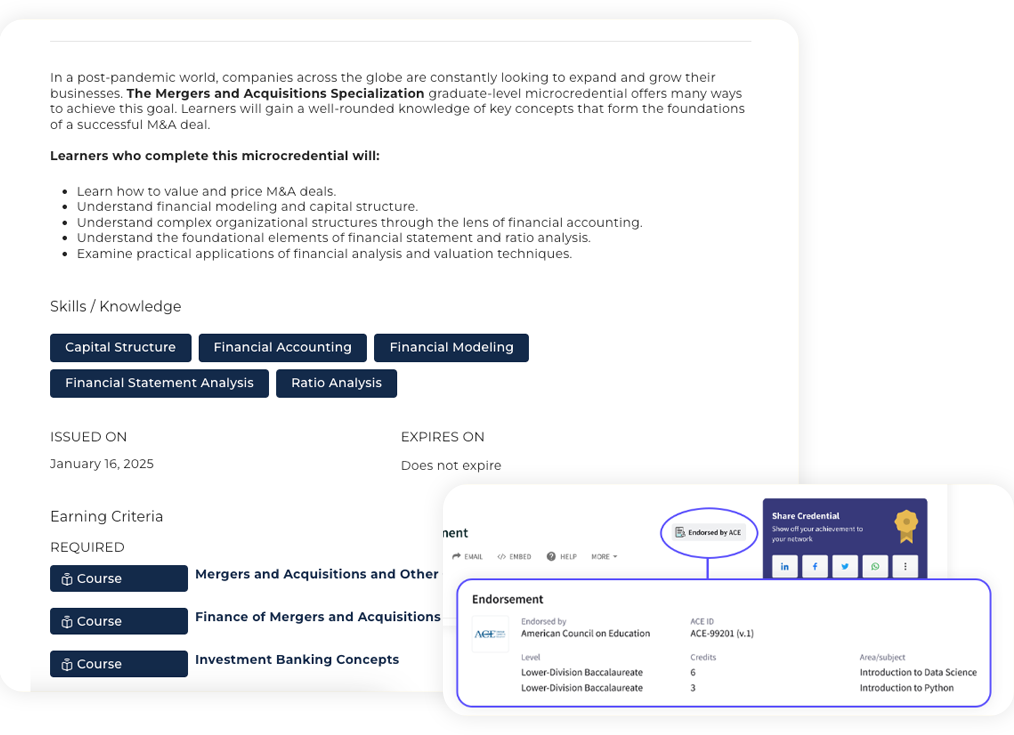
In doing so, you’re unlocking significant value for employees and the company. David shared:
“A few years ago, a large Asia Pacific company realized they didn’t have visibility into their employees’ existing skills. So they assessed everyone and issued digital badges. Because that metadata was in a consistent, consumable, searchable format, they discovered that many women and minorities were severely underemployed — not due to a lack of skills, but because job descriptions and seniority were limiting their mobility.”
With new insights gained from digital credentials, the company enrolled these employees in a leadership development program and promoted them into roles where they could shine.
Step 4: Connect Learning Data with External Data
This is where things click: learning data becomes actionable when it’s correlated with performance, retention, or readiness. Start with what you have — completions, credential metadata, survey feedback — and then look outside of your training department to other data sources like:
- Performance metrics, like manager ratings or quota attainment
- HR metrics, like attrition, promotion rates
- Customer impact, like CSAT and NPS
- Sales metrics, like close rates, sales cycle times
David shares, “If I can see that certain employees have developed key capabilities through learning, and I can correlate that with performance data — like increased revenue, lower support costs, higher NPS scores, or stronger retention — then I have something meaningful to report to the business. But to do that, you have to go outside your learning systems. You have to ask: Can I get the NPS scores? Can I get the sales data? Once you connect those dots, that’s when you start proving your value.”
“Many of my customers have feared this step because they think there’s this huge technical aspect to it that requires integration,” Maise shares. “But many teams start by manually pulling HRIS and LMS data into a spreadsheet to show patterns. Once you prove the value of doing this kind of analysis, you’ll get the buy-in you need to automate.”
Step 5: Close the Loop with Learner Outcomes
Important qualitative data — like whether employees feel more confident with their new skills or whether they’ve put them into practice — will have to come from surveying employees directly.
“You can look at the hard data, but then you’ll still need to ask some questions to really understand the impact,” David says.
“Whether it's built into your end of course, or it comes a month later, make sure to ask, ‘You took this course, did you actually do something with it? Has it increased your confidence?”
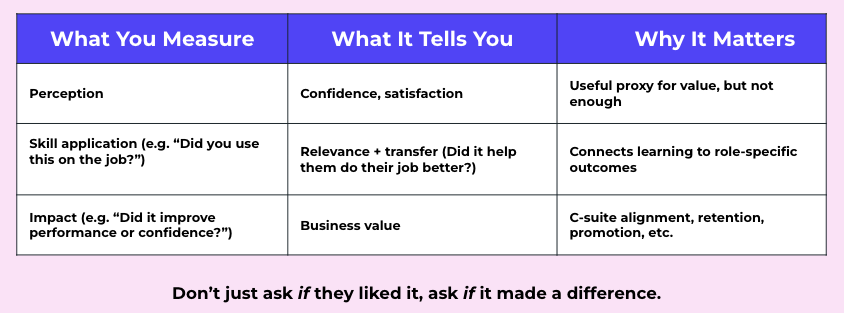
Want a head start? Get our Guide to Measuring Learner Outcomes That Actually Matter, which includes a survey template to track what happens after a credential is issued — from satisfaction to application to advancement.
Step 6: Show Progress Over Time to Build Buy-in and Credibility
Now it’s time to bring everything together, showing how employees move through your programs and how they contribute to tangible business outcomes. And it doesn’t have to be perfect from the get-go.
“Even imperfect data can shift conversations from cost to value,” Maise reminds us. “It’s about being aligned and accountable, telling the story of how learning efforts are connected directly to cost savings, sales, and business performance.”
Here are four ways companies have linked learning to business outcomes:
Example 1: Internal Mobility
One team compared the skills of Sales Reps and Tech Sellers and found just a three skill difference. So, instead of hiring externally, they launched an internal upskilling program to nurture the talent they already had.
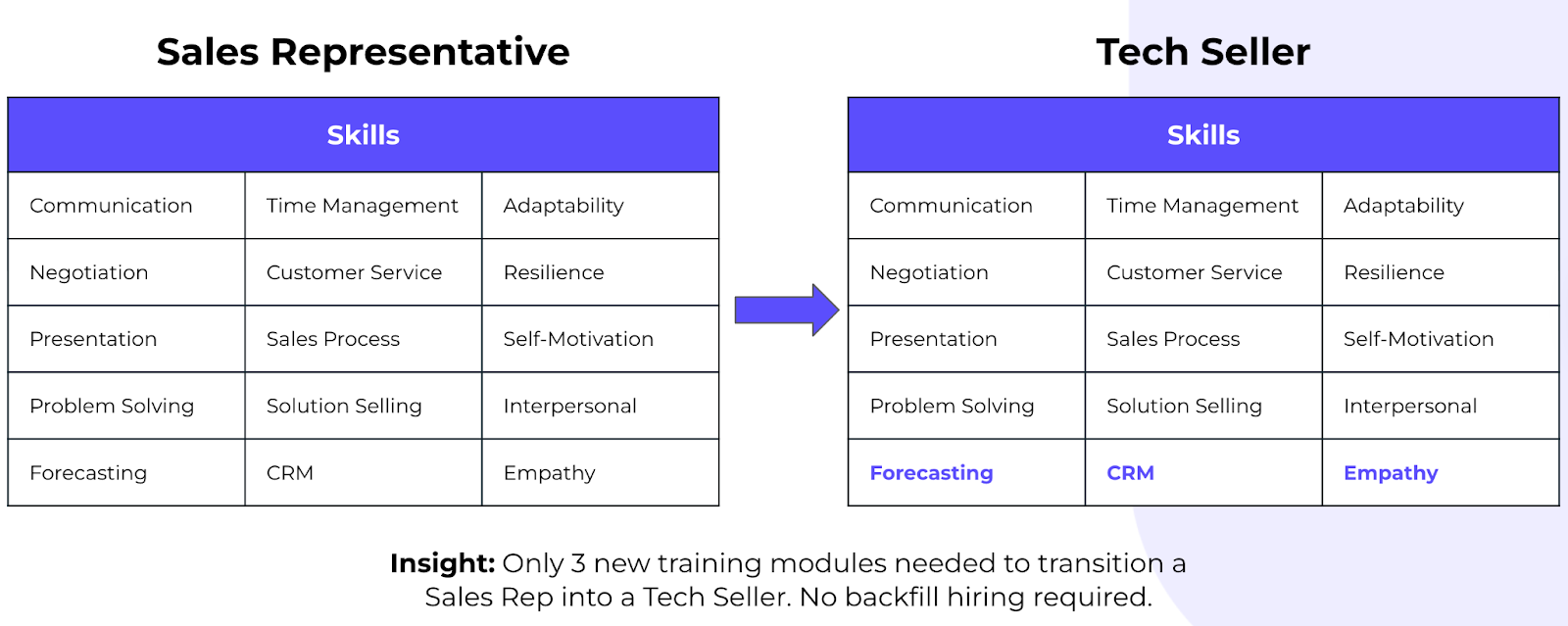
David says, “This forms a habit of going back to your taxonomy and ontology and saying, ‘Does the job I’m hiring for have an overlap in skills with roles we’ve already filled? If so, how much effort would it take to upskill someone internally?’ In most cases, training costs less and fills the role faster than hiring someone new.”
Example 2: Sales Performance
The L&D team at IBM found that reps who completed two or more courses with test scores of 82% or higher closed more deals.
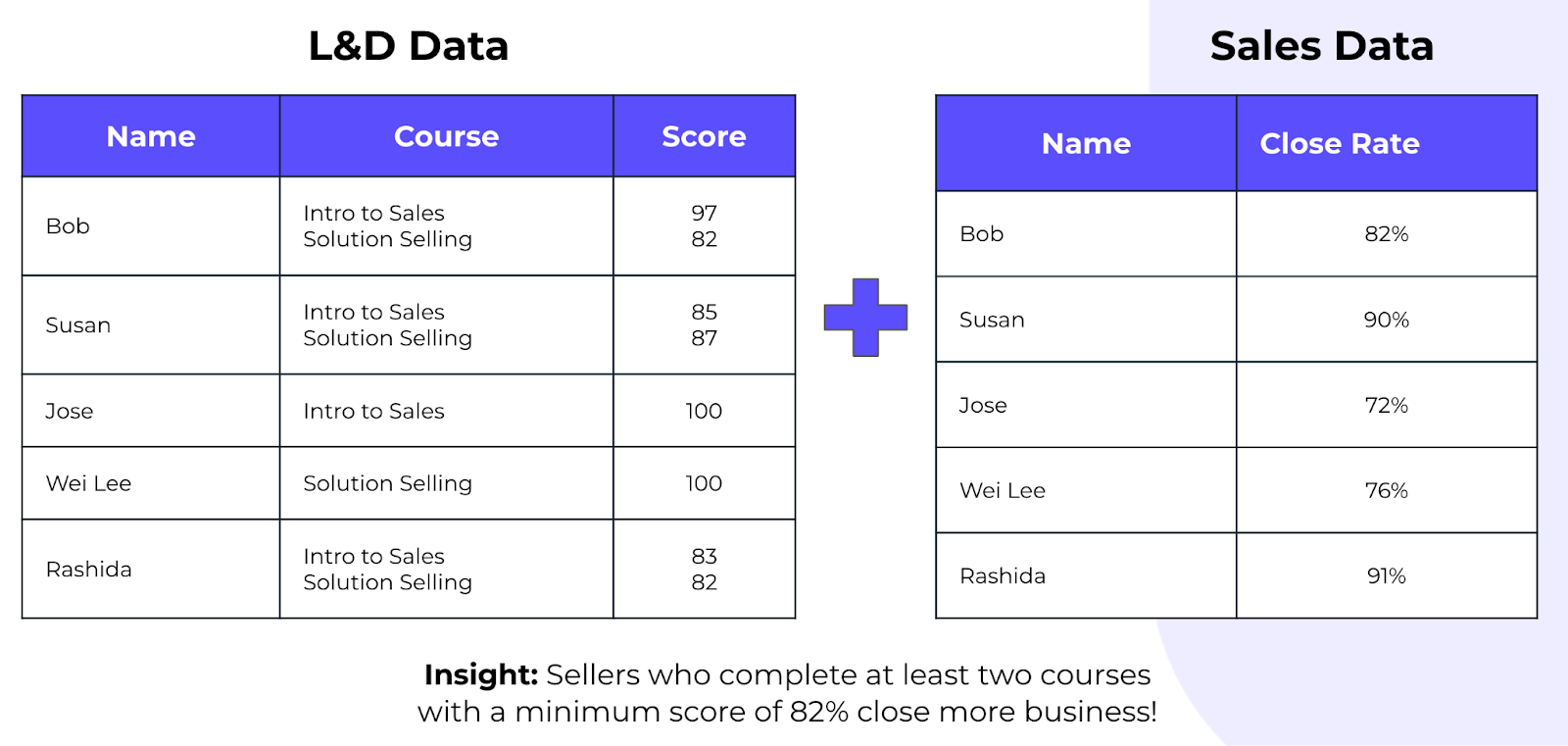
And these folks tended to stay for longer, which saved the company even more money in the long run.
Example 3: Employee Retention
At IBM, they also found that employees who earn two or more badges had 1.5 percentage points higher retention. That small lift translated to $3.56 million in annual savings in this example. This kind of analysis is possible even with basic credential and HR data — it’s about asking the right questions.
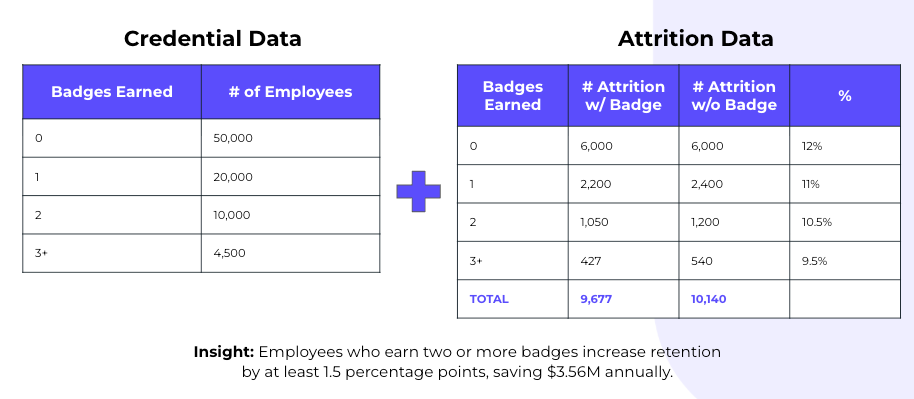
“Attrition costs a lot more than you think,” David says. “Somebody has to cover that employee at least part-time when they’re gone, so you have to figure in their salary. There’s a manager who has to hire and train the new employee. There’s all this expense you can eliminate by keeping someone on the team and training them up.”
Example 4: Productivity Savings
David shared a story about pitching an email training program at IBM to a large utility company. The program taught employees how to archive emails and how to reduce the amount of time they spent skimming their mail.
To get executive buy-in, David translated those outcomes into hard numbers. “We looked at how many minutes employees were spending on email each day and asked, ‘What if we could save just one minute per employee per day?’”
They ran the numbers (factoring in employee time and server costs) and found that cutting just one minute of wasted time per day would save the company $253,000. “Guess how quickly they signed off on that training program? That day,” David shares.
Make L&D a Strategic Business Driver
Early results from our 2025 State of Credentialing survey of over 500 HR leaders show that more than half (55%) of employers now issue digital credentials for internal employee development. It’s a promising sign that organizations are starting to make employee skills more visible.
But visibility alone isn’t enough. To position L&D as a true strategic partner, credentials can’t just be certificates. They have to be treated as valuable data assets that make it easier to develop talent, build stronger teams, and drive growth.
Getting there means:
- Credential the skills that matter and make them actionable across your systems.
- Moving beyond participation metrics to measure performance, confidence, and skill application.
- Using skills data to inform decisions around promotions, readiness, and retention.
Want more advice on how to make the shift? Watch the full conversation with Maise Hunns and David Leaser below:
Or, click here to learn more about how digital credentials can unlock employee and business growth.


