


Hello and welcome to Certified Insights from your digital credential friends at Accredible. You’re in good company with 70K+ education and training leaders.
Each month, we share tips and strategies to help you grow your credentialing program. Up next:
⚡ The credential was never meant to be a snapshot
💬 Take the 6-minute State of Credentialing survey — we'll plant a tree and donate $25 to support education
📚 Certified Reads on entry-level hiring in the AI era, Workforce Pell for noncredit programs, and co-curricular credentialing at Johns Hopkins
Take two people. Same certification. Same issuer. Same date. One has applied that skill every single day since they passed, built deep expertise, and adapted as the field evolved. The other hasn't thought about it since.
From the outside, you cannot tell them apart.
That's not a flaw in your program. It's not a flaw in the credential. It's just what the object was designed to do — and for a long time, it was enough.
What the credential doesn't see
A digital credential is a record of a moment. The exam passed, the project submitted, the standard met: all captured, all verified, all true. Portable, shareable, backed by an issuer with the authority to set the standard. Genuinely valuable.
But it's frozen. The day it was issued is the day it stopped reflecting anything new about the person holding it.
Think about the people in your programs who are genuinely excellent. Not the ones who passed and moved on, but the ones who kept going. Who use the skill every day. Who've adapted as the platform evolved, built judgment you can't test for in an exam, and become the person their team turns to. Their credential says the same thing it said three years ago. It has no way to say anything else.
And increasingly, that's a problem for the people on the other side of the credential, too. When an employer looks at a badge earned two years ago, the questions they actually want answered aren't on it. Do they know the current version of the platform? Can they practice what they learned, or did it stop there? Are they still current? A credential that tells you someone passed a course is useful. A credential that tells you they're still proficient today means something different entirely.
That's the design boundary. The credential was built to verify competency, but it can only verify it once. Everything that happens after issuance — the growth, the application, the deepening expertise — is invisible to it.
What programs do instead
Most programs have felt this limitation and built around it. Renewal cycles, Continuing Professional Development (CPD) point systems, layered pathways, supplementary assessments. A lot of very smart program design that essentially exists to compensate for what the credential itself can't do.
Those workarounds are worth examining not as solutions but as signals. When well-run programs build elaborate scaffolding around a core constraint, that's the constraint becoming visible.
And the market is making it more visible every year. Skills-based hiring is raising the bar for what "verifiable" actually means. Employers and partner evaluators are increasingly asking not whether someone demonstrated competency once, but whether they're still demonstrating it. The credential can answer the first question cleanly. It was never built to answer the second.
You can see it in recertification data, too. Technology certification programs typically see renewal rates somewhere between 5% and 30%. The instinct is to look at the process: outreach timing, exam friction, pricing, and find the fix. But programs with sophisticated renewal infrastructure and streamlined pathways often hit the same ceiling anyway.
A credential that isn't doing visible work in the market between issuance and renewal eventually starts to feel optional to maintain. That's not a motivation problem. It's what happens when an object stops earning its place.
What a Live Credential does differently
A Live Credential isn't a smarter renewal process. It isn't a better version of the existing model. It's a different category of object entirely.
This is the thing that gets me most excited, and it's worth sitting with for a second.
Go back to those two people from the start. Same certification, same date, completely different trajectories since. A static credential has no way to distinguish them. A Live Credential does — because it doesn't freeze at issuance. It persists, updated by real-world signals from actual practice. The rubric that defined the original assessment influences the rubric against which ongoing skill application is evaluated.
A static credential answers one question: did this person demonstrate this competency, to this standard, on this date?
A Live Credential also answers what comes after: are they still proficient? Is that competency alive in the way they actually work?
Certifications recognize meaningful achievement. Live Credentials extend that value with continuous, verified evidence of real-world skill application.
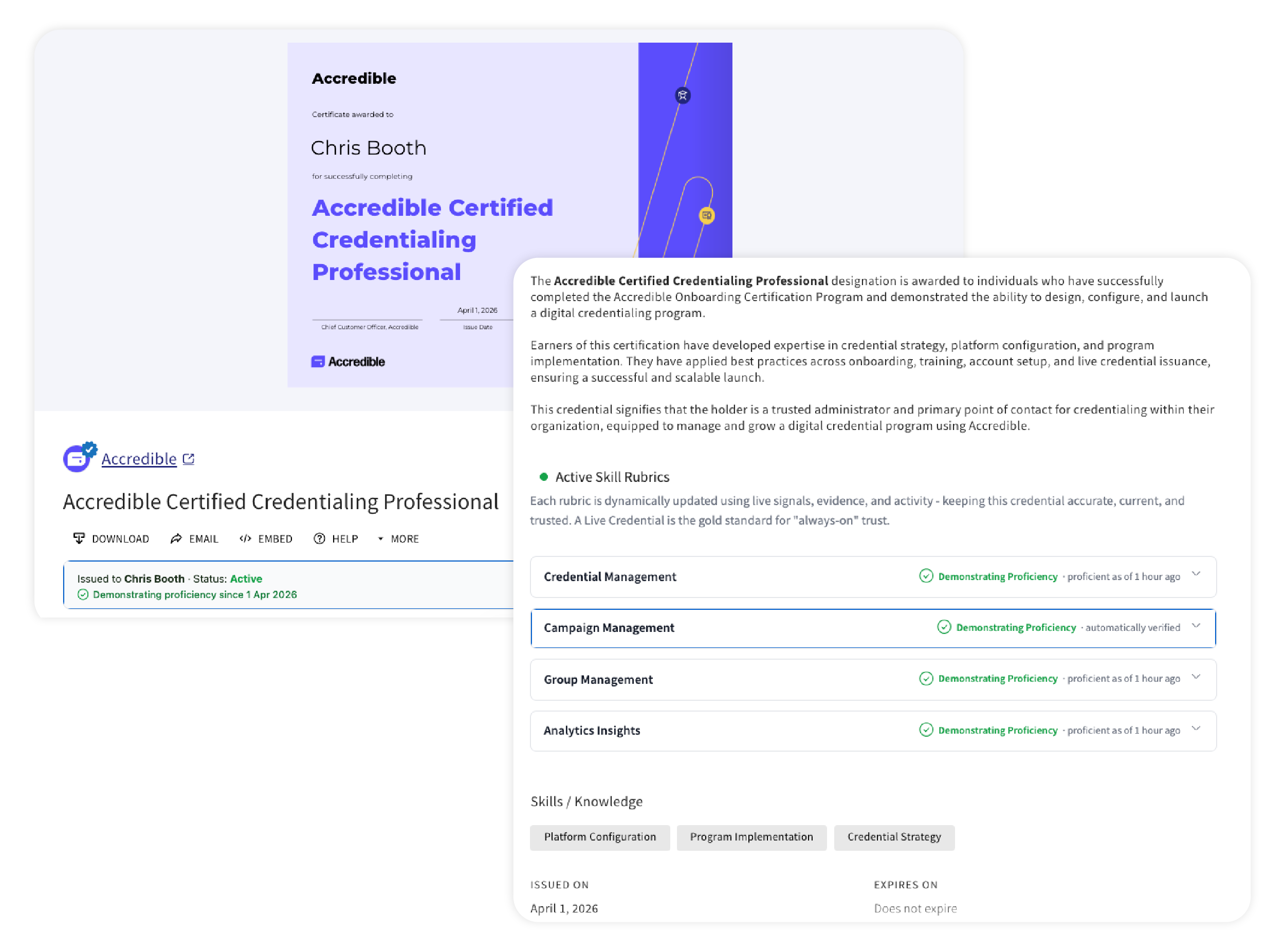
For CPD programs, this replaces the administrative cycle of logging hours and accumulating points with something more honest: an ongoing record of actual practice, evaluated against the standard the program already set. For product certification programs, it closes the gap between what the credential says and what the earner is doing in the platform every day.
In both cases, the relationship between issuer and earner doesn't end at issuance. The credential becomes the ongoing connection, not the final product. That's a genuinely different thing. That's what I mean when I say this is version two of what a digital credential can be.
The conversation with certification leaders tends to arrive at the same place. They know their programs produce something meaningful. They know their best earners have kept growing. And they know, even if they don't always say it directly, that the credential undersells what those earners have actually become.
The earner grew. The market moved. The badge didn't change.
That gap is worth taking seriously. Not as a program design problem, but as a question about what the credential itself could do. If competency is a trajectory, and I think we all know it is, then the credential that best represents it is one built to travel with the earner, not freeze at the starting line.
At Accredible Labs, we're building Live Credentials with programs that are asking exactly these questions right now, working through what proficiency looks like in practice and not just at the moment of assessment. If this is where your thinking is going, we'd genuinely love to talk.
Go deeper: From Completed to Current: The Next Evolution of Digital Credentials →
Learn more about Live Credentials →
Until next time,
Chris
General Manager @ Accredible Labs

The 2026 State of Credentialing survey is open! It only takes 6 minutes, and your insights will help shape this year’s report on what’s working, what’s evolving, and what’s next for credentialing programs.
🌱 We’ll plant a tree and make a $25 donation to support education for every response
🎁 You’ll be entered to win a $100 Visa gift card
📘 You’ll get early access to the full report
👉 Take the survey and add your voice to this year’s industry snapshot.
Entry-Level Hiring in the AI Era — Strada Institute
Strada surveyed 1,500 talent leaders on AI's impact on hiring. Key finding: employers want demonstrated, applied competency — not credentials alone. The bar is rising.
Workforce Pell Is Here. Noncredit Qualifies with Caveats — Workshift
Workforce Pell Grants go live July 1. Noncredit programs can qualify — but only with clock hours, governor approval, and verified outcomes. A practical breakdown of what programs need to be eligible.
Credential Chat: Co-Curricular Learning at Johns Hopkins — AACRAO
Dr. Janet Schreck shares how JHU built governance around co-curricular credentialing — what counts, who decides, and how to earn faculty trust. A practical look at CLR implementation from someone who did it.
Badge Summit — July 13–15, 2026
Join credentialing leaders across higher ed, workforce, and industry shaping badge and microcredential strategy.
ASAE Annual Meeting & Exposition — August 15–18, 2026
The flagship gathering for association professionals. Strategy, membership, and the future of how associations deliver value to their communities.
From Completion Data to Capability Evidence — Training Industry Webinar (On Demand)
Most L&D programs can't answer what leadership actually asks: are employees building skills? Accredible’s Lauren Shapiro shares a practical design model and five-point audit to close that gap.
Tired of juggling paper certificates, PDFs, and endless manual processes to track learner achievements?
Or running into scaling limitations with your current digital credentialing solution?
Accredible has you covered. Create and issue branded digital credentials that showcase skills and provide real value — without the hassle.
Know someone who'd find value in Certified Insights? Forward this email and invite them to subscribe.
Did a friend forward this email to you? Sign up to get this newsletter next month.

Accredible is the world’s leading digital credential platform, enabling education and training leaders to increase learner engagement and drive program growth.


Accredible is the world’s leading digital credential platform, enabling education and training leaders to increase learner engagement and drive program growth.

