


A hiring manager opens a resume. Under certifications: “Cloud Certified Data Engineer.” Issued 2022.
She pauses. Does this person still know the platform? The product has shipped three major versions since then. Have they kept up? Is the certification still active? She has no way to know without picking up the phone, and she has 40 more resumes to review. So she does what most hiring managers do: she mentally discounts it and moves on.
This is the quiet problem at the heart of professional certification. Not the programs themselves, which represent genuine investment by both the companies that build them and the people who earn them. The problem is in what happens after issuance. Certifications recognize meaningful achievements that tell the world something was true at a point in time, but that may or may not be true today.
Software companies have built some of the most rigorous and respected certification programs in the industry. They have invested heavily because they believe certified users are more likely to adopt deeply, expand their usage, and remain engaged over time. Certification programs build ecosystems. They create communities of practitioners who stake professional identity on their expertise with a platform. All this is true.
But too much of that value is left to decay after the badge is issued.
The Trust Gap Nobody Talks About
There’s a structural trust problem in how credentials are used in hiring, and it quietly undermines the value of many certification programs.
Hiring managers want to know if a candidate can do the job today. A certification tells them the candidate could demonstrate specific competencies or knowledge on a specific day in the past. That gap, between what was true then and what’s true now, is where trust erodes. And when trust erodes, the credential gets discounted.
This isn’t a criticism of how certification programs are designed. The programs themselves are often excellent. The problem is that the credential they produce is a snapshot, and the world doesn’t stand still after the shutter clicks.
Platforms evolve. What it meant to be a certified cloud architect in 2021 is not the same as what it means today. Hiring managers know this intuitively, even if they can’t always articulate it. So they treat certifications as a soft signal rather than a hard one, something that moves a candidate a little further up the pile rather than something that meaningfully de-risks a hire.
A version of this problem plays out inside companies, too. An employee joins and gains a fresh certification during onboarding. Their employer is reassured. The person starts doing the job well, and because they’re visibly competent, neither side feels urgency to recertify when the time comes. The credential lapses quietly, unremarked.
Many certification leaders already see this pattern: credentials are most valuable around moments of transition, hiring, promotion, partner selection, and client assurance, but their perceived value fades between those moments. When the market stops rewarding the credential, renewal starts to feel optional. And optional becomes lapsed.
We’ve found that technology certification programs typically see renewal rates somewhere between 5% and 30%. The instinct is to look at the process (i.e., outreach timing, exam friction, pricing) and find the fix. But programs with sophisticated renewal infrastructure often find the same ceiling. When improvement efforts plateau consistently, the limiting factor probably isn't the process.
The Digital Badge Was a Start, Not an Endpoint
The industry recognized this problem. The rise of digital badges over the past decade was a genuine improvement. Making credentials easier to display, share, and verify online was meaningful progress. Badges solved the discoverability problem: a certification no longer had to live only on a printed certificate or a resume line.
But most digital badges still behave like published records. They prove that something was issued. They don’t create a live, queryable relationship between the issuer, the earner, employers, partners, and the systems those parties use to make decisions. To a busy employer reading a resume or scanning a LinkedIn profile, a badge that was valid at issuance can look functionally identical to one that lapsed six months ago, unless the current status is surfaced clearly inside the workflow where the decision is being made.
Digital badges made credentials easier to display. They didn’t make credential status operational.
What a Live Credential Actually Does
Live Credentials is what we've been building at Accredible Labs to close that gap — connecting the certification programs our customers have invested in to the market those credentials are supposed to serve.
A Live Credential isn’t a smarter badge. It’s a different category of object.
Where a badge is a record of what was issued, a Live Credential is a current, permissioned representation of someone’s standing in an ecosystem: what they have earned, whether it still applies, and what they are entitled to claim in the market. It reflects proficiency in real time. It knows whether a credential is active, lapsed, or in the process of renewal. It can surface what level or specialty the earner holds, and whether they remain eligible to represent a vendor as a certified partner or practitioner.
That makes it useful inside workflows rather than alongside them. In the old model, “Cloud Certified Data Engineer, 2022” is a line of text. A Live Credential resolves that same claim to a current status: active or lapsed, certified on which version, specialist in which domain, verified by which issuer. A recruiter can reference it directly. A partner directory can reflect it automatically. A client evaluating a vendor’s team can check it without making a call.
The credential stops being a point-in-time asset and becomes infrastructure.
Here's how it works in practice. After the initial assessment, the earner opts into continuous verification. Real-world signals (e.g., product usage, applied activity, documented practice) are ingested and evaluated against a rubric derived from the original certification standard. The issuer defines that rubric: what does ongoing proficiency actually look like, not just at the moment of assessment?
We built the first version for our own platform certification. The rubric covers four areas of real-world practice: credential management, campaign management, group management, and analytics usage — each evaluated continuously against observable platform activity. Not a proxy exam. The credential updates as the evidence updates. If the earner stays active, the credential stays current. If proficiency slips, they get specific feedback on exactly where the gap is and what to do about it.
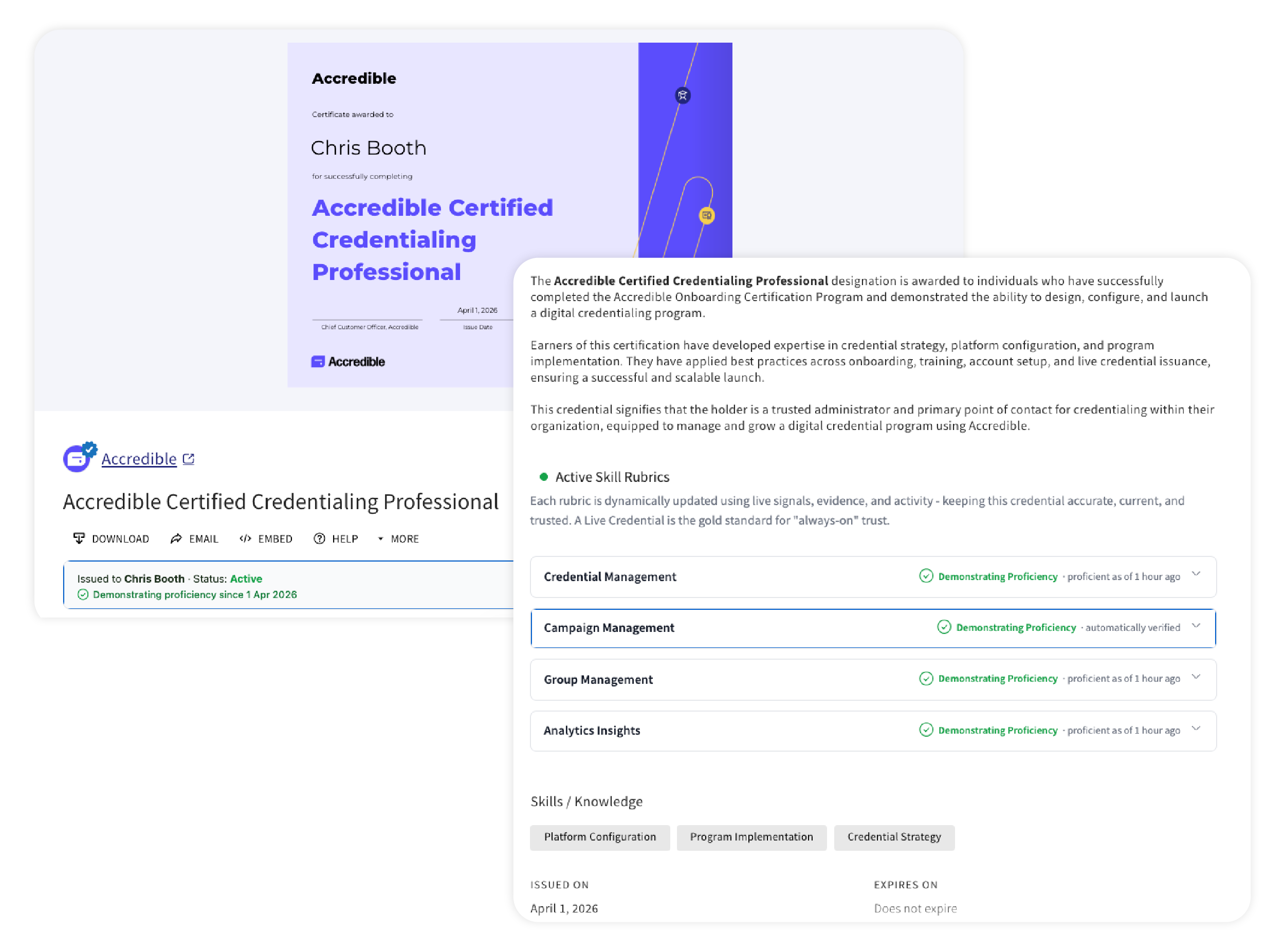
For the practitioner holding the credential, this changes something real. Their expertise doesn't stop being visible the day the badge is issued. The credential travels with them — reflecting what they're actually doing, not just what they once demonstrated. For earners who stay active in their field, that's a meaningful difference: a credential that keeps earning its place rather than quietly aging out.
Associations and professional bodies running Continuing Professional Development (CPD) programs know this burden well. The current model requires someone to chase submissions, review evidence, reconcile records, and make judgment calls about whether a portfolio of logged hours actually demonstrates ongoing competency. It's labor-intensive and often inconsistent — and it still doesn't give strong assurance that the underlying skill is being practiced. Live Credentials replace that cycle with continuous verification against criteria that the issuer defined from the start. The standard doesn't change. The evidence collection becomes ongoing rather than episodic.
What This Means for Issuers
For companies running certification programs, the commercial case is direct.
Live Credentials create an ongoing relationship between the issuer and the earner that a static badge cannot. When the credential remains visibly useful in the market, renewal has a commercial logic it currently lacks. That changes renewal from a bureaucratic obligation into a competitive one. Renewal improves not because of enforcement, but because maintaining the credential is worth more than letting it lapse.
The economics follow from that. The operational overhead of running a recertification program is largely fixed — the costs don't scale down because only a fraction of earners come back. A model where the credential maintains an active relationship year-round changes that structure. Revenue becomes tied to ongoing engagement rather than episodic events.
There’s also a longer-term structural question. If a Live Credential can surface continuous, verified evidence of real-world skill application, the case for requiring a full re-examination at every renewal cycle becomes less obvious. The friction in recertification has always come partly from the exam itself. That friction looks different when the credential is doing some of that verification work in the background, continuously.
For partner and reseller ecosystems, the value is different but equally concrete. Buyers choosing between implementation partners need to trust that “certified” means something today, not just historically. A partner directory backed by live credential data gives buyers reliable information and gives partners a genuine reason to maintain their certified status. Certification becomes a differentiator again.
The Foundation Is Already There
This builds on what already works. The programs, the examinations, the communities, the brand value built around certification: all of that is the foundation, and it’s a strong one. The question is whether certification programs compound after issuance or stop at it.
Before: a certification is issued, displayed occasionally, sometimes verified, and eventually forgotten. After: certification status is current, relevant, and useful to every party with a reason to care, employers, partners, clients, and the earner themselves, throughout the life of the credential.
The certification programs that move toward that model first won’t just run better programs. They will own a more defensible relationship with their practitioner ecosystems and a stronger commercial case for the work they have already built.
The badge was never meant to be the end of the story.
We're building Live Credentials at Accredible Labs with a small number of programs working through exactly these questions right now — defining what ongoing proficiency looks like in practice and building the infrastructure to verify it. If this is where your thinking is going, we'd like to talk. Talk to our team →


