


Hello and welcome to Certified Insights from your digital credential friends at Accredible. You’re in good company with 100K+ education and training leaders.
Each month, we share tips and strategies to help you grow your credentialing program. Up next:
📌 What made Asana’s credentialing program work
💬 Why the field is moving past pilots — and what “proof” really looks like in practice
📚 Certified Reads on LERs as infrastructure, workforce data that actually gets used, and why employers now demand evidence over proxies
Most credentialing programs don’t struggle because leaders lack vision.
They struggle because they’re stuck in a familiar place: plenty of learning activity, not enough signal — internally or in the market.
That’s what makes Asana’s certification program worth studying. What stands out isn’t flash or scale (which it has). It’s that the team made a small number of explicit, sometimes uncomfortable decisions early on, and aligned the organization around them.
In just over a year, Asana’s program has issued 74K+ digital credentials, maintained learner satisfaction in the mid-4s, achieved a 91% credential share rate, and delivered a 5–6x lift in Academy-sourced lead conversion.
The program was even recognized as a top AI certification by Forbes and named Credentialing Program of the Year in the 2025 Certified Impact Awards.
To unpack how it came together, I recently sat down with Asana’s Head of Customer Education, JJ Janikis, in a spotlight webinar. What stood out wasn’t a single feature or metric. It was how intentional the decision-making was from the start.
Skills before features
One of Asana’s earliest — and boldest — choices was not positioning the program as “Asana Certification.”
Instead, they built a Collaborative Work Management certification, anchored in skills, workflows, and outcomes that extend beyond any single tool.
“Asana is the tool,” JJ told me. “But collaborative work management is the skill.”

That distinction reframed the program. The credential wasn’t about knowing where buttons live. It was about proving you can design and run effective work across teams. That framing supported learner credibility and career signaling, and Asana’s ambition to lead a category, not just sell software.
This was possible because Asana had executive buy-in from leaders who’d seen the power of certification firsthand and were already aligned around an enterprise motion. For many organizations, starting with product proficiency is the only realistic option. Asana could afford to think more expansively, and they did.
Try this: If your credential title only makes sense inside your organization, it won’t travel. Start by naming the skill, not the system.
Marketing as connective tissue
Another decision that shaped everything: Customer Education lives inside Marketing.
That placement gave the program access to systems that already move attention, budget, and decision-making. Certification launches aligned with campaigns, and completion data flowed into the same systems used to track pipeline, adoption, and growth.
What mattered wasn’t the org chart. It was connectivity.
As JJ put it, he was hired specifically to build the certification program from the ground up, and had executive backing and cross-functional resourcing from day one. That alignment made it possible to move quickly and measure impact without constant re-justification.
For teams sitting outside marketing, the takeaway isn’t to reorganize overnight. It’s to ask whether your credentialing work is connected to the systems your organization already trusts — whether that’s enrollment, member engagement, employer partnerships, or advancement.
Try this: Identify one system your executive team already reviews weekly — and make your credential visible there.
Open assessments, real rigor
Asana also made a clear call on assessment strategy. They chose not to pursue high-stakes, proctored exams.
Instead, they focused on applied learning — timed and randomized exams paired with practical activities and role-based capstone projects that reflect real work. Open-book assessments will never signal the same way tightly controlled exams do, and Asana accepted that tradeoff intentionally.
The result wasn’t diluted rigor — it was rigor applied where it counts. Learners had to demonstrate they could design and implement workflows, not just memorize concepts.
Try this: If proctoring isn’t feasible, raise rigor through application — projects, scenarios, or artifacts someone would actually use on the job.
Digital credentials were non-negotiable
One decision Asana never debated: if they were going to certify skills, those skills had to be visible and portable beyond the program itself — and beyond their LMS.
From the start, digital credentials weren’t treated as a completion artifact. They were the bridge between learning and real-world signal.
“If someone’s putting in the work to build these skills,” JJ told me, “their employer and their professional network need to be able to see it.”
That mindset shaped everything — from white-labeled credential design to frictionless LinkedIn sharing. The credential had to feel credible enough that learners wanted it attached to their name.
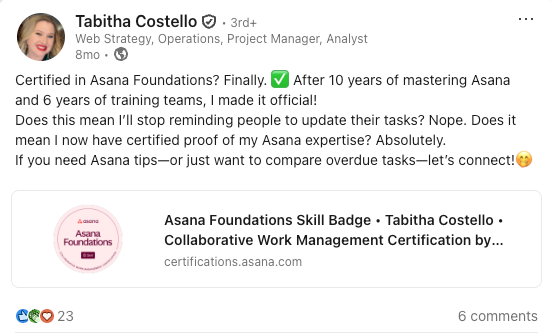
The downstream effects showed up quickly. Learners consistently shared credentials at high rates (91%+). Separately, a project manager who completed the certification posted a TikTok recommending the program to peers, driving thousands of new registrations almost overnight.
Neither moment was engineered. Both were enabled by a credential experience that translated cleanly outside the Academy.
Try this: Design credentials for life beyond your platform. Visibility isn’t a tactic — it’s the value.
Measure in layers
Measurement is where many programs stall. Asana avoided that trap by thinking in layers.
They started with leading indicators: registrations, completions, credentials issued, satisfaction, repeat earners. But they didn’t stop there.
“We knew it would take longer to show business outcomes,” JJ explained. “But we also knew we had to plan for that measurement from day one.”
Over time, the team connected certification data to product adoption, pipeline, and annual recurring revenue (ARR) — using existing marketing and analytics infrastructure to tell a more complete story.
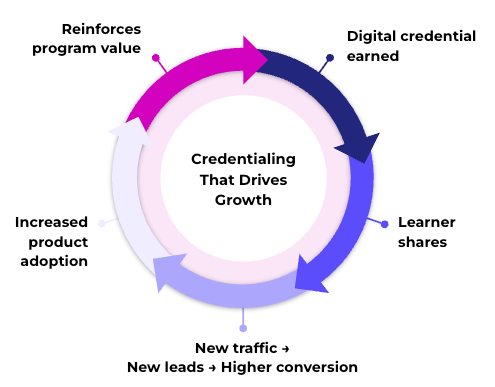
Try this: Decide upfront what second-order metric matters next — usage, retention, or progression — and design toward it.
Want a simple way to capture outcomes after issuance? Explore our Guide to Measuring Learner Outcomes That Actually Matter + survey template →
Let the framework evolve
One of the most honest lessons from Asana’s journey is that their framework didn’t stay fixed.
They started with a modular vision. Then simplified. Then returned to modularity once scale exposed duplication and friction.
“Some of these gaps only showed up once real learners were moving through the program,” JJ said.
Designing for reuse, credit for prior learning, and flexibility became more important as the catalog grew. Revisiting earlier decisions and doing some rework was part of building something durable.
Try this: Treat your framework as a hypothesis. Review it after your first real wave of learners, not before.
What to take forward
Most credentialing programs don’t have an execution problem.
They have a decision problem.
Asana was clear about what the program was for, where it lived, how it would be measured, and which tradeoffs they were willing to make — and aligned around those decisions.
The real question isn’t whether you can replicate Asana’s outcomes.
It’s whether the decisions shaping your program are deliberate or just inherited.
That’s where impact starts.
→ Watch the full conversation with JJ
Until next time,
Ryan
Senior Director @ Accredible

The new SkillsFWD report argues the field has moved past pilots and promises. What matters now is proof: credentials that actually move across systems and influence hiring, credit, and advancement decisions — not just issuance volume.
📩 Reply to share your take: Where does your program struggle most today: getting credentials used, getting them trusted, or connecting them to real outcomes?
The LER Ecosystem Report 2026 — SmartResume
Learning and Employment Records are moving from pilots to infrastructure. This report maps the fast-maturing LER ecosystem across states, higher ed, employers, and policy, and explains why portable, verifiable records are becoming essential connective tissue between learning and work.
From Refrigerator Art to Real Impact — Sean Murphy
Issuing credentials isn’t enough. This essay argues that workforce data only creates value when it’s interoperable, governed, and actively used across systems. A sharp call to move from symbolic credentials to infrastructure that actually matches talent to opportunity.
Employers want proof: Are candidates ready for the job? — HR Dive
Employers still value degrees, but they increasingly want evidence of application. New data shows why certificates, experience, and demonstrated skills now matter most, and what credentialing leaders must design for as hiring shifts toward proof, not proxies.
1EdTech Digital Credentials Summit — February 18-20, 2026
The premiere event for education leaders, employers, and edtech innovators to work toward creating a better path to the future for all learners.
ATP Innovations in Testing Conference — March 1–4, 2026
Assessment leaders, psychometricians, and credentialing innovators gather in New Orleans to explore what’s next in testing, validation, and measurement.
Tired of juggling paper certificates, PDFs, and endless manual processes to track learner achievements?
Or running into scaling limitations with your current digital credentialing solution?
Accredible has you covered. Create and issue branded digital credentials that showcase skills and provide real value — without the hassle.
Know someone who'd find value in Certified Insights? Forward this email and invite them to subscribe.
Did a friend forward this email to you? Sign up to get this newsletter next month.

Accredible is the world’s leading digital credential platform, enabling education and training leaders to increase learner engagement and drive program growth.


Accredible is the world’s leading digital credential platform, enabling education and training leaders to increase learner engagement and drive program growth.

