


Hello and welcome to Certified Insights from your digital credential friends at Accredible. You’re in good company with 58K+ education and training leaders.
Each month, we share tips and strategies to help you grow your credentialing program. Up next:
📊 Most credentials go unseen by employers — here’s how to fix that
🧠 Are your credentials recognition… or proof?
📚 Certified Reads on ID wallets, accreditor shifts, and badges as donor strategy
Employers are looking for digital credentials. But they’re not finding them.
That gap doesn’t just hurt candidates — it’s a missed opportunity for credentialing programs.
In our latest research, we surveyed 500+ HR and recruiting leaders and nearly 200 education and training leaders (credential issuers). What we found shows a sharp disconnect between how credentials are used in hiring and how they’re delivered.
Credentials that are trusted, visible, and clear aren’t just a nice-to-have. They help employers make faster, more confident decisions. They help learners stand out and prove their skills. And they help your program get discovered and valued in ways that support long-term growth.
This issue highlights three key findings from the 2025 State of Credentialing report. Each one has practical takeaways you can act on now:
Let’s break them down.
Insight #1: Employers face a trust gap
AI has made it easier than ever to generate polished, keyword-matching resumes. The result: a sharp rise in employer skepticism.
“AI is really good at creating things that look real but aren’t, and recruiters are becoming way more skeptical of what’s in front of them,” said Erin Scruggs, VP & Head of Global Talent Acquisition at LinkedIn. “That’s where digital credentials are having a real moment. They provide verifiable evidence of skills at a time when employers are actively looking for signals they can trust.”
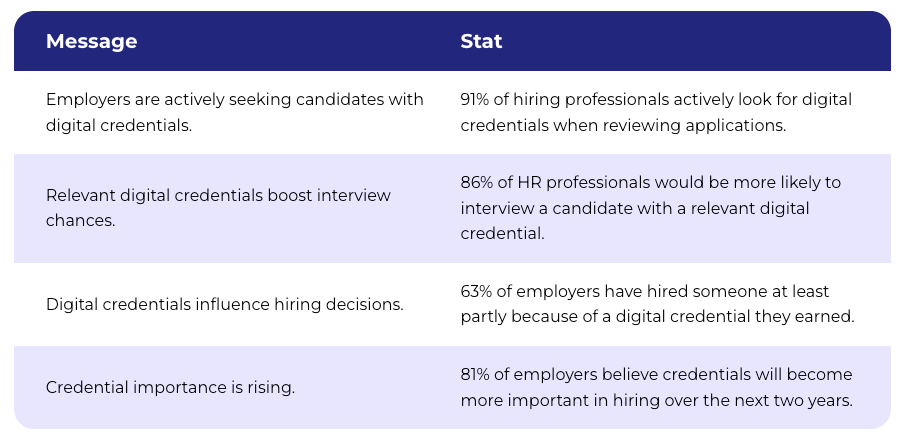
Here’s what the data shows:
That’s a significant use of time and effort just to confirm someone can do what they say. You (and your program) can close that gap.
When digital credentials are thoughtfully designed and backed by credible evidence, they give employers what they need most: confidence.
Insight #2: Digital credentials are wanted — but rarely seen
This is where the disconnect becomes most clear.
That means most programs are missing the moment when employers are paying attention.
Credentials have the power to influence hiring decisions, but too often they’re invisible. Closing this gap isn’t on learners alone. Issuers control two of the biggest levers.
1. Help learners share.
Most learners don’t know how to use a digital credential where hiring actually happens. Make it effortless to add them to applications and LinkedIn (which 87% of HR leaders use to search and validate credentials). Clear guidance at the right moment — in credential delivery emails, program pages, or learning platform prompts — can make the difference between proof and just a logo.
To support this behavior, use the report data to prompt learners with timely messaging that encourages visibility and reinforces value.
2. Make your credentials (and learners) discoverable.
84% of learners want to be featured in an online directory to connect with future opportunities. And 75% of HR leaders already use or want access to searchable directories of credentialed talent. But only 37% of issuers offer them.
That’s a massive missed opportunity.
Tara Miller, Certification Operations Program Manager at Snowflake, calls their online directory “a way to quickly and easily identify applicable Snowflake skills, benefiting both our certified population and the employers seeking them.” She sees it as a strategic tool to give hiring teams a pool of certified talent that’s searchable, filterable — by skill, location, or even work availability — and that reduces recruiting costs and boosts career visibility for credential holders.
Directories and clear sharing guidance can turn credentials into career accelerators and growth engines for your programs.
Insight #3: Credentials need clarity for humans and systems
Employers aren’t rejecting digital credentials because they don’t believe in them. They’re rejecting the ones that feel vague or unverifiable.
What matters most? Employers told us it comes down to three things:
Yet, when we compare these priorities to what most issuers actually provide, a significant gap emerges — one that limits the credential’s influence in hiring decisions.
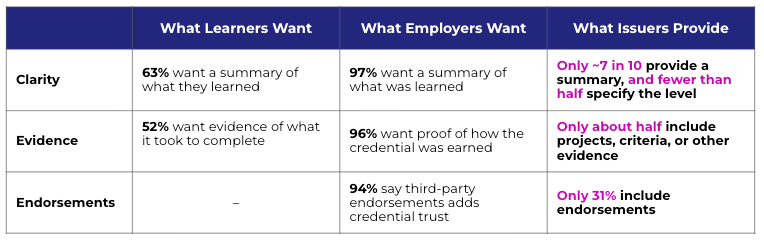
As Tiffany Vause, Director of Strategic Initiatives at WIN Learning, notes, “You can put ‘communication’ on every resume because it shows up in every job posting. But that doesn’t mean you can actually do it. Being able to have the digital credential showing that an individual has gone through training, passed the assessment, and mastered soft skills — it’s a way to prove it. Not just say it.”
And clarity for people is only half the equation. 60% of employers say credentials would be more useful if they integrated directly into ATS and hiring platforms. But only 34% of issuers provide the machine-readable digital credential metadata that allows that kind of integration.
Rochelle Ramirez, SVP of Product at Accredible, shares, “If you can get skill tags, learning proof, dates, and difficulty levels into your credentials as fields, they’ll make a big difference. That’s what turns credentials from noise into signals.”
Credentialing isn’t just about design — it’s about signal strength.
Human clarity makes a credential meaningful. System clarity makes it usable at scale.
The takeaway
This year’s report shows how much control issuers already have and where the biggest opportunities lie.
When credentials are trusted, shared, and structured to work across hiring systems, they unlock real value:
When learners’ credentials are seen and valued by employers, it not only helps them land jobs and promotions, it also fuels awareness and demand for the programs that issued them.
You’ve already done the hard work to build your credentials. Now’s the time to make them work harder — for everyone.
📖 Explore the full 2025 State of Credentialing report and watch the on-demand webinar with Erin, Tiffany, and Rochelle bringing the employer, issuer, and platform perspectives on connecting credentials to real hiring impact.
Until next time,
Ryan
Senior Director @ Accredible
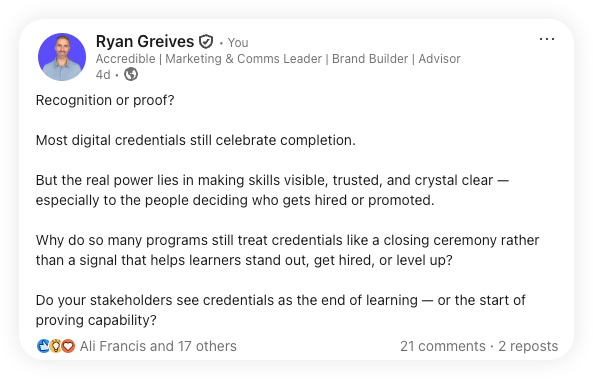
🧠 Recognition or proof?
Too many credentials still celebrate completion — without making skills visible or actionable.
We asked this question on LinkedIn, and the responses are rolling in.
👉 Jump into the conversation and share your take. We’ll highlight the best replies in next month’s issue.
Participatory Stewardship and the Use of Badges — Holly Garner & Jana Barrett (Medium)
What if donor recognition wasn’t top-down — but peer-to-peer? Garner and Barrett introduce “participatory stewardship,” a model where learners tell their own story, with funders woven in. Digital badges act as both a credential and visibility tool, connecting impact to identity, and turning every share into authentic, measurable recognition.
Connecting Digital ID Wallets, Skills Passports & LERs — The EvoLLLution
Should skills wallets and learning records stay separate from digital ID systems — or be part of a larger evolution? Holly Zanville argues for integration, warning that fragmentation threatens mobility, trust, and user control. A clear-eyed look at where the ecosystem is headed.
Accreditors’ New Frontier — Inside Higher Ed
Two major accreditors are stepping into the “wild west” of microcredentials, launching endorsement systems for noncredit providers. With Workforce Pell on the horizon, this move could shape how quality is defined — and who earns trust — in the growing credentialing space.
From Recognition to Revenue: Designing Microcredential Programs That Drive Growth — October 16
In this fireside chat, BenchPrep CEO Ashish Rangnekar and Accredible CEO Danny King explore how microcredential programs can drive both learner engagement and institutional growth. Learn how to build stackable, brand-aligned credentials that motivate, scale, and deliver business impact.
ePIC 2025 — October 21–23
Now in its 23rd year, ePIC explores open recognition technologies, policies, and practices — from digital badges to learning ecosystems. Hosted by Reconnaître and partners, this fully in-person conference brings together international leaders rethinking how we recognize learning across contexts.
I.C.E. Exchange 2025 — November 17-20
This flagship gathering of the credentialing community brings together program leaders, psychometricians, marketers, and innovators to explore standards, operations, and emerging models — including microcredentials and stackable pathways.
Tired of juggling paper certificates, PDFs, and endless manual processes to track learner achievements?
Or running into scaling limitations with your current digital credentialing solution?
Accredible has you covered. Create and issue branded digital credentials that showcase skills and provide real value — without the hassle.
Know someone who'd find value in Certified Insights? Forward this email and invite them to subscribe.
Did a friend forward this email to you? Sign up to get this newsletter next month.

Accredible is the world’s leading digital credential platform, enabling education and training leaders to increase learner engagement and drive program growth.


Accredible is the world’s leading digital credential platform, enabling education and training leaders to increase learner engagement and drive program growth.

