


Hello and welcome to Certified Insights from your digital credential friends at Accredible. You’re in good company with 58K+ education and training leaders.
Each month, we share tips and strategies to help you grow your credentialing program. Up next:
🔐 A 4-layer framework to build trust in your credentials
💬 How are your credentials helping learners tell their story?
🔗 Jobseeker and employer adoption gaps, rising certificate completions, and skills-first growth through internal mobility
Employers are increasingly open to recognizing non-traditional learning and verifying it via digital credentials — especially in the new era of AI-generated résumés and inflated claims.
However, with the rapid growth and variation in credentials, trust hasn’t kept pace. According to Brookings, 38% of employers say it’s difficult to understand what a microcredential represents, and 32% cite inconsistent quality.
That’s because we don’t just have a communication problem — we have a trust problem.
And that has real consequences: when credentials aren’t trusted, programs struggle to demonstrate ROI, gain employer buy-in, or support meaningful learner outcomes.
So, how do we increase trust in digital credentials without overhauling the entire hiring system?
It starts with intentional design. Digital credentials can’t just be awarded — they must be structured to build trust.
Based on more than 10 years of experience designing credentialing programs at IBM and now Digital Credentials Ltd, I've seen firsthand how a lack of transparency and trust can limit the impact of even the best-intentioned programs.
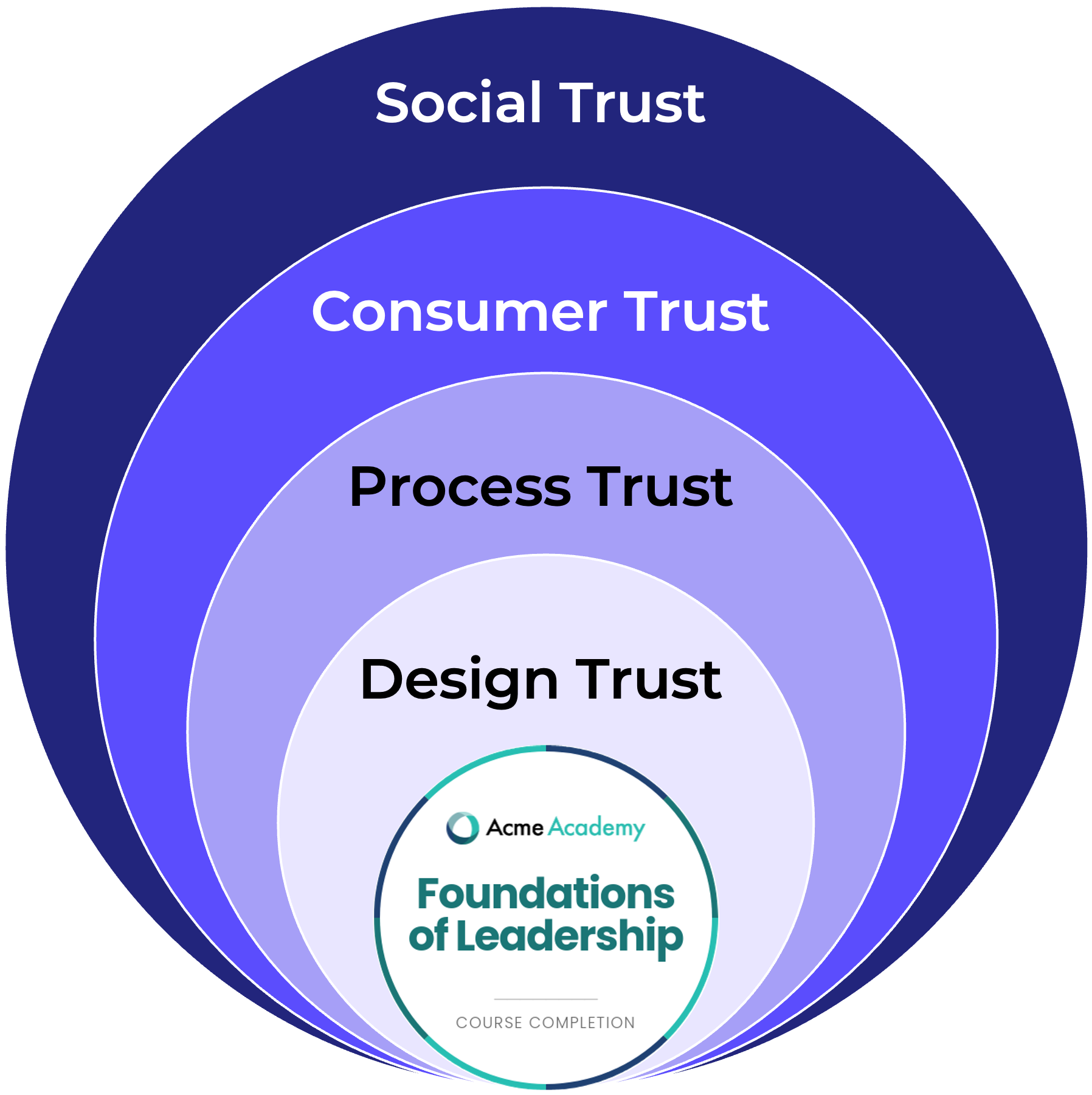
That’s why we developed a four-part Credential Trust Model to help organizations issue credentials that employers, learners, and institutions can rely on. Let’s dive in.
The Four Layers of Trust
Layer 1: Design Trust
Trust starts with the issuer's brand, but it is earned through attention to detail. Is the credential well-designed, clearly branded, and rich with metadata?
A strong design builds immediate visual trust and gives employers the clarity they need. Your brand should lead, without unnecessary tech vendor co-branding, so that every credential directly reinforces your organization’s credibility.
Be sure to include:
Additionally, ensure that trust signals are machine-readable and compliant with the Open Badge standard to support transparency and interoperability.
Layer 2: Process Trust
Trust builds when credentials are developed, assessed, and issued through a structured and transparent process.
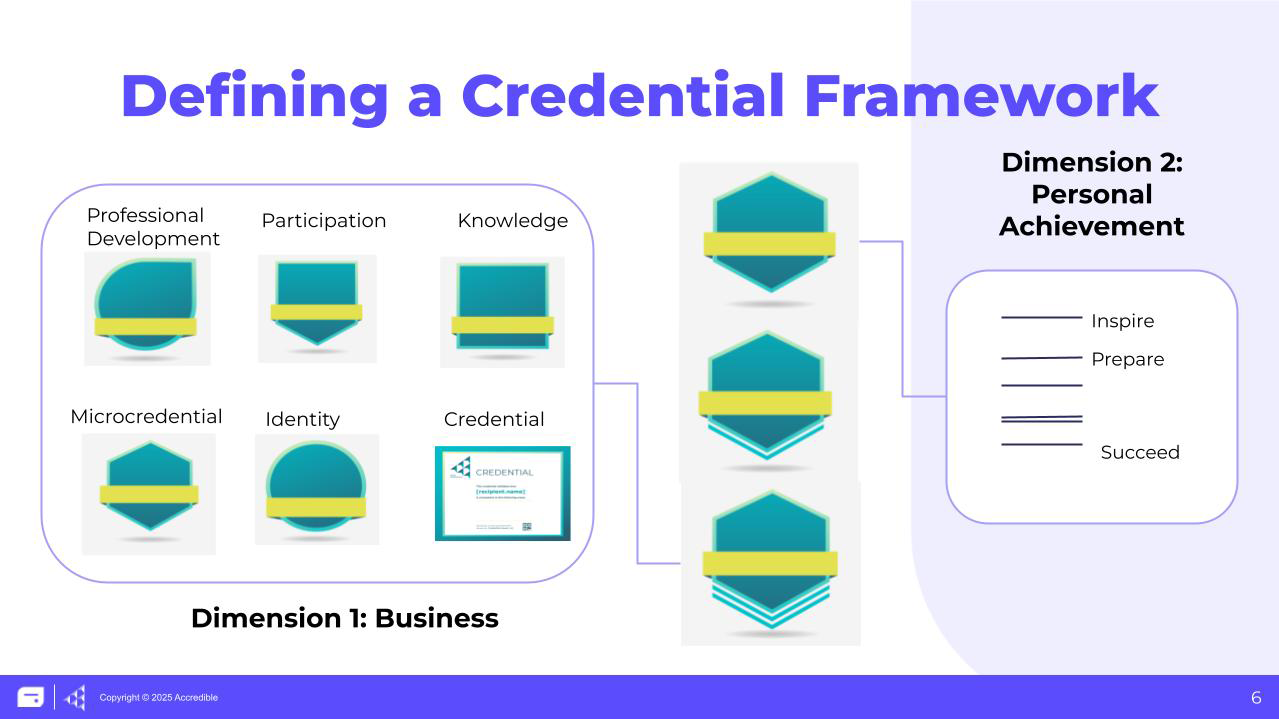
Key elements that help demonstrate credential quality include:
Trust is further strengthened when credentials are issued and verified through a secure, standards-aligned digital credential platform, ensuring authenticity, reducing fraud, and making verification seamless for employers.
These signals are even stronger when supported by Trust Anchors — organizations with recognized authority in quality assurance, standard-setting, or assessment. Their role is to validate the integrity of the credentialing process itself, helping to build deeper trust in how the credential was earned.
If you're investing in partners to deliver part of your process, it's likely because they add value. Leverage that value — ask them to endorse the role they play in your credentialing program.
Similarly, if your program aligns with a recognized standard, ask the standard owner to endorse the alignment. These endorsements help demonstrate that your credential is backed by a robust, verifiable process.
Layer 3: Consumer Trust
Credentials gain trust when they are recognized and used by real organizations. This includes:
Focus on a few Anchor Endorsers — well-known organizations whose endorsement signals wider trust in the market. Consider publishing endorsement criteria and developing a lightweight process for endorsement requests.
Layer 4: Social Proof
This is where trust becomes visible:
Peer validation is especially powerful: when learners see a credential shared by colleagues or peers, it often carries more weight than formal endorsements. The more a credential is earned, shared, and endorsed, the stronger its trust signal becomes. Organizations can also publish verified credentials in searchable online directories, offering another powerful layer of visibility and social trust.
Mapping Endorsements to Trust Layers
It’s helpful to distinguish three types of endorsements, aligned to the trust layers:
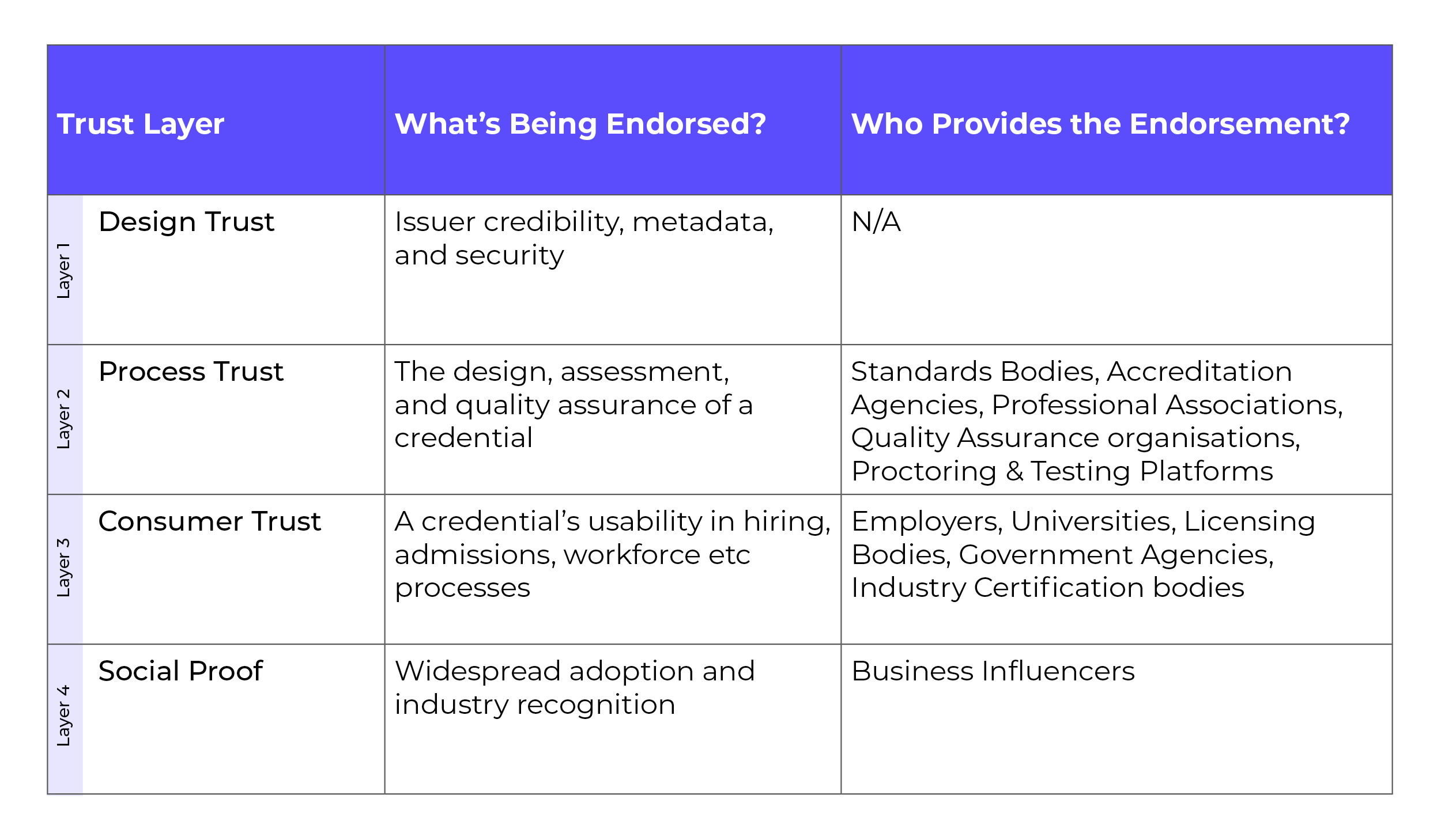
Each type reinforces a different aspect of trust. Together, they surround the credential with a credible, verifiable ecosystem of validation.
💡 Want to see how others are using endorsements to build trust? Explore real-world use cases.
Final Thought: Trust is Like a Soufflé
Even non-cooks know that baking a soufflé is tricky. All the ingredients must be combined just right. Get it wrong and it collapses. Get it right and it rises beautifully.
Just like a soufflé, trust in digital credentials is delicate. Each layer — Design, Process, Consumer, and Social Proof — must be aligned and executed with care. Get it right, and trust rises.
Because trust doesn’t happen by accident — it’s built layer by layer, signal by signal.
Now is the time to ask yourself: Are you building trust, or just issuing badges?
Until next time,
Consultant at Digital Credentials Ltd
Need help designing a credentialing program that builds trust at every level? Accredible Professional Services can guide you through developing a credential design framework and governance model that incorporates all four layers of trust — ensuring your credentials are recognized, credible, and valued in the market.
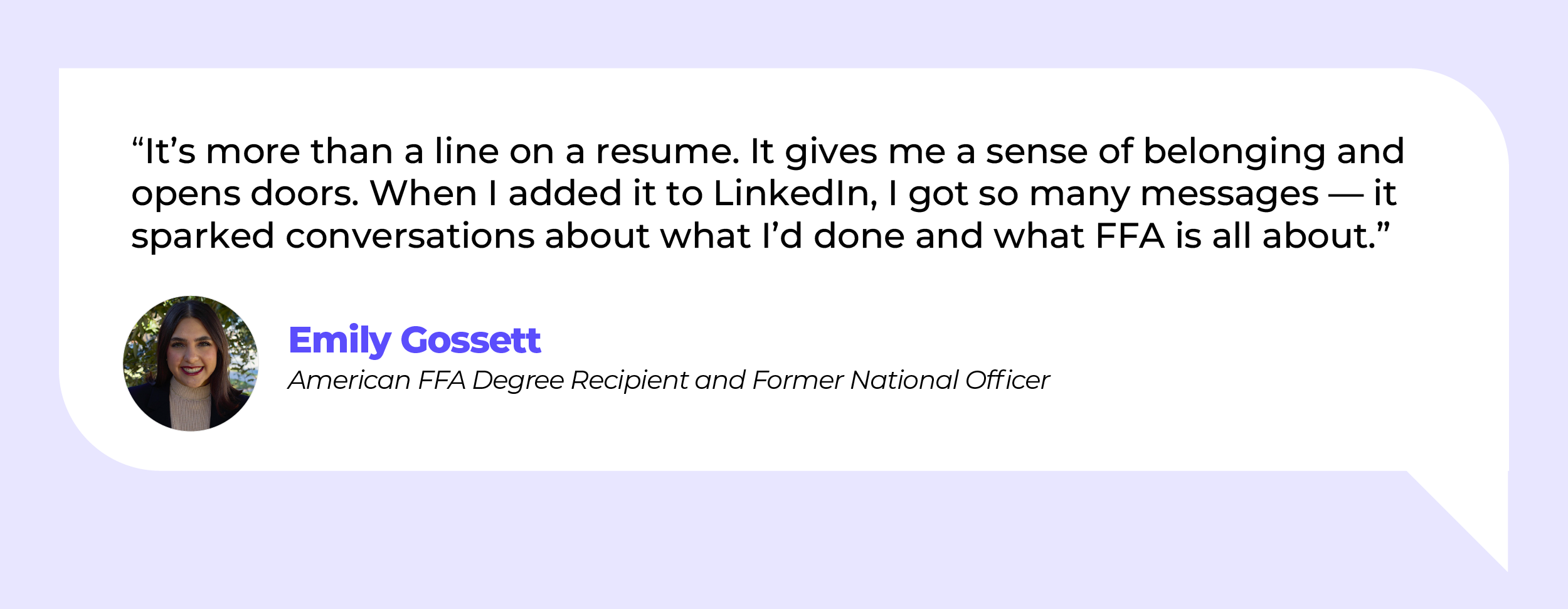
We recently chatted with several learners and educators about the impact of earning digital credentials from the National FFA Organization — and it got us thinking: How are your credentials helping learners communicate their value and tell their story?
Hit reply and let us know — we may feature your example in a future issue.
Verifiable Credentials and Wallets in a Skills-First Talent Marketplace — Jobs for the Future
A new JFF report explores how verifiable credentials and digital wallets can support a more equitable, skills-first talent marketplace — 75% of jobseekers say a digital wallet would help in their job search.
Certificate Completion Drives Undergraduate Attainment Rates — Inside Higher Ed
Undergraduate completion rates rose for the first time in three years, driven by an 11% surge in certificate completions. More students are earning multiple credentials in a single year, signaling a shift toward flexible, workforce-aligned learning paths.
Internal Mobility: The Cure for Stalled Skills-First Efforts — Forbes
Skills-first hiring falls short if employees can’t grow. This piece argues internal mobility is key to realizing the full value of skills-first strategies — and retaining great talent along the way.
Measuring Credential Value & Learner Outcomes — May 14, 2025
Discover how to go beyond completions and track the true impact of your credentials. Join us for a strategy session and live demo on measuring learner outcomes, credential engagement, and ROI — plus get a first look at our new post-completion survey template.
Tired of juggling paper certificates, PDFs, and endless manual processes to track learner achievements?
Or running into scaling limitations with your current digital credentialing solution?
Accredible has you covered. Create and issue branded digital credentials that showcase skills and provide real value — without the hassle.
Know someone who'd find value in Certified Insights? Forward this email and invite them to subscribe.
Did a friend forward this email to you? Sign up to get this newsletter next month.

Accredible is the world’s leading digital credential platform, enabling education and training leaders to increase learner engagement and drive program growth.


Accredible is the world’s leading digital credential platform, enabling education and training leaders to increase learner engagement and drive program growth.

