


Hello and welcome to Certified Insights from your digital credential friends at Accredible. You’re in good company with 100K+ education and training leaders.
Each month, we share tips and strategies to help you grow your credentialing program. Up next:
↔️ The Translation Gap
💬 Where credential value breaks down
📚 Certified Reads on LogicMonitor’s badge-first program, the ETS Human Progress Report, and California’s workforce infrastructure push
A few months ago, I was talking with someone who'd spent the last decade in higher education. VP-level. Student experience, operations, institutional strategy. Smart, credentialed, genuinely capable. She was trying to move into product management.
She'd built institutional strategy, driven growth initiatives, and owned programs from concept through execution. She'd earned certifications specifically to signal the transition. Her skills were real. Her intent was documented.
The ATS saw "VP, Student Experience." Rejected before a human read a word.
I've told this story before, and every time I do, the reaction is the same. Not surprise. Recognition. Because this isn't an edge case — it's a pattern. Most people applying for jobs right now have no idea they've already been filtered out. Not by a recruiter. By a system that never understood what they've actually done.
Proof Isn't Enough
The credentialing industry spent years solving a genuinely hard problem. Verifiable, portable, structured proof of learning — credentials that travel, that can be trusted, that actually mean something. That work matters and shouldn't be dismissed.
But proof and translation are two different things, and we only built one of them.
A credential proves what someone has earned. It doesn't tell them what it means for their career, which roles it prepares them for, or how to talk about it in language the market actually uses.
Translation used to happen informally. In conversations. In interviews. In the space between a resume and a hiring manager. Now it has to happen before someone is even seen.
That gap used to be inconvenient. Now it's becoming costly. According to Jobscan's 2025 research, 99% of Fortune 500 companies and 89% of large organizations now use AI-assisted tools to filter and rank candidates before a human weighs in. These systems aren't reading context. They're matching patterns. The translation problem didn't go away. It got automated.
Sarah DeMark, who spent 25 years building credential systems at Cisco, VMware, and one of the largest universities in the country, put it plainly in a recent LinkedIn post: "The tools exist. The frameworks exist. The language exists. Nobody handed her the decoder ring."
She was talking about the individual trying to navigate these systems, and she's right. The decoder ring has never been part of what we issue.
What Earners Actually Need
When we look at what credential earners actually struggle with, the patterns are consistent. In Accredible's 2025 research, the hardest challenges weren't about access to credentials — they were about what to do with them. Earners want to know what roles fit the skills they already have, how to explain what they've done in language that translates, and what they should do next. The record doesn't answer any of those questions. It just proves the work happened.
And 76.8% said they want to see where their credential can take them at the moment they earn it.

That's the moment when they're paying attention. When they're motivated. When they're asking — what does this actually mean for me?
The Window You Have
Most solutions to this problem show up too late. Resume rewriting tools. Job search platforms. Career coaching. By the time someone reaches for those, they're already in the gap — updating a resume under deadline, preparing for an interview, or sitting with a rejection they don't fully understand.
But there's a moment earlier in the process that almost nobody is designing for.
The moment someone earns a credential is the only moment you know two things are true: they're paying attention, and they care what comes next. Pride and uncertainty sit side by side. They've done the work. Now they're asking — what does this actually mean for me?
That moment already belongs to you. You created it. You issued the credential that triggered it.
The problem is that nothing in the current experience does anything with it.
What Your Program Is Responsible For
For a long time, the job of a credentialing program was clear: issue something credible, make it easy to share, and trust that it would carry value on its own. That's no longer enough.
Most issuers know when a credential reaches a learner. What they don't have is any signal of where it went — whether it helped someone move forward, whether it showed up in the market the way you intended, whether it worked. You issue something real, and the story goes dark.
If a credential doesn't help someone move forward, it's not clear whether it actually worked.
Prove → Describe → Translate → Act. Most programs stop at the “prove” step.
The job of a credentialing program is no longer just to issue or prove — it's to ensure what's issued can be translated and acted on. It changes what success looks like, what your program is responsible for, and where the real value of what you've built actually lives.
Closing that gap doesn't require rebuilding your program. It requires adding the layer that was always missing.
What This Looks Like
This is the problem we've been focused on solving at Accredible.
Career Journey is a free career guidance experience — built into every credential already issued through Accredible, with no new workflow and nothing to configure. It starts from what's already verified — the credential the earner received from you — and builds outward from there. It translates what they earned into language the market understands, connects them to roles where they have a real edge, and gives them one clear next step while they're still in that moment of attention.
It meets earners at the moment they're already in — viewing their credentials, asking what comes next — and does something useful with it. For them, and eventually for you. We're building toward outcome data that will give issuers visibility into what their credentials actually do for earners. We'll have more to share on that later this year.
Most career tools ask you to describe yourself before they can help you. Career Journey starts from what's already been verified. That's what makes it different.
You Already Own the Moment
The translation problem isn't new. What's new is that the market has made it impossible to ignore — and that the tools to close it are finally real.
Issuing the credential is still step one. What happens next is what determines whether it actually worked.
You already own the moment. The question is whether your credential does anything with it.
Until next time,
Rochelle
SVP of Product @ Accredible
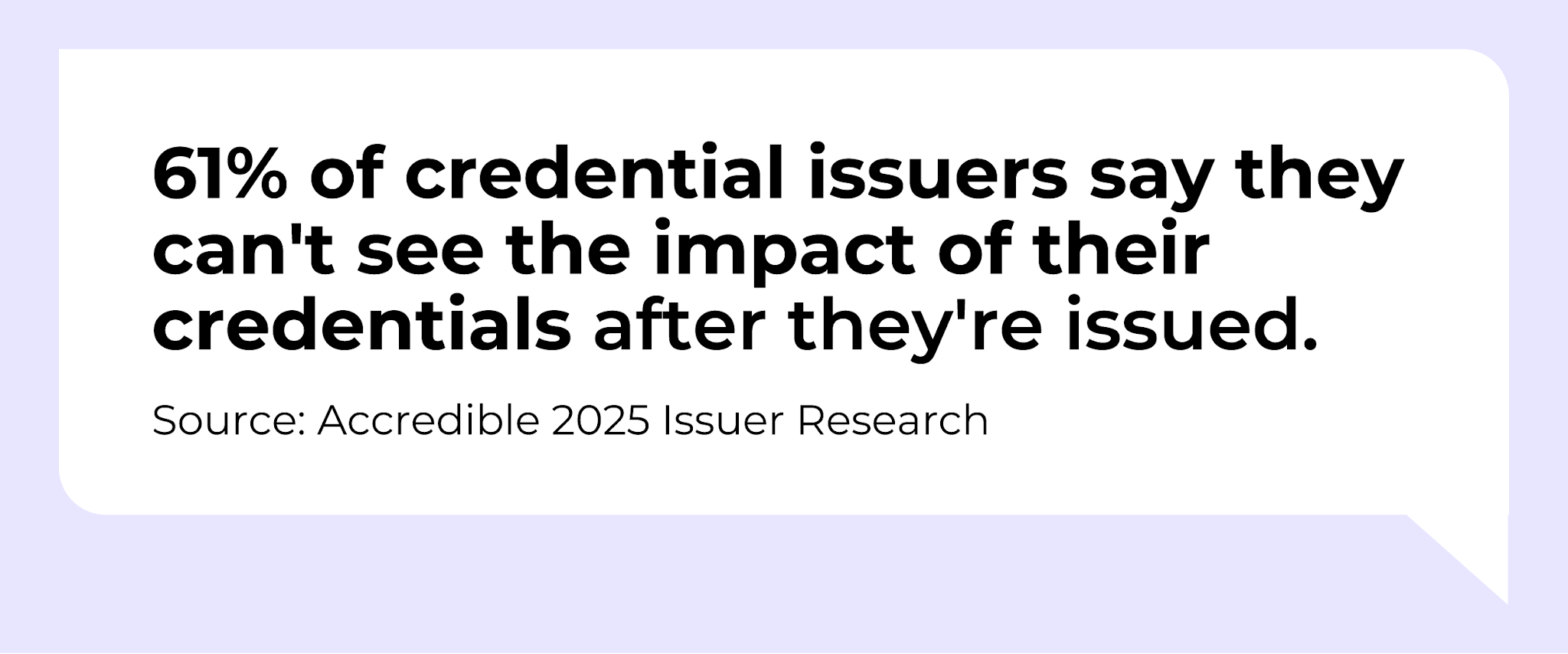
We asked issuers where credential value breaks down. 61% pointed to the same place: after issuance (i.e., usage, program influence, career outcomes).
If you could see one thing about what happens after your credential is earned, what would it be? 📩 Reply and tell us.
From Legacy Certs to a Living Program: How LogicMonitor Built a Badge-First Credential Strategy
See how a lean team replaced outdated certifications with a scalable badge framework — reducing time-to-launch, increasing engagement, and keeping training aligned with a fast-moving product.
2026 ETS Human Progress Report
A global look at how workers are navigating constant change — and why adaptability, verified skills, and clearer credential pathways are becoming essential to workforce readiness.
The California Career Passport RFP Is Out. And It’s a Game Changer. — Signol Labs
Ian Davidson breaks down how California is treating credentials as workforce infrastructure — not records — and what it takes to make skills visible and usable in real hiring systems.
Training Industry webinar: learn how L&D teams redesign programs to produce measurable, decision-ready skills data.
Badge Summit — July 13–15, 2026
Join credentialing leaders across higher ed, workforce, and industry shaping badge and microcredential strategy.
From Certification to Career Signal: How Associations Build Credentials Employers Trust — ASAE Webinar (On-demand)
Translate credential data into outcomes: see how leading associations increase visibility, trust, and member impact.
Tired of juggling paper certificates, PDFs, and endless manual processes to track learner achievements?
Or running into scaling limitations with your current digital credentialing solution?
Accredible has you covered. Create and issue branded digital credentials that showcase skills and provide real value — without the hassle.
Know someone who'd find value in Certified Insights? Forward this email and invite them to subscribe.
Did a friend forward this email to you? Sign up to get this newsletter next month.

Accredible is the world’s leading digital credential platform, enabling education and training leaders to increase learner engagement and drive program growth.


Accredible is the world’s leading digital credential platform, enabling education and training leaders to increase learner engagement and drive program growth.

