

Hello and welcome to Certified Insights from your digital credential friends at Accredible. You’re in good company with 100K+ education and training leaders.
Each month, we share tips and strategies to help you grow your credentialing program. Up next:
🧩 Do your credentials hold up in real workflows?
💬 2026 State of Credentialing — we need your input!
📚 Certified Reads on durable skills visibility, Workforce Pell’s quality stakes, and securing credential trust end-to-end
For years, the credentialing conversation centered on adoption.
Will employers recognize digital credentials?
Will institutions accept them?
Will learners use them?
Those questions still matter. Plenty of programs are still building issuance muscle, and visibility is uneven.
But the programs gaining traction are being judged on something more practical: does the credential hold up when it enters a real hiring or admissions workflow?
Credentials don’t usually fail at issuance. They fail at the moment someone has to interpret them, verify them, and make a decision with them.
That’s where the field is tightening: less debate about whether credentials “matter,” and more pressure to make them work.
Interest without confidence
Our 2025 State of Credentialing research surfaced a tension worth taking seriously.
Employers say they’re paying attention. Many click into digital credentials to view details, verify authenticity, or bring them up in interviews — and 97% consider them essential or valuable when making hiring decisions.
And yet only 68% of HR and recruiting leaders say they feel confident interpreting the meaning and value of a digital credential.
That gap isn’t academic. It’s where opportunities get lost.
Employers told us they hesitate when credentials:
As Ashish Rangnekar, CEO of BenchPrep, put it: “When employers can see applied ability, a badge shifts from a participation trophy to a trusted signal.”
Lifelong Learning Practice’s founder and principal consultant Wendy Palmer recently framed the same issue in plain terms: If what we’re producing doesn’t withstand scrutiny, it isn’t evidence — “it’s assertion, marketing, or digital glitter.”
Admissions and credit-for-prior-learning teams face a similar reality. If a credential doesn’t communicate level, rigor, and verification clearly, it adds friction instead of accelerating decisions.
Employer interest isn’t the bottleneck. Interpretation is.
The minimum viable signal
In hiring and admissions workflows, credentials have seconds to earn trust.
So the practical question becomes: what’s the minimum information a credential needs to be usable — by a human and, increasingly, by a system?
This isn’t about adding complexity. It’s about removing guesswork.
At a minimum, most credentials should make it easy to answer:
Here’s a strong real-world example from the International Society of Arboriculture’s Certified Arborist credential. Notice how it makes the skill areas, validity window, and earning requirements obvious in seconds.
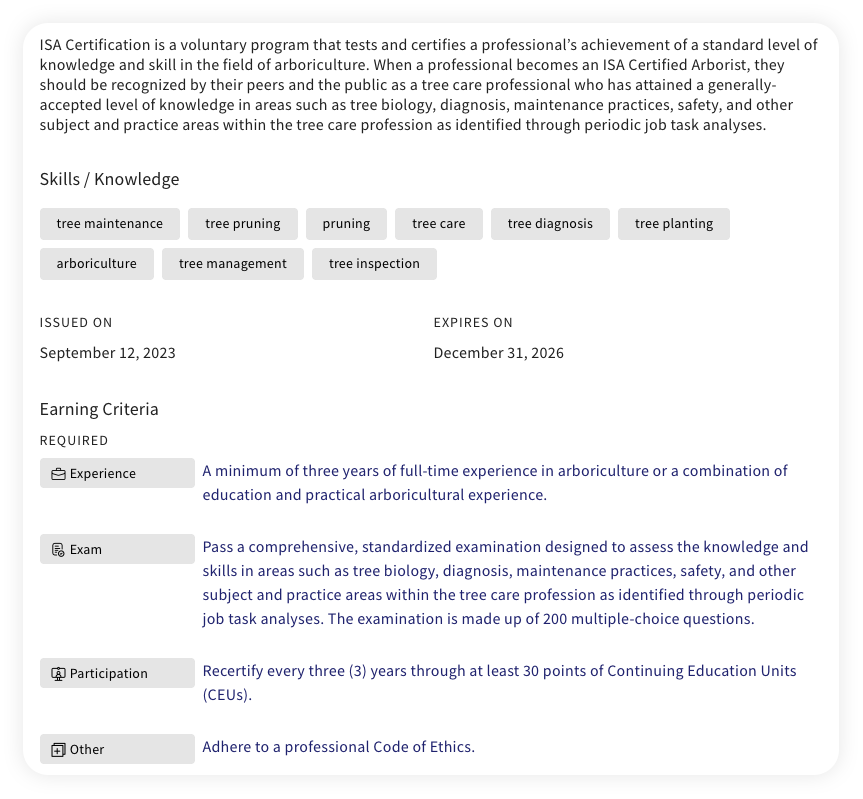
Not every program needs every element in the same way. But every program needs enough clarity that a reviewer can interpret the credential without guessing, and a system can handle it without human translation.
This came up directly in a recent 1EdTech working session: leaders were wrestling with a deceptively simple prompt — what is the minimum information an employer needs to trust and use a credential?
That’s a meaningful shift. Less abstract standards debate. More operational requirements.
And the gap is still real. Many issuers provide a general summary, but fewer specify level. Only about a third provide third-party endorsements. And structured, machine-readable metadata aligned to recognized frameworks is still not the norm.
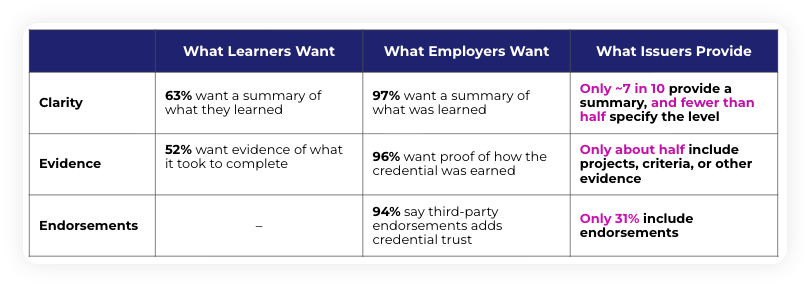
Wendy Palmer put it bluntly: “Most issuers still focus on producing the credential itself, without considering how the data inside will be consumed. The single most important step is embedding employer-relevant, machine-readable skills data so credentials can be read, understood, and acted on in hiring systems.”
That’s the bar now: not more credentials, but clearer signal.
Where credentials break
Even a well-designed credential can stall if it doesn’t move through existing workflows.
Right now, most admissions teams and hiring managers still live in familiar systems: document uploads, ATS portals, registrar processes, email threads.
So credentials have to do two things at once:
That “presentation layer” matters more than people like to admit because it’s where credentials either show up cleanly or get lost.
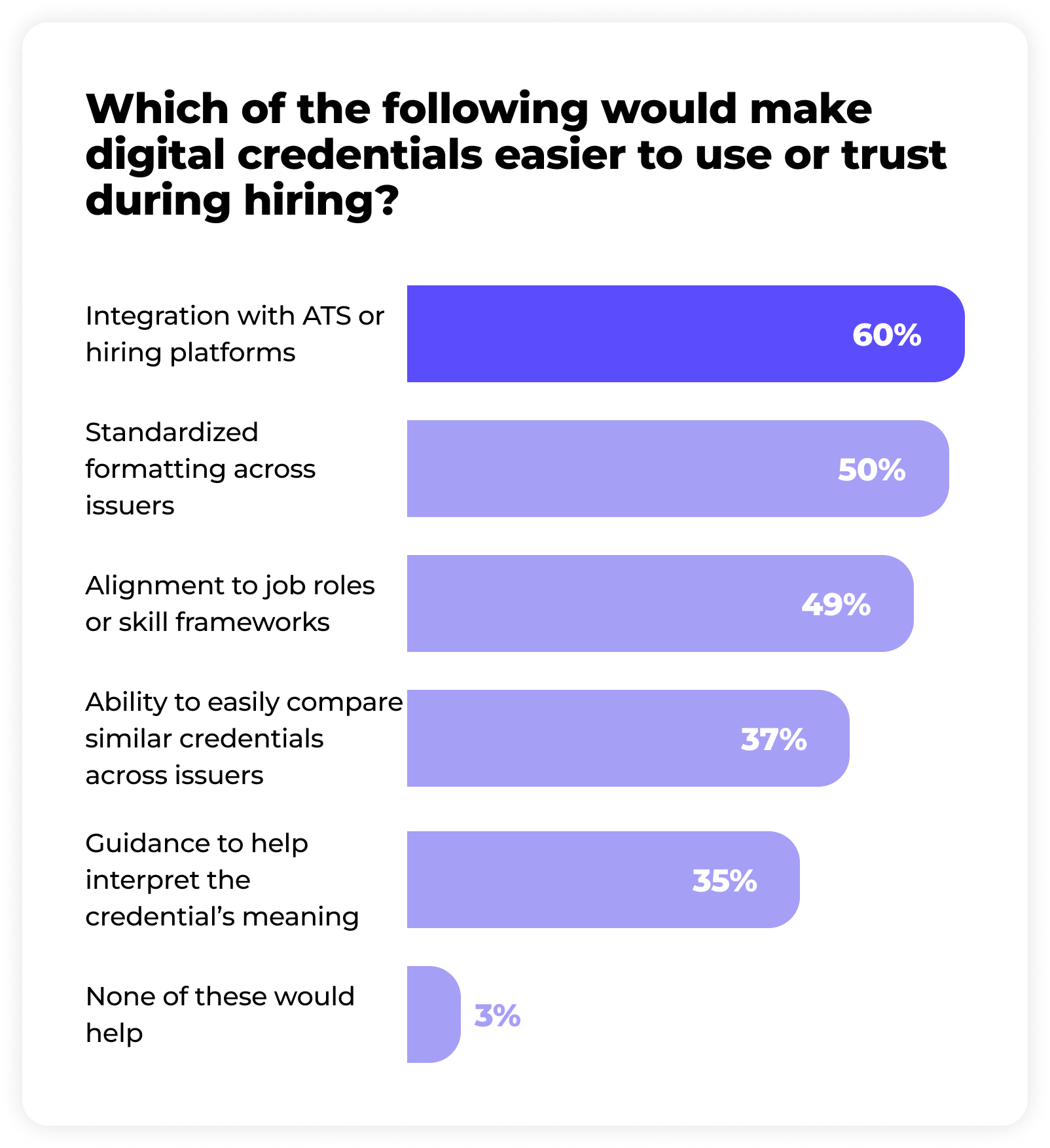
When we asked employers what would make digital credentials easier to use or trust, the top response was integration with ATS and HR platforms (60%). Close behind: standardized formatting across issuers (50%) and alignment to recognized skills frameworks (49%).
In other words, employers want credentials that behave like infrastructure, not a special case.
We’ve seen that dynamic in the growth of digital credential transcripts and verified career records: not as replacements for structured credentials, but as a bridge into the workflows that exist right now. Since Accredible launched digital credential transcripts in March 2025, transcript usage has grown 3x month-over-month, with universities and employers as the top recipients.
That’s not just “credential activity.” That’s credentials entering decision environments.
On the credit side over the past year, structured, American Council on Education-endorsed credentials issued on the Accredible platform now represent over $850M in recommended college credit value. Not all of that will be applied, but it’s a tangible proof point that when credentials carry structured, readable data, institutions can act without manual interpretation.
Interoperability matters. But workflow fit does too.
Proof beats pilots
A line from "The SkillsFWD Demonstration: What We Learned" report stuck with me: “Pilots don’t change systems. Proof does.”
That’s the next divide in credentialing.
Not digital versus non-digital. Not early adopters versus skeptics.
But programs whose credentials:
…and programs whose credentials are issued, shared, and quietly ignored.
If you want a practical next step, run this test on one of your current credentials:
If any answer is no, the credential may still be valid, but it’s more likely to get stuck at the moment that matters.
The direction is clear: expectations are rising, and “good enough” is becoming harder to defend.
The programs that meet this moment won’t just issue more credentials — they’ll issue credentials that move decisions.
Ship credentials that hold up in real workflows, and your program becomes harder to ignore.
Until next time,
Ryan
Senior Director @ Accredible
As we plan for our 2026 State of Credentialing Report, we want to ensure the research we conduct is as valuable as possible to you and your programs.
What questions or challenges should we explore this year? What trends, gaps, or benchmarks would help you strengthen your credentialing strategy?
Your voice matters. Submit your ideas in our short survey.
Higher education needs to change in order to survive the AI economy — Fast Company
Art Markman argues that colleges teach durable skills but lack systematic ways to make them visible. He calls for competency frameworks, authentic assessments, and skill tracking over transcripts — a blueprint for turning learning into usable, verifiable signal.
How Will Workforce Pell Change Student Decisions? — Pew
Workforce Pell could reshape nondegree credential enrollment, but quality and accountability remain open questions. Pew outlines the data gaps, financing risks, and state oversight challenges that will determine whether new funding drives mobility or confusion.
Credential Security: The New Trifecta — Integrity Advocate
This whitepaper argues that trust in digital credentials depends on a full-chain security model: secure learning delivery, verified assessment integrity, and tamper-proof credential issuance. A useful framework for institutions facing rising fraud and scrutiny.
Engage Learners & Showcase Verified Skills — March 17, 2026
Join this 30-minute Accredible group demo to explore standards-aligned credentials, verified career records, and strategies to strengthen learner engagement and program impact.
CCME 2026 National Symposium — March 29–April 2, 2026
Leaders in military and veteran education convene to advance skills-based learning, AI, and credential innovation.
2026 UPCEA Annual Conference — April 15-17, 2026
Explore new ideas, collaborate, and advance the impact of online and professional continuing education.
Tired of juggling paper certificates, PDFs, and endless manual processes to track learner achievements?
Or running into scaling limitations with your current digital credentialing solution?
Accredible has you covered. Create and issue branded digital credentials that showcase skills and provide real value — without the hassle.
Know someone who'd find value in Certified Insights? Forward this email and invite them to subscribe.
Did a friend forward this email to you? Sign up to get this newsletter next month.

Accredible is the world’s leading digital credential platform, enabling education and training leaders to increase learner engagement and drive program growth.


Accredible is the world’s leading digital credential platform, enabling education and training leaders to increase learner engagement and drive program growth.

