


The digital credentialing landscape is moving quickly. New standards emerge, new verification models take shape, and expectations around portability and trust continue to rise. Our responsibility at Accredible is to make all of that complexity disappear for issuers while giving learners the flexibility and mobility they deserve.
With that in mind, we’re excited to share that Accredible now supports Open Badge 3.0, W3C Verifiable Credentials, and the American Council on Education (ACE) extension for Open Badge 3.0 across both export and ingestion. These additions strengthen interoperability, improve verifiability, and ensure that your credentials remain usable across systems — today and tomorrow.
What This Means for Issuers and Organizations
Credentialing shouldn’t require managing standards, navigating transitions, or guessing which format will “win.” With these updates:
- Issue once. Accredible automatically packages credentials into Open Badge 2.0, Open Badge 3.0, or W3C VC when they’re shared or verified.
- No migration projects. There’s no need to reissue, convert, or maintain multiple formats.
- Future standards, zero disruptions. Accredible adopts new formats without disrupting your workflows or your learners' ability to use their credentials.
You stay focused on your learners. We make sure your credentials work wherever they need to.
What This Unlocks for Learners
Learners increasingly hold credentials from many sources and expect a unified way to manage them. With our new support:
- Learners can ingest Open Badge 3.0 and W3C Verifiable Credentials from any compliant issuer into their Accredible wallet.
- Credentials retain their original cryptographic signatures and verification guarantees.
- Sharing becomes more universal and more reliable across systems.
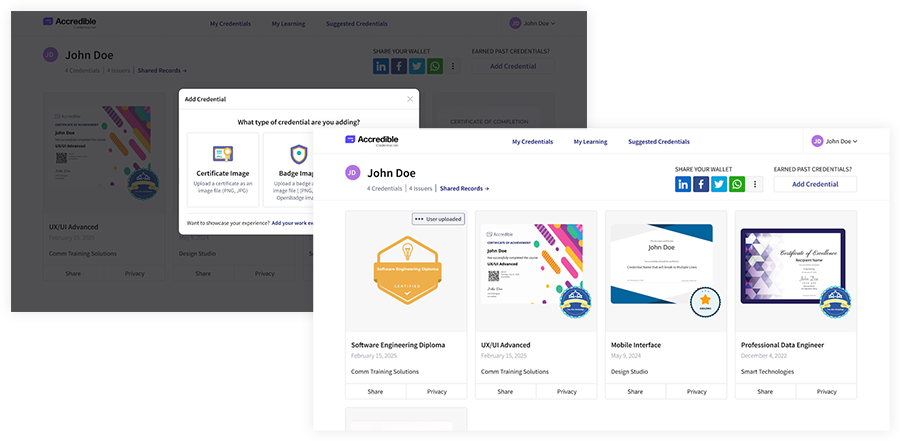
This makes the Accredible wallet a more powerful and future-ready home for all verifiable achievements.
The Open Badge 3.0 ACE Extension: Adding Richer Meaning to Credentials
The American Council on Education (ACE) extension, available exclusively within Open Badge 3.0, enables digital credentials to include structured, machine-readable data that improves how learning is recognized and applied. The extension includes fields for recommended credit hours, academic level, minimum passing score, competency alignments, and links to ACE’s National Guide — helping institutions and employers more easily evaluate prior learning, especially in workforce training programs seeking academic credit or career relevance.
To date, recommended college credit worth over $800 million in potential tuition value has been issued through the Accredible platform, demonstrating how quickly a well-structured, standards-based credentialing system can deliver real value for learners.
“Structured, portable credit recommendations are essential for helping learners translate skills into opportunities,” said Dr. Sarah Cunningham, Executive Director of One Dupont Ventures at ACE. “Accredible’s support for the Open Badge 3.0 extension helps scale this value across digital ecosystems, making it easier for institutions, employers, and learners to connect learning with recognized outcomes.”
Strengthening the Standards Ecosystem Together
The evolution of Open Badge 3.0 and the growth of W3C Verifiable Credentials reflect a broader movement toward global interoperability in learning, skills, and workforce recognition.
“As one of the largest credential issuers in the country, Accredible is operating at a scale where standards implementation has real ecosystem impact,” said Curtiss Barnes, President and CEO of 1EdTech. “Their support for Open Badge 3.0, Verifiable Credentials, and the ACE extension helps ensure credential data can move cleanly into CLRs, LERs, and other systems that connect learning to opportunity.”
We value the partnership of standards bodies working to improve trust and portability in credentialing.
Looking Ahead
Our commitment is simple: Accredible will continue to support the standards that enable interoperability, mobility, and trust — without creating friction for organizations issuing credentials or learners using them.
This set of releases marks another step toward a more connected and future-proof credentialing ecosystem. We’re excited about what it enables today and what it sets the stage for tomorrow.


